
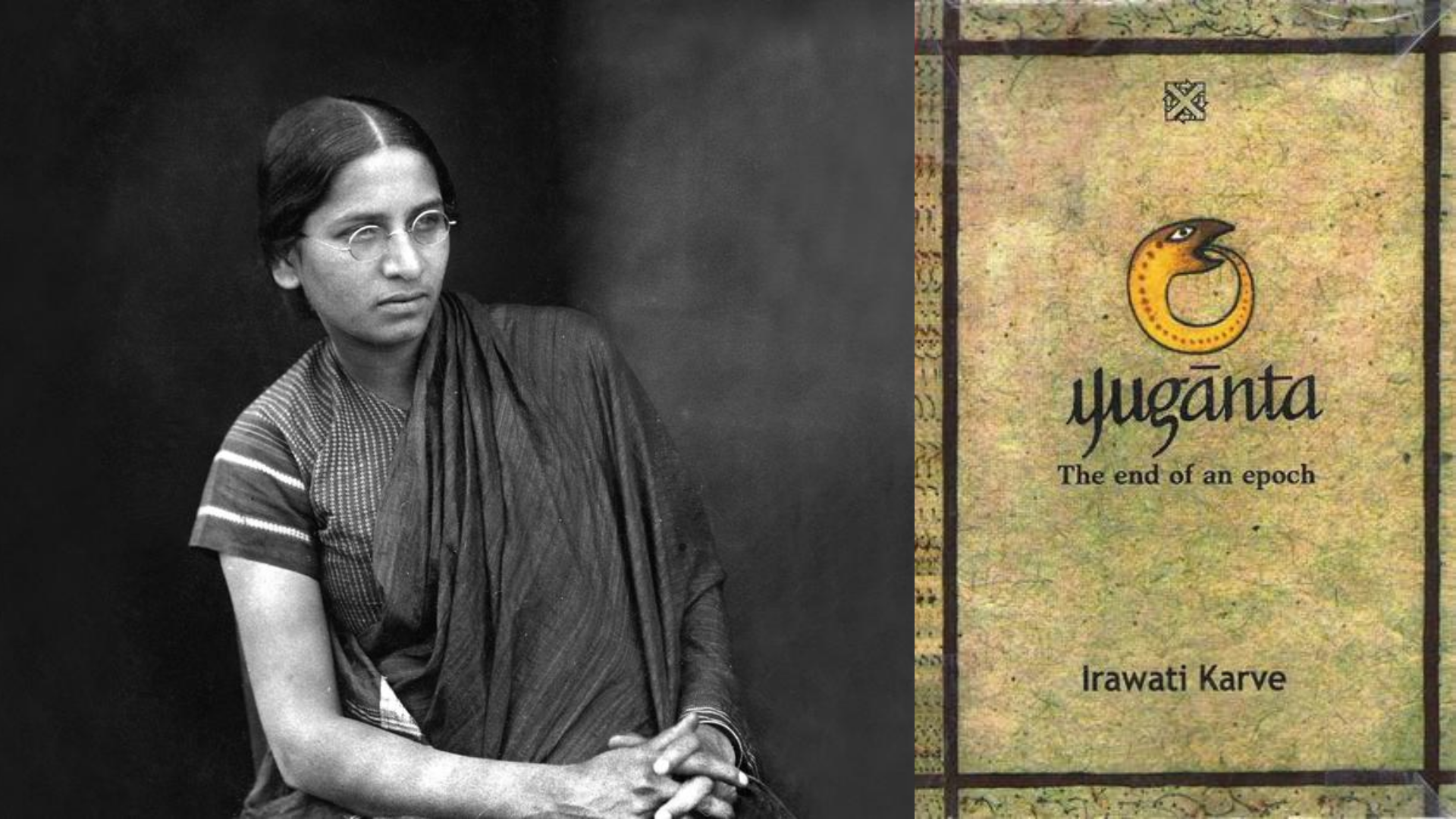

Irawati Karve was an Indian sociologist, anthropologist, educator and writer. She was born on December 15, 1905 and was one of the students of GS Ghurye, the founder of sociology in India. Her interdisciplinary approach and writings on kinship, caste and Indian society have profoundly influenced the fields of sociology and anthropology in India.
One of her most famous works is Yuganta: The End of an Epoch, where she critically analyzes the characters in the Mahabharata. According to Karve’s analysis, the Mahabharata is not really a myth, but rather an account of historical events that took place in India many thousands of years ago. In this context, the author provides readers with a deep insight into the political and social realities of this period of Indian history.
While Yuganta offers a feminist analysis that was progressive for the time, Karve fails to contextualize it Draupadi or illustrate the complexity of her character without reproducing the same subtle, embedded misogyny that Karve herself supposedly abhors.
While Yuganta offers a feminist analysis that was progressive for its time, Karve fails to contextualize Draupadi or illustrate the complexities of her character without reproducing the same subtle, embedded misogyny that Karve herself supposedly abhors.
On the other hand, there are so many things that Karve does right. She deconstructs the logic that holds women responsible for men’s violence. She debunks the myth of “Kritya,” the belief that a bloodthirsty woman is the cause of war in every Yuga. She shifts the blame away from Renuka and Draupadi, which were considered causes of war in the Krita Yuga and Dwapar Yuga respectively, and rightly points out that the men should be held responsible.
She points out that Renuka was treated as property and stolen as such. The war was about a cow and a slave, not just a woman. Likewise, the seeds of hatred were sown in Dhritarashtra’s mind when Pandu became king before him. The hatred between the Pandavas and the Kauravas was present long before Draupadi’s arrival.
However, the same Karve throws Sita under the bus. She writes: “In Rama’s war against Ravana, Sita was the only cause.” That is not true. Ravana should be held responsible for the abduction of Sita. She was merely a pawn in the game, as it later turned out when Rama exposed her to Agnipariksha.
The expert and the laughing woman
Karve also portrays the bond between Bhima and Draupadi with genuine tenderness. When Bhima drags herself back to a fallen Draupadi in her death scene, he asks her what he can do for her. A dying Draupadi replies, “Be the eldest in our next birth, Bhima.” With your protection we can all live in safety and joy.’
Karve understands this bond. She understands that Bhima never blamed Draupadi. However, her subsequent change in tone is so jarring that it’s worth pointing out. Draupadi, who had been harassed and humiliated in the royal court, dragged by her hair and held by a piece of cloth, stood up for herself and asked the elders uncomfortable questions. She asked if a slave could stake his wife. Bhishma hung his head in shame. So did Drona and the others. Karve calls Draupadi’s reaction not only stupid but also terrible. She argues that Draupadi should have cried out for decency and compassion instead of arguing like an “expert.”
Karve also calls Draupadi’s laughter at Duryodhana in the Mayasabha a “grave mistake” and one of the reasons for her disrobing. To emphasize: a grown man is making a fool of himself in public. A young woman laughs. And Karve, a feminist scholar, says her laughter was a mistake.
Karve also calls Draupadi’s laughter at Duryodhana in the Mayasabha a “grave mistake” and one of the reasons for her disrobing. To emphasize: a grown man is making a fool of himself in public. A young woman laughs. And Karve, a feminist scholar, says her laughter was a mistake. Not Duryodhana’s envy. Not his decision to stake her. Her laughter.
Karve uses the term again, and this time it is even more meaningful. Yudhishthira, the same man who gambled away Draupadi, silences Draupadi every time she speaks by calling her an ‘expert’. Karve quotes this approvingly without questioning his hypocrisy. She writes, “It was impossible to defeat the Dharma through learning.” Karve makes her cognitive dissonance painfully clear here; It is as if she sees Yudhishthira’s refusal to engage with his wife’s thoughts as a sign of wisdom rather than an expression of his insecurity.
According to Karve, Draupadi’s “claims to wisdom” were the result of her “inexcusable arrogance”. Instead of criticizing Draupadi, Karve tries to control her by stating that a young woman should not address a men’s gathering. This reveals Karve’s discomfort with Draupadi because of her wild, unyielding behavior and her refusal to be silenced.
Instead of criticizing Draupadi, Karve tries to control her by stating that a young woman should not address a men’s gathering. This reveals Karve’s discomfort with Draupadi because of her wild, unyielding behavior and her refusal to be silenced.
Karve’s surveillance of Draupadi becomes even more evident in the Kichaka episode. The latter had sexually harassed Draupadi and publicly abused her at the royal court. Bhima, the Pandava, wanting to avenge Draupadi, kills him. Draupadi wants to see Kichaka’s funeral; She wants to see proof of his death with her own eyes. Karve writes: “She should have remained unseen somewhere.” She even goes so far as to say that Draupadi was “not satisfied with her revenge” – as if the desire for revenge was somehow immoral for a woman.
Karve doesn’t say a word against Kichaka or his brothers who tried to burn Draupadi alive. Instead, Karve just says that Draupadi should have hidden; a statement that reinforces years of patriarchy and oppression.
Caste and erasure
Karve does not delve into the nuances of caste, even though it plays a dominant role in the epic. It is important to note that their feminism is limited to privileged women of the “upper” caste – Draupadi, Kunti, Gandhari. For example, she never mentions Hidimba, Bhima’s tribeswoman, who was abandoned when she bore him their first child under a diplomatic agreement. Although Hidimba was in love with Bhima, he did not reciprocate her feelings or really care for her.
Karve’s analysis ends where caste begins. A feminist reading that reclaims the voices of the “upper” caste by suppressing marginalized voices is not a true feminist reading.
Karve also never mentions the family of Nishada, who died in the Lakshagriha incident thanks to the deception of Kunti and the Pandavas. Karve’s analysis ends where caste begins. A feminist reading that reclaims the voices of the “upper” caste by suppressing marginalized voices is not a true feminist reading.
While Karve wanted Draupadi to be strong, she did not want her to be strong enough to break free from the patriarchal constraints. Karve wanted a performance of victimhood – she wanted to cry, fall at the men’s feet and, most importantly, not upset them with her questions. This is a classic victim-blaming tactic. A “feminist” academic is essentially saying that a woman who was publicly harassed should have begged for mercy instead of standing up for herself.
Having said all this, however, I would like to acknowledge another way of reading Karve. It is possible that Karve does not always support the patriarchal constraints she describes. Perhaps she is simply indicating that the world of the Mahabharata was not ready for a woman as strong as Draupadi. The “expert” insult may have come from Yudhishthira and the misogynists, not Karve herself. She may be reporting rather than endorsing it.
But here lies the problem with this generous reading: Karve does not consistently signal when she is being ironic. The foreword to Yuganta, written by W. Norman Brown with Karve’s approval, describes Draupadi as “arrogant, stubborn, selfish, untrustworthy and an inveterate troublemaker”, as if this were Karve’s own conclusion. It places Karve himself in this interpretation. Karve writes in the introduction: “All such reflections are the author’s own.” There is no wording that tells the reader: That’s not me; This is the epic. The line between what Karve tolerates and what she merely acknowledges is fluid.
After reading Yuganta, one thing remains: Karve is complex. She is no mere misogynist. However, she is not a simple feminist either. She is an academic scholar caught between the constraints of her time and the ancient text of the epic.
After reading Yuganta, one thing remains: Karve is complex. She is no mere misogynist. However, she is not a simple feminist either. She is an academic scholar caught between the constraints of her time and the ancient text of the epic. There is no trace of irony, not even in the introduction, where she could have explained that the narrator’s voice reflects the epic’s patriarchal society rather than her own.
It should be read as it is written and it becomes clear that she blames Draupadi more than she defends her. This contradiction is not the reader’s fault; It’s Karve’s failure. Naming this is an honest reading, not an attack. We owe it to Draupadi and ourselves to read honestly, even if it is uncomfortable.
References
- Karve, Irawati. Yuganta: The End of an Epoch. Orient Longman, 1969.
- LearnSociology team. “Irawati Karve | Indian sociological thinkers.” LearnSociology, January 13, 2024, www.learnsociology.in/blog/irawati-karve-indian-sociological-thinkers.
Parvathy Menon is a third year English Literature student at OP Jindal Global University, Sonipat. Her writing explores the intersections of gender, caste and literature, with an emphasis on feminist readings. She is passionate about amplifying marginalized voices through accessible writing.
