
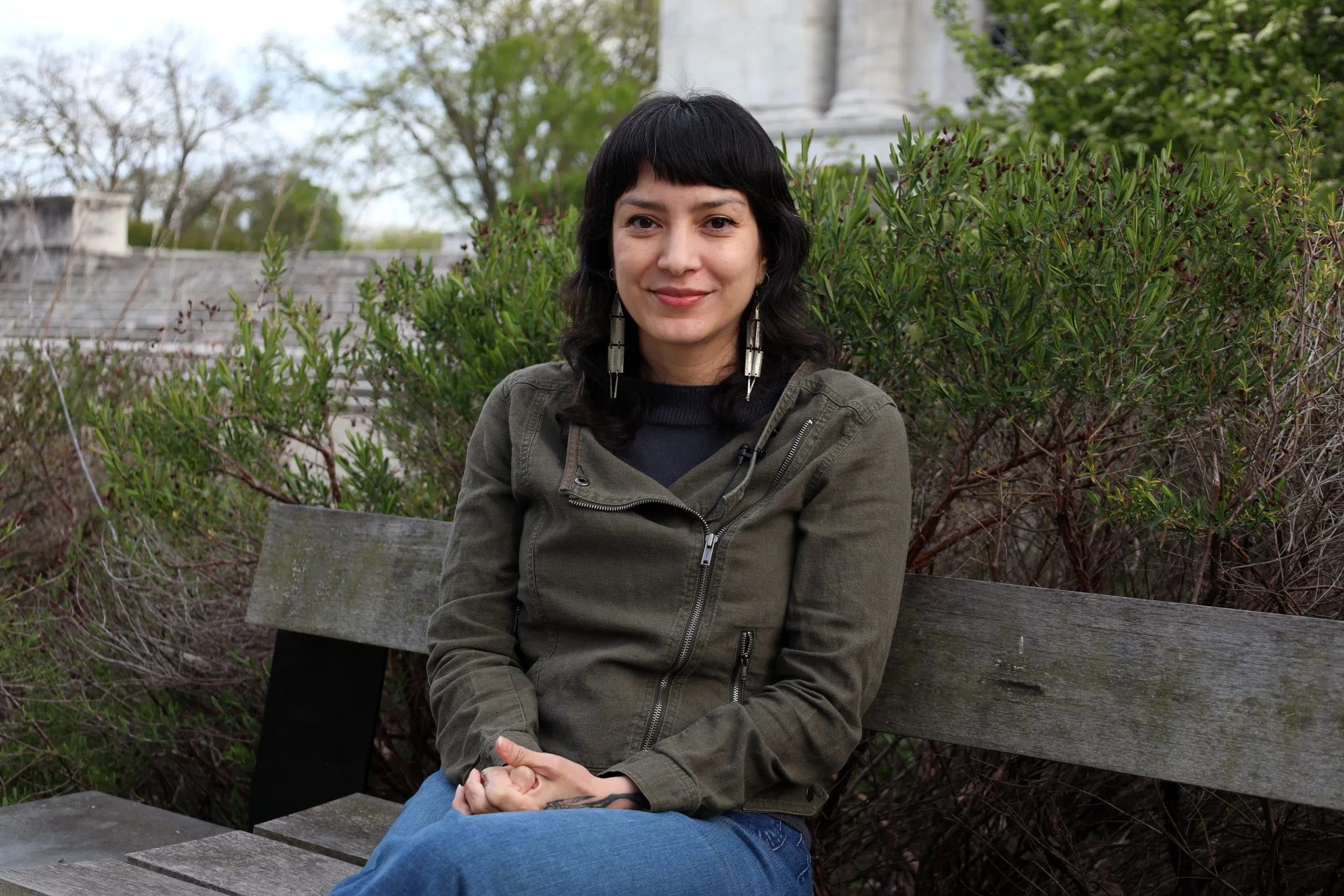

In the still quiet of the Center for Native Futures in Chicago, closed for the weekend, June Carpenter, artist-in-residence, works in her studio. Only the sound of Carpenter’s music and the delicate click-clack of beads dropping onto thread can be heard.
Like most, her career has taken a rather “circuitous” route to the career she is building for herself–a path that led her exactly where she needs to be. When not in the studio, Carpenter is at The Field Museum working as a repatriation specialist and NAGPRA director.
Carpenter describes repatriation as “the return of human remains or cultural items to Indian tribes, lineal descendants, or indigenous communities.” NAGPRA, or the Native American Graves Protection and Repatriation Act, is the federal law enacted in 1990 that governs the return of human remains and cultural objects to Indian tribes, Native Hawaiian communities and lineal descendants. While NAGPRA was passed over three decades ago, 2023 revisions have created an increase in returns.
When asked if she ever grows frustrated or angry at having to do this emotionally laborious work, Carpenter said, “If we’re not the ones in the museum doing the work, who’s going to do it?”
Before she moved to Chicago, Carpenter spent time doing repatriation work for her tribe, the Osage Nation. In law school, she was passionate about art law and worked for a few museums in New York, Philadelphia and then back home in Tulsa. When Carpenter felt pulled to pursue work that would more directly benefit the native community, she applied for her current position, and now, three years later, she is also developing an artistic career.
Carpenter says her work in repatriation has a more indirect influence on her artwork. Witnessing the seismic role these returns have to the tribes she works with has made her think about the harm that has been inflicted on the Native community at large.
“I think my art has shifted over time from being more about me and my personal experiences to focusing on broader issues of the native community,” she says.
Carpenter’s artwork helps her to heal. Lately, Carpenter has been working with textiles and clothing, seeing fashion as a kind of alter ego—an armor, she says, for the intensity of her day-to-day responsibilities.
“This work is really difficult, and you’ve got to be pretty tough to get through it all,” she says of the experience.
From bulletproof vests to dance shawls, Carpenter’s textile work includes motifs and techniques rooted in her Osage heritage. Her latest work-in-progress is a leather jacket and skirt inspired by her love of punk music. The set will be adorned with beaded patches, pins, and tribal seals.
When reflecting on her coming of age in the 1990s, Carpenter thought of a favorite band, The Descendants, and couldn’t help connecting the name to the lineal descendants, or direct blood relatives of Native remains or tribes, who request items through NAGPRA. The patches on the jacket will feature terminology related to repatriation work in an effort to make that vocabulary accessible to everyone. And spikes and studs, of course.
Carpenter’s toughness has manifested in her artwork as well as her museum work. Her 2023 painting, “The Sun Through The Darkness,” symbolically tells the story of her ancestors during the Reign of Terror on the Osage, a time in the early 20th century during which countless Osages were killed for their headrights , or legal grants to oil-rich land owned by the tribe. A history that neither Carpenter nor her family knew anything about.
The family only learned of this when Carpenter was contacted by a journalist at Bloomberg who has a podcast called “In Trust,” which focuses on the brutal transfers of wealth that led to much of present-day Osage County leaving Osage hands.
“It was crazy. I think that is something I am still very much processing. It was very surprising to hear, not having known anything about it beforehand, and then having to go take that to my family,” Carpenter said of the experience.
It was important to Carpenter that the podcast not paint her great-great-grandmother solely as a victim. She wanted it to be known that “she very much was a survivor and lived a very happy and full life” after all that she experienced.
Carpenter believes there is still a lot of healing to be done within her community. She hopes that others can find healthy ways to move forward in their processing of generational trauma and grief as she has through her artwork.
Carpenter’s work most recently appears in the newest group show at CNF, “Sight of Resistance,” which opened on July 12, 2025, and will run through Jan. 10, 2026.
