


Abstract
In the architectural landscape of human physiology, the adult liver is a fortress of metabolic stability—a domain governed by the refined order of mature hepatocytes. Yet, when the equilibrium of Ranjaka Pitta is shattered and the Yakrit Srotas become burdened by chronic inflammatory “noise,” the liver occasionally slips backward in time. It begins to broadcast an ancient, dormant code: Alpha-Fetoprotein (AFP). Once the primary herald of fetal development, the re-emergence of AFP in the adult serum serves as a biochemical “ghost in the machine”—a haunting signal that the liver has abandoned its mature state and regressed into a chaotic, proliferative infancy. This abstract explores the diagnostic significance of this fetal echo, framing the rise of AFP not merely as a clinical number, but as a profound metabolic crisis. By synthesizing modern oncological surveillance with the Ayurvedic paradigm of Dhatu Paka and Arbuda formation, we present a holistic roadmap for interpreting this biomarker. We argue that the clinical management of elevated AFP—from early-stage cirrhosis to hepatobiliary malignancy—must transcend simple threshold monitoring to address the underlying “metabolic soil” that compels the cell to revert to its primitive, undifferentiated roots. Let’s discuss it in detail!
Introduction
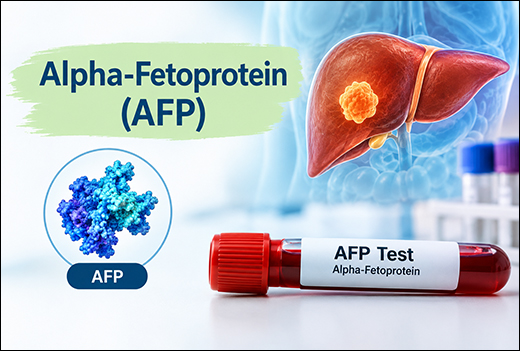
Alpha-Fetoprotein (AFP) is a glycoprotein synthesized primarily by the fetal liver and yolk sac during development. Serving as the dominant serum protein in the fetus, its levels decline rapidly after birth, remaining minimal in healthy adults. In modern clinical practice, AFP is a critical diagnostic and screening biomarker. It is extensively utilized as a tumor marker for hepatocellular carcinoma (HCC) and germ cell tumors, aiding in both early detection and treatment monitoring. Furthermore, elevated maternal serum AFP levels are instrumental in prenatal screening for neural tube defects and abdominal wall abnormalities. By bridging fetal physiology with diagnostic oncology, AFP remains an indispensable tool for clinicians in assessing hepatobiliary health and reproductive screening, providing essential data for both prenatal care and the management of malignancy.
What Is AFP?
Alpha-Fetoprotein (AFP) is a single-chain glycoprotein with a molecular weight of approximately 70 kDa, belonging to the albuminoid gene family. Biochemically, it is synthesized initially by the fetal yolk sac and subsequently by the fetal liver. It acts as the principal transport protein in fetal serum, binding various ligands—including fatty acids, bilirubin, and heavy metals—and maintaining oncotic pressure during development. Physiologically, AFP exhibits high concentrations during early gestation, peaking around the 12th to 16th week, before steadily declining as the liver matures and albumin production replaces it. In the adult, serum concentrations are trace, as the gene is epigenetically repressed. Consequently, the re-expression of AFP in adulthood is a sensitive, albeit non-specific, indicator of hepatocyte dedifferentiation or malignancy, providing a biochemical bridge between fetal developmental states and adult pathological processes.
What Happens During The Procedure?
This is the most common method and is used for both pregnant individuals (maternal serum AFP) and non-pregnant individuals (tumor marker).
- Preparation: No special preparation or fasting is required. For prenatal screening, your healthcare provider will record your weight, age, and estimated gestational age, as these factors are critical for interpreting results.
- The Procedure: A healthcare professional collects a blood sample, typically from a vein in your arm, using a standard needle.
- Aftercare: The site is bandaged, and you may experience slight bruising or mild discomfort, which typically resolves quickly. The sample is then sent to a laboratory for analysis using immunoassay techniques.
Interpretation And Normal Value
Interpretation of Alpha-Fetoprotein (AFP) levels requires careful clinical context, as “normal” values vary drastically depending on the patient’s physiological state (pregnancy vs. non-pregnancy) and the specific diagnostic intent.
1. Non-Pregnant Adults
In healthy, non-pregnant adults, AFP serves primarily as a tumor marker.
- Normal Range: Generally < 10–15 ng/mL.
- Clinical Interpretation:
- Elevated Levels (> 40–200+ ng/mL): Significant elevation is strongly associated with Hepatocellular Carcinoma (HCC) and germ cell tumors (e.g., yolk sac tumors of the ovaries or testes).
- Contextual Considerations: Mild, persistent elevations can occur in chronic liver conditions such as cirrhosis or hepatitis, requiring monitoring via imaging (e.g., CT/MRI) and trend analysis rather than a single isolated result.
2. Pregnancy (Maternal Serum AFP)
Interpretation during pregnancy is complex and relies on Multiple of the Median (MoM)—a statistical normalization that adjusts for gestational age, maternal weight, ethnicity, and diabetes status—rather than raw absolute values.
- Standard Reference Window: Typically measured between 15 and 20 weeks gestation.
- High Levels (> 2.5 MoM): Often triggers investigation for:
- Neural Tube Defects (NTDs): Such as spina bifida or anencephaly.
- Abdominal Wall Defects: Including gastroschisis or omphalocele.
- Other Factors: Multiple gestations (twins/triplets) or underestimated gestational age.
- Low Levels (< 0.25–0.50 MoM): May be associated with an increased risk for certain chromosomal abnormalities, such as Down syndrome (Trisomy 21) or Edwards syndrome (Trisomy 18).
Indications
The clinical significance of the Alpha-Fetoprotein (AFP) test is defined by two distinct applications:
1. In Pregnancy (Prenatal Screening)
- Purpose: Part of routine second-trimester screening (typically 15–20 weeks).
- Significance: Helps identify increased risks for:
- High Levels: Neural tube defects (e.g., spina bifida, anencephaly) or abdominal wall defects.
- Low Levels: Chromosomal abnormalities, such as Down syndrome (Trisomy 21) or Edwards syndrome (Trisomy 18).
It is a screening tool, not diagnostic. Abnormal results require follow-up, such as an ultrasound or amniocentesis.
2. In Non-Pregnant Adults (Tumor Marker)
- Purpose: Used as a biomarker to aid in the diagnosis and management of certain cancers, primarily hepatocellular carcinoma (HCC) and germ cell tumors (testicular/ovarian).
- Significance: It is used to track treatment response, predict disease progression, and check for recurrence and helps monitor high-risk patients with chronic liver diseases like cirrhosis or hepatitis.
AFP is non-specific, elevations can also occur in benign liver conditions. It must be interpreted alongside imaging and clinical history.
Ayurveda’s Insight!
In Ayurvedic medicine, elevated Alpha-Fetoprotein (AFP) is not a singular entity but a clinical marker of significant Dhatu Paka (metabolic disruption at the tissue level) and Agni Mandya (impairment of digestive/metabolic fire), specifically localized to the Ranjaka Pitta (the subtype of Pitta governing liver function and blood formation).
From an Ayurvedic lens, the re-expression of AFP in an adult—indicative of cellular dedifferentiation—is interpreted as a failure of the liver (Yakrit) to maintain Dhatu Samya (tissue equilibrium). The liver is the seat of Ranjaka Pitta. When this is overwhelmed by Ama (metabolic toxins) or exacerbated by chronic inflammation (often Rakta-pradoshaja Vikara), the Agni within the liver is impaired. This causes the liver to lose its “functional intelligence,” leading to uncontrolled cellular proliferation, which correlates with the malignancy indicated by high AFP. Elevated AFP indicates severe Rasavaha and Raktavaha Srotas (channels of plasma and blood) congestion. The “tumorous growth” is viewed as a buildup of Mamsa (muscle/tissue) and Medas (fat) elements that have lost their normal physiological regulation due to severe Tridosha imbalance.
While modern medicine labels the resulting pathology as Hepatocellular Carcinoma or cirrhosis, Ayurveda categorizes the underlying process as a severe Granthi (nodular growth) or Arbuda (malignancy), typically resulting from:
- Kaphaja-Pittaja Imbalance: Kapha provides the substrate for growth (the physical mass), while Pitta provides the inflammatory energy (the proliferative drive).
- Beeja Dushti (Genetic/Constitutional): Given your work on the genetic nature of certain conditions, one might consider if this cellular shift indicates a fundamental “error” in the Beeja (the biological code), where the liver is reverting to a fetal-like, proliferative state.
In clinical practice, rather than targeting the “AFP number” alone, the Ayurvedic approach addresses the Srotas and the Agni:
- Deepana and Pachana: Using herbs that restore hepatic Agni to prevent the formation of further Ama which fuels the Arbuda.
- Rakta-Shodhana (Blood Cleansing): Utilizing agents that target the Ranjaka Pitta to reduce systemic inflammation.
- Medhya and Rasayana support: To modulate the Dhatu metabolism and provide a “corrective” signal to the cellular environment, potentially encouraging the liver to shift away from its dedifferentiated, fetal-like state.
Thus the rise in AFP as “Ranjaka Pitta Vikriti with underlying Dhatu-Agni-Paka,” where the failure to transform Rasa into Rakta manifests as pathological cell signaling. This bridges the gap between the biochemical marker (AFP) and the Ayurvedic metabolic crisis. So here are 5 herbs which support liver health and Malignancies.
1. Kutki (Picrorhiza kurroa)
Kutki (Picrorhiza kurroa) is a potent Tikta-Rasa (bitter) herb, Kutki is the premier Yakrit-uttejaka (liver stimulant) and Pittahara. It excels at clearing Ranjaka Pitta and correcting Agni Mandya. Its Bhedana (purgative) property removes accumulated Ama from the liver Srotas. It contains kutkin (picroside I and II), which are powerful hepatoprotective agents. They exhibit potent antioxidant, anti-inflammatory, and immunomodulatory effects, preventing lipid peroxidation of liver cells. In cirrhosis and carcinoma, Kutki reduces systemic inflammation, promotes hepatocyte regeneration, and acts as a biliary stimulant, aiding in the detoxification of metabolic byproducts that stress the failing liver.
2. Kalmegh (Andrographis paniculata)
Kalmegh (Andrographis paniculata), also known as the “King of Bitters,” Kalmegh is a profound Rakta-shodhaka (blood purifier). It balances Pitta and Kapha, effectively reducing Jwara (fever/inflammation) associated with liver pathology. Its Lekhaniya (scraping) property helps reduce abnormal tissue growth. The active constituent, andrographolide, inhibits NF-$\kappa$B signaling, suppressing inflammatory cytokines. It improves liver enzyme profiles (ALT/AST) and exhibits significant anti-tumor potential by inhibiting cell cycle progression. It is invaluable in cirrhosis to suppress chronic inflammation and in carcinoma to inhibit the proliferation of malignant hepatocytes by curbing the inflammatory microenvironment.
3. Punarnava (Boerhavia diffusa)
Punarnava (Boerhavia diffusa) is a powerful Punarnavaka (regenerative) herb, it acts primarily on Medas and Rakta Dhatu. Its Sothahara (anti-edematous) and Mutrala (diuretic) properties are essential for managing liver-related ascites and systemic fluid retention. Punarnava contains rotenoids and punarnavine, which exhibit potent diuretic and anti-inflammatory properties. It helps reduce renal load and prevents fibrotic progression through its antioxidant pathways. It is the primary choice for managing complications of advanced liver disease, specifically reducing portal hypertension-related ascites and supporting renal function when the liver’s
4. Bhumi Amla (Phyllanthus niruri)
Bhumi Amla (Phyllanthus niruri) is a cold-potency (Sheeta Virya) herb that pacifies Pitta. It is traditionally used in Kamala (jaundice) and Yakrit-vikara. It acts as a Rasayana for the liver, strengthening the Yakrit Srotas and cooling the inflammatory response. Well-documented for its anti-hepatitis B virus activity and strong antioxidant properties. It inhibits DNA polymerase and suppresses the transcription of hepatitis-related viral markers. It serves as a foundational therapy for cirrhotic patients with chronic viral hepatitis, preventing viral replication and cellular necrosis, thereby slowing the progression toward carcinogenesis.
5. Kanchnaar (Bauhinia variegata)
The quintessential Gandamala-hara (anti-tumor) herb. It possesses Kashaya (astringent) and Lekhaniya properties, designed to “scrape” and resolve Granthi (nodules) and Arbuda (tumors). It balances Kapha-Medas accumulation. Contains flavonoids and tannins that exhibit anti-proliferative and apoptotic effects. Research suggests it may influence the tumor microenvironment by downregulating pathways associated with tissue fibrosis and abnormal cellular growth. Specifically indicated in hepatic carcinoma and advanced cirrhosis with nodular transformation. Kanchnaar (Bauhinia variegata) targets the structural stagnation and excessive growth, aiming to modulate the tumor microenvironment and inhibit malignant cellular progression.
Conclusion
In conclusion, the management of elevated Alpha-Fetoprotein (AFP) requires a sophisticated, integrative approach that bridges the gap between modern diagnostic precision and the restorative wisdom of Ayurveda. While modern medicine utilizes AFP as a critical biomarker for early detection in high-risk liver pathology—identifying hepatocellular carcinoma and germ cell tumors through serum quantitative analysis—Ayurveda provides the vital context of Dhatu Paka and Agni Mandya. By synthesizing the anti-proliferative, hepatoprotective, and immunomodulatory properties of traditional herbs like Kutki, Kalmegh, Punarnava, Bhumi Amla, and Kanchnaar, practitioners can do more than monitor a number; they can target the underlying metabolic environment that fuels cellular dedifferentiation. The ultimate objective is to restore Dhatu Samya (tissue equilibrium), effectively managing the Srotas congestion and inflammatory microenvironment that characterizes advanced liver disease. This dual-lens strategy—leveraging both the sensitivity of biomarker screening and the foundational healing of Rasayana therapy—offers a comprehensive roadmap for improving clinical outcomes in oncological and cirrhotic patients.
