
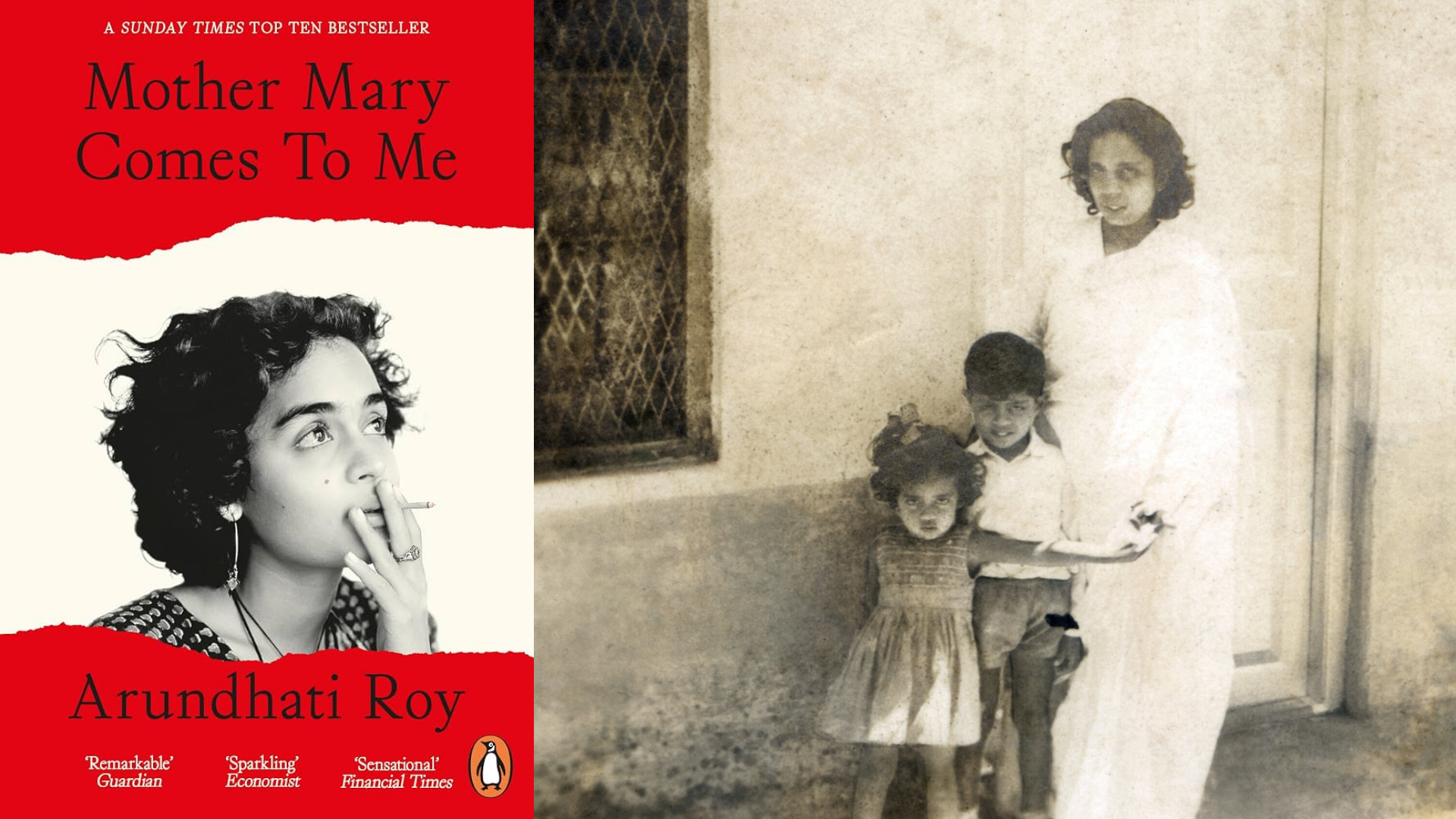

If Arundhati Roy’s Mother Mary comes to me When it was published last year, much of the conversation surrounding the memoir revolved around a question that seemed almost as difficult as the relationship it describes: What does a daughter owe her mother in the retelling of her life?
Roy’s portrait of her mother, striking and at times deeply uncomfortable, was praised for its candor, although a handful of readers were uncomfortable with the liberties Roy took in portraying her mother. A year later, the memoir continues to evoke strong emotional responses from readers. This piece celebrates the anecdotes from the book that remain strikingly vivid and offers timeless lessons about motherhood, love, politics and writing.
See beyond the mother
The most important thing about Roy’s memoirs is that they free mothers from the pressures placed on them by a patriarchal society. In a culture where women’s identities are reduced to mere motherhood, Mary Roy is deeply offended when someone asks her at a street stall if she is Arundhati Roy’s mother. She remarked, “I felt like she had slapped me.” Roy is able to celebrate this strangeness and recognize the deeper roots of her mother’s anger, seeing it as a symptom of her mother’s own struggle against oppressive social structures that seek to define and demean her.
One of the key anecdotes in the memoir relates Roy’s childhood memory of attending a birthday party in Kottayam. As Roy observes a tender, loving mother with her child, he is overcome by a longing for a mother who could love her in the same way. But that longing disappears as soon as she sees the woman’s husband throw an envelope on the floor and shout, “Woman, there is a letter for you.”
At that moment, as the woman bends down to receive the letter, Roy thinks: “I didn’t want a mother like her.” It is remarkable that even as a small child, Roy could sense the quiet strength of her own mother, who refused to bow down. It is this spirit of defiance that Roy celebrates in her fierce, unyielding mother, whom she calls her “gangster,” and which she seeks to immortalize in these pages.
Love of a daughter
Roy continually expresses her astonishment at her mother’s ability to abuse her brother LKC: “It was remarkable that in this land of son worshipers, Mrs. Roy felt able to say these terrible things to her son.” She further recalls, “My brother and I grew up in the gap between this syrupy dream and our moody nightmare, without always knowing which was worse.” All in all, if we had to choose between the two, I would choose our nightmare and him, the dream.” And it’s no coincidence that only one daughter could see and acknowledge her mother’s furious struggles in this syrupy nightmare.
But Roy is not satisfied with this truth. She refuses to look at things puristically. She further complicates it by acknowledging the damage within the dynamic: “Because he [LKC] was the only man she [Mary Roy] the only man she could punish for the sins of the world. “The way she treated him forever unsettled and complicated and filled with reservations my view of feminism.”
Roy’s most radical act isn’t telling the truth about a difficult mother. It’s because she refuses to choose between truth and love. The memoir argues that Mary Roy was an extraordinary woman, that Mary Roy made her leave home, that Mary Roy was sometimes unjust, that Mary Roy defied the patriarchy, that Mary Roy reproduced some of its violence, and that none of these truths need cancel out the others.
Breaking love laws
In her Booker Prize-winning novel The God of Small Things, Arundhati Roy broke the laws of love that dictate who should be loved, how and how much. She does it again in her memoir “Mother Mary Comes to Me.” By exposing her mother’s fragility and the complicated, sometimes impenetrable terrain of their bond, she frees the idea of motherhood from the uniform ideal of perfection and instead allows for a more stubborn idea of love that defies the clear laws of love and accepts contradictions.
By exposing her mother’s fragility and the complicated, sometimes impenetrable terrain of their bond, she frees the idea of motherhood from the uniform ideal of perfection and instead allows for a more stubborn idea of love that defies the clear laws of love and accepts contradictions.
In Roy’s own words: “[I]The following pages may be confusing to readers who are looking for conventional explanations of love, relationships, marriage, divorce, separation, and romantic relationships to understand how I have lived my life. I often don’t understand it myself. I stopped trying.’ It is her mother’s unrelenting anger at disobeying the law that encourages Roy to follow the same path.
In a refreshing look at love, family, money and charity, she presents the world that becomes possible when we break the rules of love that limit who we should love, how and how much. And this book becomes the ultimate testimony of that love. As a reader, you will only see it as an expression of love once you free yourself from these restrictive laws of love.
As Maria fights for the inheritance rights of Syrian Christian women, an older woman asks Maria, “Why are you trying to destroy our beautiful community?” Roy remembers the urge to tell her that her mother wasn’t just fighting for an equal inheritance; She is actually fighting for the right “not to be a perfect mother, for the right not to be a nice, obedient woman.”
Just as Mary’s Supreme Court ruling paved the way for equal inheritance rights for women, Arundhati’s writing paves a path of its own, allowing readers, especially women, to free themselves from the stifling expectation and need for approval. Just as in her writing career, Roy uses every page of the book to express her displeasure against everything she doesn’t believe in. It is rich in trenchant criticism of capitalism, solidarity with Gaza, denunciations of authoritarianism at home, and condemnation of educational institutions that perpetuate systemic inequalities.
The language of love and authenticity
Roy characterizes the language of her writing: “[L]The language was outside of me, not in me. I knew it wouldn’t come to me on its own. I had to hunt it down. Down like prey. Take it out, eat it. And when I did that, I knew that my speech would ease the flow of blood through my body. … It wasn’t a non-violent, vegetarian dream.’ Like the language it describes, the memoir is meant to be devoured, discussed, deeply felt, and violently experienced through love. Her language allows us to reimagine an alternative to living and loving, something tangible, something beyond what is.
Books that not only tell a story but also awaken something in you are rare. They remind you that dreams are not just ideas, but alternative realities waiting to be lived. This is one of those books. Many people see this as a story about Mary Roy. This is as much, if not more, the story of a daughter raised by a mother who refuses to accept the leftovers she is given and demands more.
The memoir itself proves to be a manifesto of faith in intuition, in rebellion and in finding a path that remains true to one’s own inner voice. Roy doesn’t just write about other worlds; She lives as if they were possible. And suddenly you begin to recognize and accept these peripheral worlds within yourself.
Urvi Sharma is Assistant Professor of English and Cultural Studies at Amity University, Punjab. She specializes in studying how gender dynamics influence our everyday lives. When she’s not explaining why men are responsible for 99 of the world’s 100 problems, she’s reading memoirs by women to collect quotes for the remaining problem.
