

So you sat there crying over the Aegean for three hours, trying to get back to his wife? Me too. But here’s the truth: the Odysseus that Homer wrote about remained faithful for about two of the ten years he spent on the journey home. And the two women who Nolan’s odyssey reduces to mere temptresses and obstacles in his journey, Circe and Calypso, were actually his lovers in the epic.
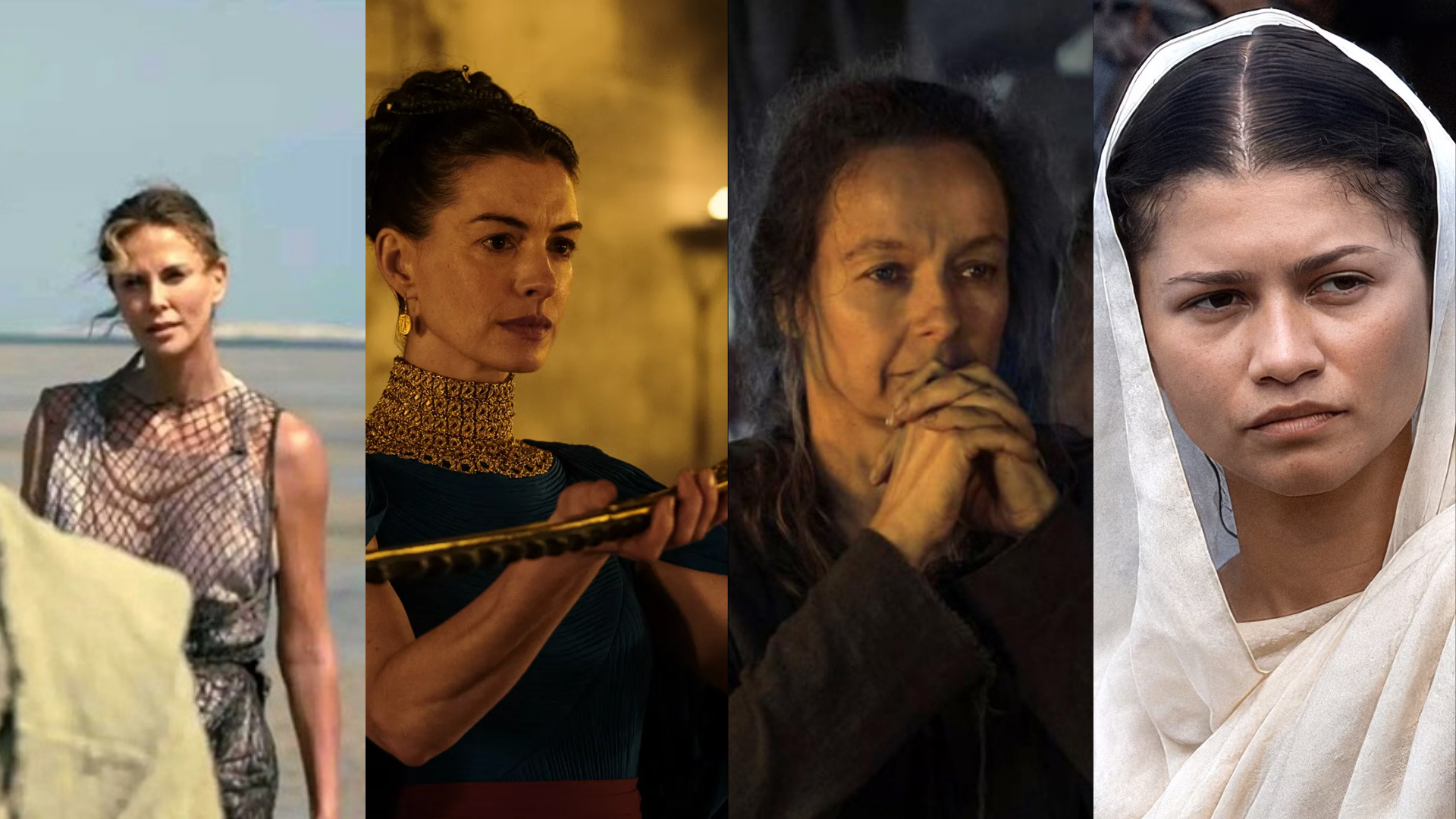
Odysseus (Matt Damon) and Calypso (Charlize Theron) in a scene from The Odyssey (2026). Photo credit: Universal Pictures/Syncopy
He stays with Circe on Aiaia and with Calypso on Ogygia for a year. And the fact that he was involved in them is made clear in the nearly three-thousand-year-old epic, even if none of it made it to our IMAX screens. That’s intentional, because would we enjoy a hero whose wife bears sole responsibility for monogamy at home in Ithaca and fends off suitors by weaving an infinite loom?
By glossing over Odysseus, Nolan abandons the women the adaptation could have celebrated instead: Penelope, Calypso, and especially Circe, the witch who, as a lover of Greek mythology, continues to fascinate me to this day.
Why Circe felt like a complete strangerR
I admit without embarrassment that my obsession with Greek mythology began with reading Percy Jackson as a child. In adulthood, numerous re-readings of the Iliad and the Odyssey followed. But my interest in Circe was obviously piqued by Madeline Miller’s 2018 retelling, Circe. In the epic, Homer introduces her as “Circe, the goddess of beautiful hair” – and since then she has inspired the imagination of painters in various eras.
Circe offers the cup to Odysseus, John Waterhouse, 1891
For three thousand years, she has been imagined as an advisor in Angelica Kauffman’s Ulysses and Circe (1786), a femme fatale in John Collier’s Circe (1885), and a royal hostess offering the cup to Odysseus in John William Waterhouse’s Circe (1891). She is dressed in luxurious gauze curtains, with wine in one hand and a sword in the other; She sits on an ornate throne with lions and wolves at her feet. A queen of her own world in the wild.
Circe, Wright Barker, 1889
This is the image of Circe that gave me a mix of history and mythology. So forgive me for being completely unimpressed when she is reduced to a witch living in a hut in a gloomy wasteland, miserable and with a cauldron, as much as the film tries to sell this to condense the plot.
However, give it credit: it’s an iconic scene where Circe offers Odysseus’ men a meal. Out of desperation, they begin to eat, only to slowly begin force-feeding and choking as the soup rushes back down their throats. She first watches them, then approaches them as if to caress them, before clutching their faces like an aggressive potter disfiguring a piece of clay.
Their faces distort under their hands, changed without grace. Her hand goes straight to their throats as she shapes her facial features with her fingers while howls and tufts of hair erupt from her ears. Her skin changes, her eyes water as if they were being gouged out, and suddenly her screams weaken and become muffled moans.
The man sitting next to me in the theater jumped. Which I think was the goal.
Circe (Samantha Morton) in a scene from The Odyssey (2026). Photo credit: Universal Pictures/Syncopy
But is turning men into pigs really the pinnacle of Circe’s character? Homer doesn’t shy away from depicting Odysseus’ helplessness as he washes up on her shore, portraying her as much more than just a pit stop or a villain. She becomes one of the most powerful allies Odysseus encounters, offering both important advice and practical help. He calls her “the formidable goddess who speaks like a human.”
Their hospitality, palace, food, wine, music and generosity sustain a crew of 45 surviving men for over a year. Her magic and foresight provide Odysseus with a foolproof manual for returning alive from the underworld and surviving the Sirens, Scylla and Charybdis on the way home.
The problem beyond Circe
Unfortunately, this pattern runs through the entire film. Circe, Penelope, Calypso, and even Athena have no emotional structure or inner life of their own. Mostly they come and go to further the sob story of Odysseus. Regardless of their importance in the epic itself, they have little screen time other than responding to his cries for help.
Penelope (Anne Hathaway) in a scene from “The Odyssey” (2026). Photo credit: Universal Pictures/Syncopy
It’s worth noting that Emily Wilson, the classicist whose acclaimed translation of The Odyssey reportedly shaped the film, wrote far more clearly about the poem, describing it in a New Yorker essay as “a complex and truthful articulation of the gender dynamics that continue to haunt us.”
What is at the forefront of her reading is how the poem implicitly reveals male fears of women’s power and how women are constrained and silenced by the world around them. Nolan’s film hints at this idea, but ultimately ties it back to Odysseus’ guilt and homecoming, leaving the women as minor characters in its psychological story arc.
It’s worth noting that Emily Wilson, the classicist whose acclaimed translation of The Odyssey reportedly shaped the film, has written far more clearly about the poem, describing it in a New Yorker essay as “a complex and truthful articulation of the gender dynamics that continue to haunt us.”
But this is not about the “masterpiece” of an Oscar-winning director. The point is that Greek mythology was never a sanitized bedtime story with a happy ending. Reading the Iliad, for example, still leaves me cold.
Although much of early Greek mythology is written in poetic verse, that does not change the difficult themes it deals with. For example, the fact that Zeus turned into a swan to rape Leda, the trauma and consequences of which eventually led to the Trojan War; when Poseidon attacks Medusa in Athena’s own temple and Athena punishes Medusa by divine decree instead of the perpetrator; when Persephone is kidnapped by Hades and dragged into the underworld; or when Daphne has to literally transform herself into a tree to escape Apollo’s pursuit.
In these stories, steeped in bloodshed and ultimately reflecting the kind of gender power imbalance we still struggle with in our society today, the boundaries between women’s consent, agency, and men’s sexual entitlement constantly intersect. Then the least we can do in 2026 is not cherry-pick parts of a classic and hide its bitter core.
Harshala makes a living by crafting decks and consuming stories to survive. She is a content and brand strategist at SOCIAL, has a background in advertising and copywriting and has a habit of being a bit off the beaten track. She is interested in queer stories, internet culture, and the way people understand the world around them. She is also the author of The Boy in the Cupboard, a tender and imaginative picture book.
