
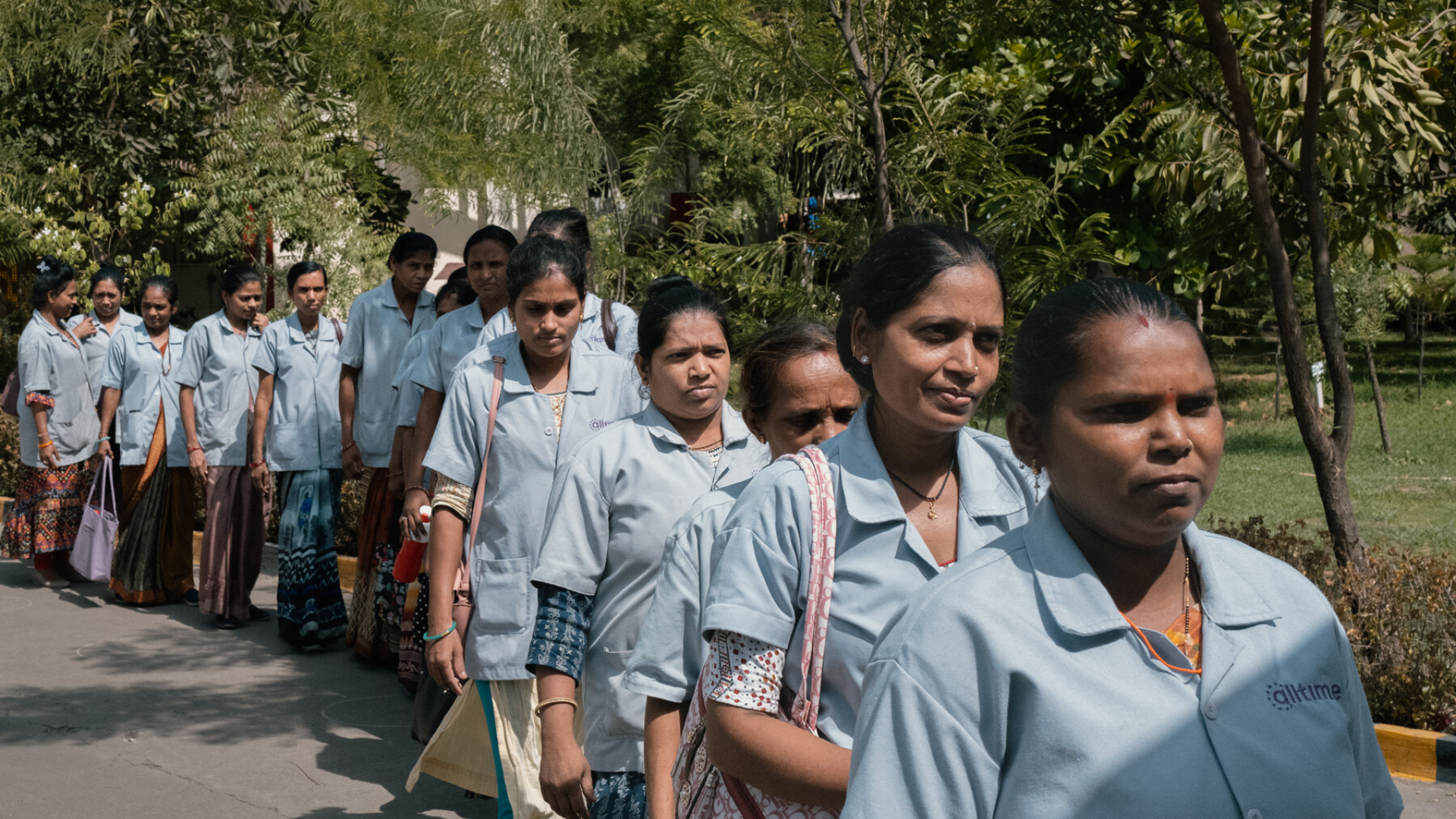

For decades, women’s access to factory work was restricted by Section 66(1)(b) of the Factories Act 1948. This section stated that no woman was allowed (yes, “allowed”) to do this Work after 7:00 p.m. In 2001, a woman named Vasantha, who worked in a textile factory in Tamil Nadu, decided to do this challenge this in court. She wanted to work at night and her employer was willing, but the law forbade it. The Madras High Court disagreed, finding that the restriction actively violated their economic freedom.
She wasn’t the only one; It took over 50 years and dozens of legal challenges for India’s new to finally come to fruition Labor lawswhich have been in force since November 2025. The new law has since lifted this restriction, allowing women to work night shifts in all sectors nationwide. A feminist victory, you might think. Well, not if you read the fine print.
“Protection” is a word that the Indian state uses liberally in relation to women because this word justifies treating women as a separate class of workers in need of leadership.
The Haryana notificationone of the many government clauses enacted in advance of the new labor laws can give us a clearer picture. Although the word “permitted” may have been removed, conditions and restrictions still apply. Imagine a woman, now legally allowed to work the night shift, on her way to a factory. She must travel in a group of at least four women. Your vehicle must have surveillance cameras, GPS tracking and a security guard. And all at the expense of her employer. The reasons for these conditions and the reasons for not allowing women to work nights at all are still the same: “protection.” “Protection” is a word that the Indian state uses liberally in relation to women because this word justifies treating women as a separate class of workers in need of leadership.
Women wanted to work the night shift. But what did they get in return? A conditional right to work, surveillance instead of freedom, protection instead of freedom of choice. These conditions explain why the new labor laws feel like one step forward and two steps backwards. Yes, women may be safer, but safer does not equal freer. The law has changed, but the assumption behind the law has not. The English political philosopher John Stuart Mill foresaw this as early as 1859.
Mill’s Harm Principle and the Indian State
Put simply, JS Mill’s harm principle states that states only have the right to restrict an individual’s freedom if they believe that doing so is to prevent harm to others. That is the only reason for government intervention: to prevent one citizen from hurting another. This may sound similar to the idea of “protection” as a justification for restricting citizens, and the two concepts may look identical from the outside. But here’s the catch: Mills’ intervention focuses on the perpetrators of the harm, not the victims of the harm.
According to Mill’s logic, the correct intervention to ensure women’s safety is to target the men who can and do harm women, or to create conditions that prevent such harm, rather than restricting women’s freedom of movement. Using protection as a pretext for imposing further conditions on female workers implies that women are the source of risk.
However, no one speaks against taking precautions for the safety of women. Rather, we must try to understand whether the state uses protection as the main logic to justify restrictions on women’s freedom and whether, under such conditions, women’s empowerment can simultaneously exist.
Same campus, different rules
The same protection logic has been applied in different contexts. For example, in many dormitories across India, boys are allowed to move freely without time restrictions, while girls’ dormitories often have curfews. In fact, a girls’ hostel in Mumbai went so far as to install it biometric identification This will alert parents in real time every time a woman leaves or enters the building. It is time to question whether these limitations, hidden in the idea of safety and security, actually contribute to women’s progress. Same campus, same city, same streets, but different rules and different freedoms.
In 2022, the Kerala High Court was asked to decide on a 9:30 p.m. curfew imposed on female students in a hostel of a government medical college in Kozhikode. These are medical students, adults in one of the most demanding academic environments, who are trained to make life and death decisions. The dorm curfew essentially said: We trust you to learn how to operate a person, but we don’t trust you to decide when to come home. To its credit, the court disagreed. In Fiona Joseph & Ors v. State of Kerala, the judge struck down the curfew and made an observation close to Mill’s argument: if safety is truly a concern, men should have a curfew.
In both cases, the night shift law and campus curfews, courts have overturned these rules. You could read about these rulings and consider them a feminist victory. However, Mill would argue that the assumptions underlying these rules in the first place have not really changed. Yes, an individual curfew could be lifted, but the assumption that the best way to ensure women’s safety is to restrict women’s freedom of movement remains. The behavior of the perpetrator is never the goal. Woman’s freedom is always.
The question that remains
The question remains: What should be done about the perpetrator’s behavior? Women must be both safe and free. If the only path to freedom puts them in danger, that gets us nowhere. We already know that restricting a person’s right to move, work or be in public spaces after dark is not a solution.
The question that remains does not concern women at all, but rather men. How do we correct the behavior of perpetrators? A good example of perpetrator-focused legislation is the Vishaka guidelines, which focus on women’s safety through accountability and place the burden on employers and perpetrators, not victims. The framework exists; Mindsets simply need to catch up.
A woman returning to her hostel at 10 p.m. does not pose a threat to anyone. A woman working the night shift does not pose a threat to anyone. The danger, where it exists, comes from somewhere else. The solution is not to force women back into their homes or dorms or to force them to find loopholes in the system. Mill would say that we need to move to a more perpetrator-centric approach because women’s safety is a man’s issue, and it has always been that way.
Shohra is a Political Science and International Relations graduate from the University of Bristol with research interests in public policy, governance, technology regulation and gender issues. Her research experience includes qualitative research on gender and representation and comparative politics research. She is currently completing a Masters in Diplomacy, Law and Economics and is particularly interested in using research to develop evidence-based policy solutions.
