
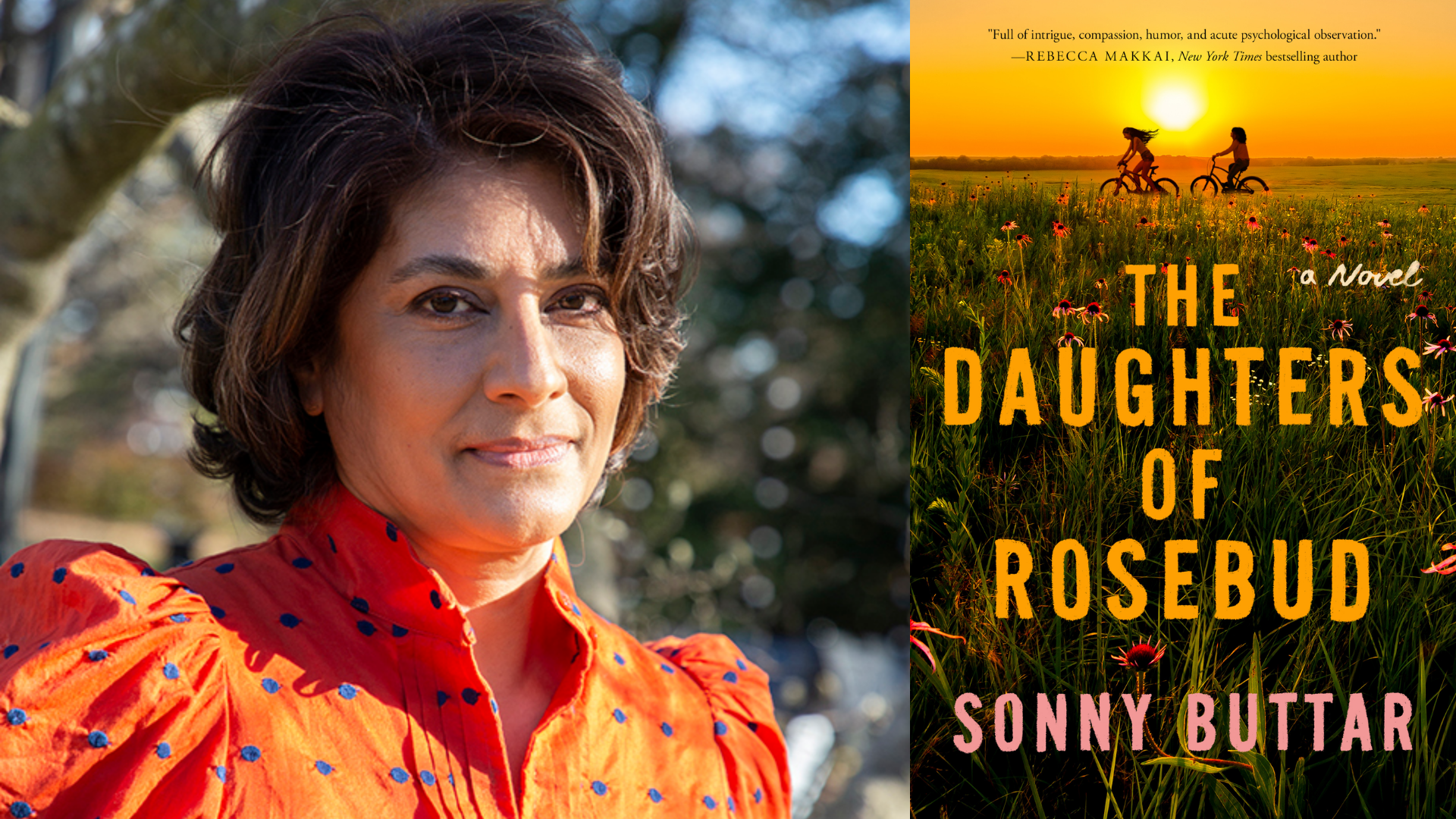
“‘The Daughters of Rosebud’: Sonny Buttar’s debut novel explores a multi-generational family saga”

There is a story that our parents only told us once. When they received their immigration papers from America, they considered leaving one of us behind in Pakistan to live with relatives because they believed it would be easier to care for one child than two. Leaving a child with a relative for a time or forever is not uncommon in the culture I come from. As soon as our father succeeded, they sent for the one who was left behind.
Asma asked, “Which one of us did you want to leave?”
My mother shifted uncomfortably, waiting for my father to say something. Abu said, “The evil one.”
I remember everything except my father’s face. Even without racking my brain, I can’t imagine if he was smiling or serious. We were outside on the patio, a large concrete slab behind our house. It was a hot summer night, the pavement still giving off its warmth long after the sun had retreated, leaving us in the shady, cool embrace of dusk. Abu grilled chicken thighs slathered in barbecue sauce, proudly holding tongs in one hand and a spatula in the other.
It couldn’t have been our first summer because there was the picnic table – they were so proud of the old thing that gave off splinters if you slid on it the wrong way. Ever since we saw the townspeople eating and dancing under the stars at the summer festival while soft music emanated from the pavilion, the outdoor dinners had an air of joy. We felt like we were doing something special. Just a recent immigrant family from Pakistan in a small country town in the middle of America having a typical Sunday evening barbecue. We felt proud, as if we had been granted access to a secret club. The Being American Club. There is a lightness in the memory. It conveys none of the harsh fear of our first summer, when everything seemed to be on fire.
If I can remember the missing pieces, maybe I can finally let go of this weight I’m carrying. Maybe it will help me understand and find some forgiveness. For her. For me.
Ami called us from the swing to help set the picnic table. She had probably made rice with chickpeas and a corn salad with chopped tomatoes and cucumbers from her garden, fresh with mint and coriander and a little spicy with chaat. Asma and I sat opposite our parents. They were in a rare talkative mood. The truth is that in those early years, no matter what happened later, we were somehow happy.
This image always comes to mind. I can’t confirm it. There is no one left to ask. It’s as if it holds the key to everything that came after. If I can remember the missing pieces, maybe I can finally let go of this weight I’m carrying. Maybe it will help me understand and find some forgiveness. For her. For me.
But memories, like dreams, are delicate things. They refuse to let go. The act of remembering, the attempt to hold on to something, destroys the memory itself, and all I’m left with is a blurry image of the picnic table. A blank space in my father’s expression, my mother’s gaze helplessly fixed on him, and Asma and I tried to figure out which one of us was the bad guy.
Sometimes I get a sense of who is calling in the split second before the phone rings. Especially when it’s Mamoo and way back when it was Asma. I have no explanation for this. It just happens.
Last week I felt the fear rising up my legs and stopping in my chest. The space was so tight that for a moment I thought something was physically wrong. And then the phone rang. I let it ring and ring.
A few years ago I found a clipping from a local newspaper article about my family’s arrival in our small rural town. It is dated 1977, the year after we immigrated. In the picture Asma is eight and I am seven. Abu must have been forty-two years old and Ami twenty-five. I don’t remember sitting for the photo. But there we are, sitting in our living room, a sweet family unit that looks like we belong. To each other. To Rosebud. To this country. There are no signs of what is to come.
I don’t remember sitting for the photo. But there we are, sitting in our living room, a sweet family unit that looks like we belong. To each other. To Rosebud. To this country. There are no signs of what is to come.
My mother, with her crown of not-quite-curly hair, sits on the couch with us girls, a dupatta loosely around her neck. She looks like a third child and smiles shyly. Asma and I are skinny and wear matching shorts and velor tops in an undetermined color. We sit so close together that we look like a normal-sized child with two heads. Asma leans towards the camera with a beaming smile, a large gap is visible in the top row. I am partially obscured, hiding behind Asma’s openness. Abu sits gloomily on the armrest of the sofa, his hand on Asma’s shoulder, squeezing her or holding her back. The pixelated black and white photo is washed out to a yellowish gray and cannot be recognized.
To me, the people in the picture feel so completely detached that they could be characters in a movie. My parents look young and innocent, their faces open to life. The article says we came to America for opportunities and a better life. We didn’t come to America for an opportunity or a better life. We came to America because our uncle Javed, our Mamoo, sponsored us. He said we should come, and we did. It’s easy to see that my parents agreed to this idea without having a plan or understanding what was on the other side. But the truth is that I never really knew her. So how can I say what made them come here? Aside from their final act, they so rarely showed agency in the big decisions.
Maybe all immigrants are foolhardy. How else can a person separate himself from his family, his language, his country and everything he knows? I imagine they, like most immigrants to this country, thought life would be easier in America.
I’m about the same age now as my parents were back then and I can’t imagine such an undertaking. The willpower required to free myself from the pull of my life, however small, is unimaginable.
Excerpted with permission from The Daughters of Rosebud by Sonny Buttar, Lake Union Publishing.
Feminism In India is an award-winning digital intersectional feminist media organization with the aim of learning, educating and developing feminist sensibilities and decoding the F-word among the youth in India.
