


Abstract
Otoacoustic Emissions (OAE) represent a sophisticated, non-invasive electrophysiological technique used to assess the functional integrity of the cochlear outer hair cells. These low-level acoustic signals, generated by the cochlea in response to auditory stimulation, act as an objective “echo” that confirms the inner ear is healthy and receptive to sound. Because the test is rapid, painless, and requires no active response from the patient, it has become the universal standard for newborn hearing screening. This article examines the biophysical foundations, procedural methodology, and clinical applications of OAE, providing a detailed look at how these echoes facilitate early detection of hearing impairment.
Introduction
For decades, assessing hearing in infants or non-responsive patients was a significant clinical hurdle. OAE changed this by shifting the focus from the brain’s response (as in BERA) to the ear’s physical performance. It was discovered in 1978. Otoacoustic emissions are essentially the “by-products” of a perfectly functioning cochlea. When sound enters the ear, the outer hair cells vibrate and contract; this microscopic movement creates a faint acoustic reflection that travels backward, out of the cochlea, and into the ear canal. If these reflections are present, it signifies that the cochlear amplifier is intact. If they are absent, it indicates a functional or structural disruption in the inner ear.
Scientific Principle Behind The Test
The generation of OAEs is rooted in the Cochlear Amplifier.
- Electromechanical Transduction: The cochlear outer hair cells (OHCs) are equipped with specialized motor proteins called prestin. When OHCs are stimulated by sound, prestin causes them to change shape (contract and expand), which amplifies the mechanical vibration of the basilar membrane.
- Reverse Transmission: This vibration is so efficient that it creates a mechanical wave that travels backward, through the middle ear, and into the ear canal as a faint acoustic signal.
- The “Echo” Phenomenon: OAEs are not neural; they are purely mechanical acoustic sounds. Because they originate in the cochlea, their presence serves as a “Gold Standard” proof that the inner ear is physiologically healthy.
Key Components Of The Test
The OAE system is highly portable and includes:
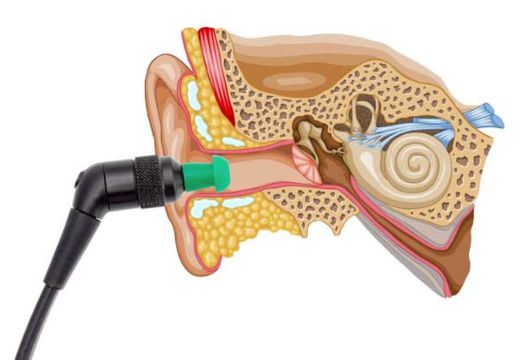
- The Probe: A small, soft-tipped probe inserted into the external ear canal. It contains both a miniature speaker (to deliver the stimulus) and a low-noise microphone (to record the returning echo).
- Signal Processor: A computer that records the acoustic data and filters out environmental noise.
- Ambient Noise Cancellation: Sophisticated algorithms that distinguish between the tiny OAE signal (often less than 0 dB SPL) and random background noise in the clinic.
What Is The Procedure?
The OAE test is remarkably brief, often taking less than two minutes per ear.
- Preparation: The patient sits or lies down comfortably. In infants, the test is best performed while the child is sleeping or quiet.
- Insertion: The clinician places the probe tip into the ear canal, ensuring an airtight seal.
- Stimulation: The computer sends stimuli, either Transient-Evoked OAEs (TEOAEs), which use clicks, or Distortion-Product OAEs (DPOAEs), which use two tones of different frequencies.
- Recording: The microphone in the probe records the “echoes” coming back from the cochlea. The computer averages these responses to confirm if the emission is present.
Interpretation Of The Test
The results of OAE testing are usually categorized as “Pass” or “Refer”.
- Pass Result: A “Pass” result indicates that otoacoustic emissions are present, suggesting normal cochlear function and hearing sensitivity.
- Refer Result: A “Refer” result indicates absence or reduced otoacoustic emissions, suggesting possible hearing impairment. Further testing such as Auditory Brainstem Response (ABR) may be recommended.
Abnormal results may indicate:
- Sensorineural hearing loss
- Cochlear damage
- Middle ear disorders
- Noise-induced hearing loss
- Earwax (cerumen) in the canal
- Excessive movement or background noise during the test.
- Ototoxicity
OAE testing helps identify hearing issues at an early stage, allowing timely intervention.
Health Issues Where Otoacoustic Emissions (OAE) Is Advised
Primary Clinical Roles
- Universal Newborn Hearing Screening (UNHS): The standard tool for identifying congenital hearing loss in infants within the first days of life to ensure early intervention.
- Ototoxicity Monitoring: Acting as an “early warning system” to detect cochlear damage in patients undergoing chemotherapy or taking high-dose antibiotics before hearing loss becomes permanent.
- Occupational Health: Screening workers in high-noise environments to catch the earliest signs of noise-induced hearing damage that standard tests might miss.
- Differential Diagnosis: Helping clinicians distinguish between Cochlear issues (damaged hair cells) and Retrocochlear issues (problems with the auditory nerve or brain).
Key Diagnostic Indications
- Pediatric Assessment: Evaluating infants or children with suspected hearing loss or delayed speech development who cannot yet perform traditional “button-push” tests.
- Auditory Neuropathy Evaluation: A vital component in diagnosing ANSD, where the ear functions normally (OAEs present) but the signal is not sent correctly to the brain.
- Tinnitus & Noise Damage: Investigating the physical health of the inner ear in patients complaining of ringing or those with a history of acoustic trauma.
- Pathology Management: Monitoring the impact of genetic hearing disorders or chronic ear infections on long-term inner ear health.
Factors Affecting The Results Of Otoacoustic Emissions (OAE)
- Middle Ear Status: Because OAEs must travel out through the middle ear, any fluid (common in kids) or pressure will block the signal, leading to a “Refer” result even if the inner ear is healthy.
- Canal Obstruction: Even a small amount of earwax can “muffle” the echo.
- Background Noise: In a noisy clinical environment, the faint OAE signal can be lost.
- Patient Movement: Crying, chewing, or even deep breathing can create sounds that interfere with the recording.
Advantages Of The Test
- Objectivity: The patient does not need to listen or respond.
- Speed: It is the fastest method to clear a patient for normal hearing.
- Sensitivity: It identifies damage to hair cells before it is visible on other types of hearing tests.
- Safety: It is non-invasive with zero risk to the ear.
Ayurveda Insight
In Ayurveda, hearing is the function of Akasha Mahabhuta (the space element). The “echo” captured by OAE is a reflection of the inner ear’s responsiveness, which is governed by Prana Vayu.
- Cochlear Function As Tejas (The Metabolic Radiance): The activity of the outer hair cells can be compared to Tejas (the metabolic radiance) of the Shabda-Vaha Srotas (Auditory Channels). If this “Tejas (the metabolic radiance)” is bright and active, the OAE is strong.
- Sanga (Obstruction): An absent OAE often indicates a Sanga (blockage) within the Srotas (Channels) whether it is physical (wax/fluid) or functional (hair cell damage).
- Vata-Pitta Imbalance: Noise-induced hair cell damage is often viewed as a Vata-Pitta conflict, where the “heat” (Pitta) and “excessive agitation” (Vata) burn out the delicate OHCs.
Herbs Used For The Ear
1. Brahmi (Bacopa monnieri)
Brahmi is described in Ayurveda as Indriya Balya (strengthens sensory organs) and supports Shravana Shakti (hearing ability) by nourishing neural pathways associated with sound processing. It helps maintain Tarpaka Kapha (nourishing fluid for sensory organs) which supports inner ear stability. Brahmi also improves sensory adaptation to sound and reduces auditory hypersensitivity. From a modern perspective, Brahmi contains bacoside A, bacopaside, and apigenin which support neuroplasticity in auditory cortex regions. These compounds enhance signal processing and protect auditory neurons. Brahmi also helps reduce oxidative stress in cochlear tissues and supports auditory memory processing.
2. Guggul (Commiphora mukul)
Guggul is described in Ayurveda as Lekhana (scraping action) and Srotoshodhaka (channel-cleansing), which helps remove subtle blockages affecting auditory perception. It supports Karna Srotas (ear channels) by improving metabolic activity in auditory tissues. Guggul also helps maintain flexibility of auditory membranes. From a modern perspective, Guggul contains guggulsterones, myrrhanol, and sesquiterpenes which help reduce inflammatory mediators in ear tissues. These compounds support cochlear microcirculation and help maintain auditory nerve conductivity. Guggul also helps protect inner ear cells from metabolic stress.
3. Ashwagandha (Withania somnifera)
Ashwagandha is described in Ayurveda as Vatashamaka (Vata balancing) and supports Shravana Indriya (hearing organ) by stabilising nerve impulses. It helps strengthen Karna Snayu (auditory nerves) and improves sensory coordination involved in hearing. Ashwagandha also supports Dhatu Poshan (tissue nourishment) of inner ear structures. From a modern perspective, Ashwagandha contains withaferin A, withanolides, and sitoindosides that promote neuroprotection of auditory pathways. These compounds help reduce neural degeneration affecting hearing and support cochlear nerve signaling. Ashwagandha also helps improve stress-related auditory sensitivity and enhances auditory resilience.
4. Sariva (Hemidesmus indicus)
Sariva is described in Ayurveda as Shothahara (anti-inflammatory) and Daha Prashamana (relieves burning sensation), which helps in calming irritation in auditory passages. It supports Karna Nadi (auditory channels) by maintaining tissue cooling and reducing heat accumulation affecting hearing sensitivity. Sariva also nourishes Rakta Dhatu (blood tissue), improving subtle circulation to cochlear structures. From a modern perspective, Sariva contains coumarins, tannins, and hemidesmol that help reduce inflammatory responses in inner ear tissues. These compounds support cochlear cell protection and reduce oxidative stress affecting hearing. Sariva also contributes to maintaining electrolyte balance in inner ear fluids essential for sound transmission.
Conclusion
Otoacoustic Emissions (OAE) have fundamentally transformed audiology by providing a window into the mechanical vitality of the cochlea. By capturing the acoustic “echoes” produced by healthy outer hair cells, this test offers a reliable, objective, and painless method for ensuring healthy hearing across the lifespan. While OAE is sensitive to even minor obstructions, its role as a screening powerhouse is unmatched. Integrating this rapid objective data with a holistic Ayurvedic focus on nourishing the auditory channels ensures a comprehensive approach to protecting the precious sense of sound.
