
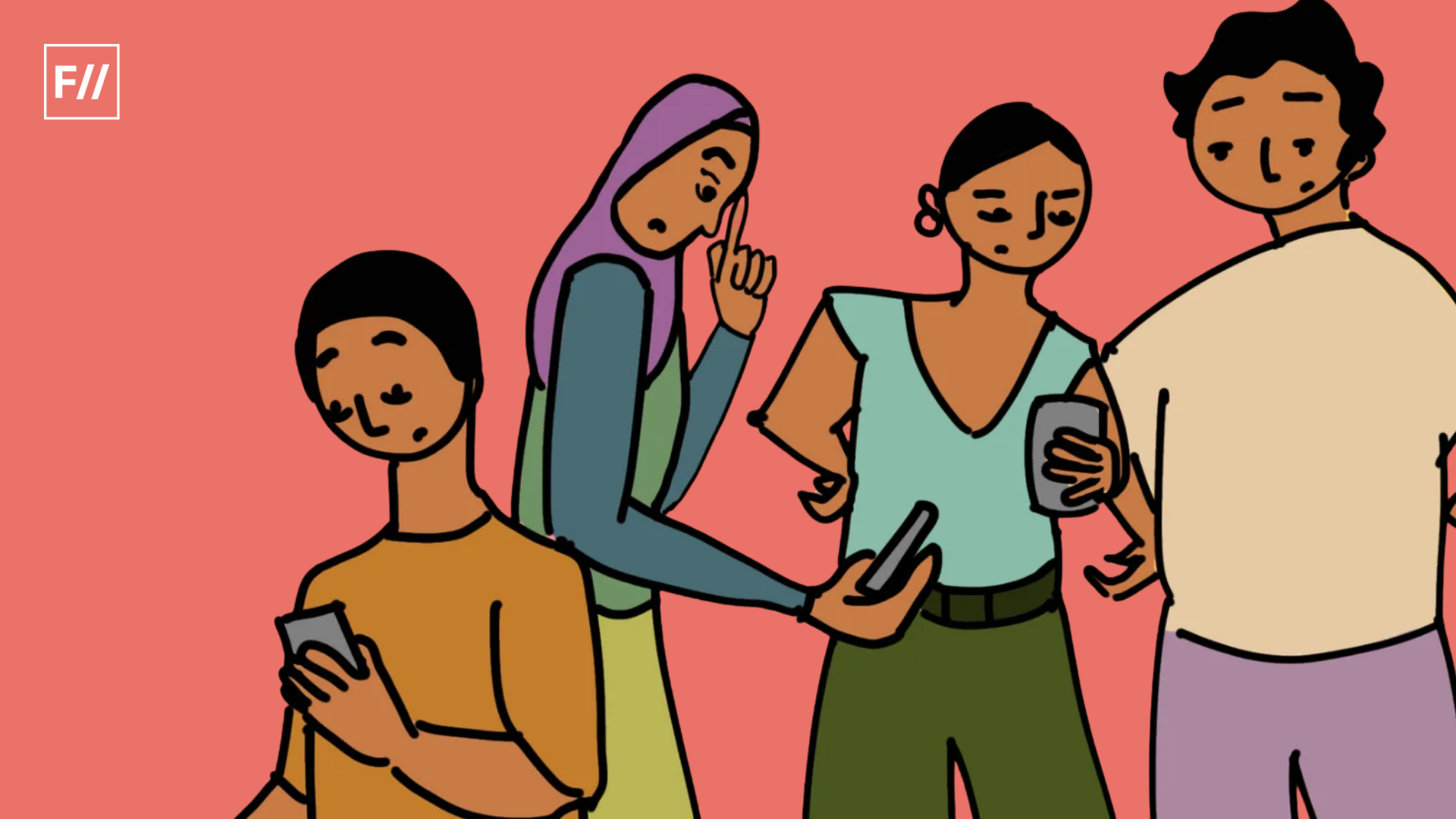

Videos of professional women from villages and small towns doing household chores have become a major phenomenon on social media. Recording her seemingly raw, organic life, cooking on a chulha (mud oven), spending time with her children and raising livestock has made her go viral, garnering millions of likes and followers. However, consuming this content is not just a harmless form of social media engagement; It plays a crucial role in normalizing and reinforcing gender norms, the gender binary and the gendered division of labor.
Gender and the gender binary
The general belief is that there are two distinct and opposing genders: men and women, each assigned fixed roles, appearances and behaviors. Social media platforms can facilitate the spread of such a binary gender view and also reinforce it. The idea of fixed gender roles places women in a subordinate position in the gender hierarchy: men are expected to provide support and take on leadership roles, while women are naturally assumed to be naturally suited to work as housewives and caregivers.
This hierarchical division of gender roles and workforce reinforces rigid ideas about gender and is often presented as a neutral division of responsibilities. Tradwife content romanticizes village life, where women often bear the entire burden of household chores. They stabilize gender as a category and dictate what it means to be a man or a woman. In doing so, they reinforce the gender-specific division of labor and maintain asymmetrical and unequal power relationships between the sexes.
The stabilization of gender as a category can be understood through Judith Butler’s work Gender Trouble, in which she writes: “Gender is not a noun, but neither is it a set of free-floating attributes, for we have seen that the substantive effects of gender are performatively produced and enforced through the regulatory practices of gender coherence.” To put it simply, gender is not something with fixed attributes, but rather something that is continually implemented; it is produced and reproduced through actions, performances and deeds. Every video of a woman cooking and tending to livestock becomes a small performance of what “comes naturally to a woman,” which millions of viewers watch, reward, and internalize.
Tradwife content also tends to follow a similar pattern, with some notable nuances: the wife gets up early, often before everyone else; look after the livestock; caring for and preparing the children; their choice of clothing; and the considerable time she spends preparing meals and serving each family member. These videos often contain carefully selected background music and visual elements that convey an image of roots and authentic village life.
Such depictions not only reinforce the existing division of labor, but also lend credence to the idea that different and seemingly separate spaces exist for different genders. These gender-specific spaces are also embedded in power structures in which women are also deprived of their decision-making power by being pushed to the periphery.
This also creates a rural-urban divide: village tradwife content portrays the village as the home of “real” family values and femininity, while the city represents the loss of both. In this narrative, the image of the woman at the stove is presented as something to be preserved, and her place in the kitchen is presented as a natural result of her gender.
Does this content empower women?
Social media curates a slice of life. It captures the everyday lives of professional women, constructing and disseminating an ideal of what a “good woman” looks like. Platforms, in turn, reward this content with likes, shares and followers. Although making money through social media and choosing to present oneself online are often understood through the lens of empowerment, particularly in terms of financial independence and the assertion of agency, the nature of that agency requires closer examination.
Tradwives’ agency can only be asserted through a narrow, gendered notion of acceptable femininity, which becomes clear when we look at how this content only reinforces, and never disrupts, adherence to traditional gender roles.
Feminism emerged as a reaction to gender inequality and discrimination with the aim of challenging and reducing these inequalities. So the question is whether content that revolves around the very things that feminism wants to challenge can really be empowering.
The Time Use Survey 2024The study, conducted by the National Statistics Office, recorded the average amount of time individuals spent on various activities per day, with the data categorized by gender (male, female and transgender). The largest gap was in time spent on employment and unpaid domestic work. Men spent an average of 287.5 minutes per day on activity, compared to 71 minutes for women. On the other hand, women spent an average of 236 minutes on domestic tasks, compared to just 24 minutes for men. The data alone cannot prove why this division exists. However, a clear pattern is emerging whereby women continue to carry out a disproportionate share of unpaid domestic work.
Tradwife content presents this same division of labor as an effortless and freely chosen lifestyle, thus reproducing a broader social pattern. In this way, it helps to legitimize the norm of “domestication of women.” If gender has been a basis for discrimination in the past, how can “doing gender” empower women? As Butler argues, the agent is produced and shaped by the actions.
Room for maneuver in Tradwife content is not entirely lacking; Rather, it works through the repetition of norms that can also be repeated differently. New forms of action that go beyond the gender-specific division of labor must be carried out in order to change the position of the “maker” and question the prescribed gender roles of a patriarchal society. Rather than simply adapting to these roles using the choices and forms of agency available within existing norms.
References
Butler, J. (2006). Gender Issues: Feminism and the Subversion of Identity (1st ed.). Routledge. https://doi.org/10.4324/9780203824979.
