
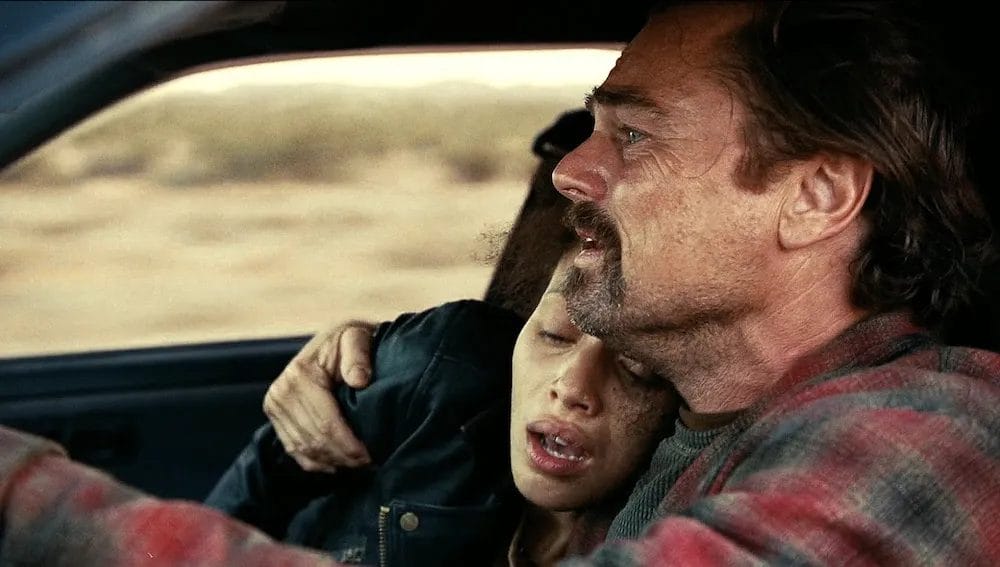

One Battle After Another (OBAA) may lose $100 million, but it’s bound to gain one trophy after another. The lauded box office bomb by Paul Thomas Anderson (PTA) already nabbed four Golden Globes and three Critics Choice Awards. With 14 BAFTA and 13 Academy Award nominations, PTA is poised to take home the Oscar for Best Director.
When accepting his Golden Globe last month, the 55-year-old filmmaker repeated OBAA’s “This pussy don’t pop for you” line as if it were clever instead of cringe. Certainly, it’s not as impactful as the visceral admission, “I’ve abandoned my child, I’ve abandoned my boy!,” delivered by Oscar winner Daniel Day-Lewis in PTA’s character-driven epic There Will Be Blood (2007).
Nor is it as quintessential to his catalog of quotes as “Kiss me, my girl, before I’m sick,” from Phantom Thread (2017) and “I have a love in my life. It makes me stronger than anything you can imagine,” from Punch-Drunk Love (2002). In other words, OBAA is not the GOAT (greatest of all time) that critics are making it out to be. In fact, it’s not even the greatest of all Anderson’s films — and he’s only made 10!
Granted, this Leonardo DiCaprio vehicle features a few amusing bits and touching moments. But the pic’s predominant praise has more to do with timing since the Academy missed its chance to reward PTA’s direction in the past, most notably for the flawless Phantom Thread. That was a decade ago and the auteur is long overdue for a win, even if OBAA lacks the aesthetics and authenticity of his more creative and cohesive endeavors.
Anderson will likely follow the trajectory of Martin Scorsese and Jane Campion who were retroactively victorious. Instead of earning Best Director Oscars for their undisputed masterpieces Goodfellas (1991) and The Piano (1993), they were awarded for lesser works: the cartoonish thriller The Departed (2006) and the virtue-signaling western The Power of the Dog (2021), respectively. The former plays like a Scorsese parody while Campion’s male-dominated drama is the antithesis of her female-focused canon.
Similarly, OBAA doesn’t feel like pure PTA. Unlike Phantom Thread which was personally inspired by an incident with his wife Maya Rudolph, OBAA is derivative of other flicks. Yes, it intentionally tips its hat to The Searchers (1956) and The Battle of Algiers (1966), but it also haphazardly lifts “Soldier Boy” by The Shirelles from Born on the Fourth of July (1989), Steely Dan’s “Dirty Work” (1972) from David O. Russell‘s American Hustle (2013), and the stoner attire from The Big Lebowski (1998).
The film’s frantic “find a phone” segment mimics the tense helicopter sequence in Goodfellas — except instead of sampling songs by Harry Nilsson, The Rolling Stones, The Who, George Harrison and Muddy Waters, PTA applies an intrusive score by Jonny Greenwood at his most annoying.
Overall, OBAA evokes a Quentin Tarantino “bro” tone with its excess swearing, glorified violence and sexualization of women. French 75 member Junglepussy (Shayna McHayle), for example, sounds a lot like Manson Family member Pussycat (Margaret Qualley) in Once Upon a Time… in Hollywood (2019).
More problematic is the screenplay adapted from Thomas Pynchon’s postmodern novel “Vineland” (1990). The book is set in 1984 with flashbacks to the 1960s, yet PTA pushes the story to present day. But the change doesn’t match the film’s gritty cinematic ’70s look or acknowledge any societal progress made in the last 60+ years. Antiquated references to a “mixed-race child” and “reefer addict” seem particularly outdated.
Because it retains its original 1970 context, the juxtaposition between counterculture druggies and the Los Angeles Police Department worked much better in PTA’s screen adaptation of Inherent Vice (2014), also based on a Pynchon novel. Despite being surreal in nature, the underrated comedy is believable thanks to the layered portrayals of hippy detective Doc Sportello (Joaquin Phoenix) and the paradoxical Lieutenant Bigfoot Bjornsen (Josh Brolin).
Conversely, OBAA is populated with polarizing stereotypes; Sean Penn’s military right-wing supremacist Col. Lockjaw and Teyana Taylor’s militant revolutionary Perfidia Beverly Hills border on caricature. It doesn’t help that she’s photographed through a male gaze — from fetishizing shots of her booty to the controversial framing of her pregnant body wielding a machine gun.

Taylor, who did most of her own stunts, is currently the favorite to win Best Supporting Actress. It’s too bad Regina Hall and Columbia College grad Chase Infinity didn’t receive equal recognition since they supply the supposed satire with its most nuanced performances.
Although filmed in VistaVision, the cinematography by Michael Bauman (who served on 2021’s Licorice Pizza) lacks the signature brilliance Robert Elswit brought to Punch-Drunk Love, There Will Be Blood and Inherent Vice or the visual richness generated by Mihai Mălaimare Jr. in The Master and PTA himself in Phantom Thread. The latter — along with Punch-Drunk Love — are among Anderson’s best and briefest.
OBAA clocks in at a sluggish 2 hours and 41 minutes. Such bloat is a recurring symptom of PTA’s unrestrained ambition: the longer the runtime, the more meandering his plots become. Take the 3-hour and 8-minute drama Magnolia (1999) and the 2-hour and 33-minute comedy Boogie Nights — please.
Had the last 15 minutes been cut from There Will Be Blood, Anderson may have scored Oscars for Best Screenplay, Best Director and Best Picture. It’s been almost 20 years since he experienced those losses. And because the Academy lavished Sean Baker with a record-breaking four Oscars for the overhyped Anora (2024) last year, it needs to make things right this year — even if that means giving PTA the gold for the wrong movie.
