

In the absence of Presentation and reflection By moving in everyday spaces around them, queer/trans people seek out or create spaces they can call their own. These are usually not family spaces that cis-het people continue to have access to. “I was part of a group where we organized events for transsexuals outside of the party scene.” “It was just on this street,” Akshata said, pointing to the street opposite my office where we met.
Addressing Anubhuti, she added, “Anubhuti has done a lot for the corporate space community through her company.” Her work was featured in Parmesh Shahani’s book Queeristan. Through their efforts, a renowned company has hired over 100 trans people, is working on trans-affirmative workplace policies, and is working to raise awareness about trans lives among the workforce. “When a company of this size and reputation makes an effort, other companies follow suit.”
In the absence of representation and reflection of themselves in everyday spaces around them, queer/transsexual people seek or create spaces that they can call their own. These are usually not family spaces that cis-het people continue to have access to.
When Anubhuti came out, there was no one in her city or company who came out as transgender. She grew up quite isolated and knew for sure that no doctor or psychiatrist would support her. “In 2012 and 2013, in a small town where everyone knew everyone, I knew no one would support me. I told the company counselor about my gender identity anyway and he prescribed me antidepressants and asked me to join a group. I never went. Then I knew it had to be DIY. Do it yourself.”
Anubhuti was 23 years old at the time. She found the website AskSusan where she asked for support. She went to Calcutta to seek medical care, she found a group there called Sappho For Equality, she found resources on Reddit, she asked other trans people, and slowly gathered the information she needed to start hormone therapy herself. When it came time for surgery, she knew that psychiatrists would ask her a series of standardized (and irrelevant) questions to determine whether she could receive a diagnosis of gender identity disorder (GID) and the certification required for gender-affirming medical procedures.
“They ask questions like: Did you play with dolls, did you like the color pink?” I didn’t do any of this as a kid, but by then I knew how to crack it, so I checked yes to everything.’
While we laughed at the absurdity of cis understanding of gender, it only underscored how much power these systems run by cisgender people had to control the lives of trans people.
While we laughed at the absurdity of cis understanding of gender, it only underscored how much power these systems run by cisgender people had to control the lives of trans people. Every step towards an authentic life in the correct gender is blocked, delayed and denied to transsexuals. Every transsexual must repeatedly fight these systems alone.
Therefore, Akshata was worried about re-traumatizing Anubhuti, who had gone through so much alone. Anubhuti, on the other hand, wanted to be by Akshata’s side, not just because she loved her, but because she wanted to be the support she never had in her own journey. “I wanted to offer her something I never had.” I felt like knowing there was someone cheering her on would make a huge difference in helping her feel less alone. One day I hugged her and said, “I hope you know you’re the boss here.” I will never forget the smile she gave me when I said that. She had gone here, there and everywhere for her GID, documents and meetings with doctors and I don’t think anyone had told her that she was really doing such a fantastic job against all odds. “Nobody tells you that as a trans person you are doing something good.”
In 2008, Akshata had started looking for resources for the transition. Yet every psychologist or psychiatrist she met gave her damaging information and pathologized her. She had done her MBA, had a well-paying job and lived in a city like Bombay, but there was no support. This lack of support threw her into the ground for years to come. She even considered living in the wrong gender because it seemed hopelessly hopeless.
In 2021, Akshata started thinking about transitioning again. She met a therapist who supported her, started HRT on her birthday and got to know the community. It was during one of these strange events that she had met Anubhuti. Akshata finally underwent surgery in December 2024 in Bangkok, Thailand. Anubhuti accompanied her.
“I had originally planned to go alone. I knew that my parents might not be able to give me the support I needed, so I went alone. But Anubhuti insisted on coming with me. During this surgery, she was by my side the whole time and that’s when I realized that I really needed her. I don’t know how I could have done it alone.”
In 2021, Akshata started thinking about transitioning again. She met a therapist who supported her, started HRT on her birthday and got to know the community.
Anubhuti adds, “I wasn’t planning on letting her go alone.” I’ve been through it and know how much it would have meant to have someone there with me. On the day of the operation we had to spend a night apart. Even the doctor teased us about being together all the time.’ Anubhuti mimicked the doctor’s hand gestures depicting scissoring to happily joke about being lesbian.
When Akshata opened her eyes after the operation, the first person she saw was Anubhuti and she felt deep joy. Anubhuti gifted her a book called “Pussy” to congratulate her and welcome her to this part of her trans journey. She spent the next few months recovering from the operation, which took a little longer given her age; Akshata was 39 years old when she underwent surgery.
When I met her for this story, Akshata couldn’t wait to get out and about in the world after her surgery. She felt confident as a woman and desperately wanted to be seen.
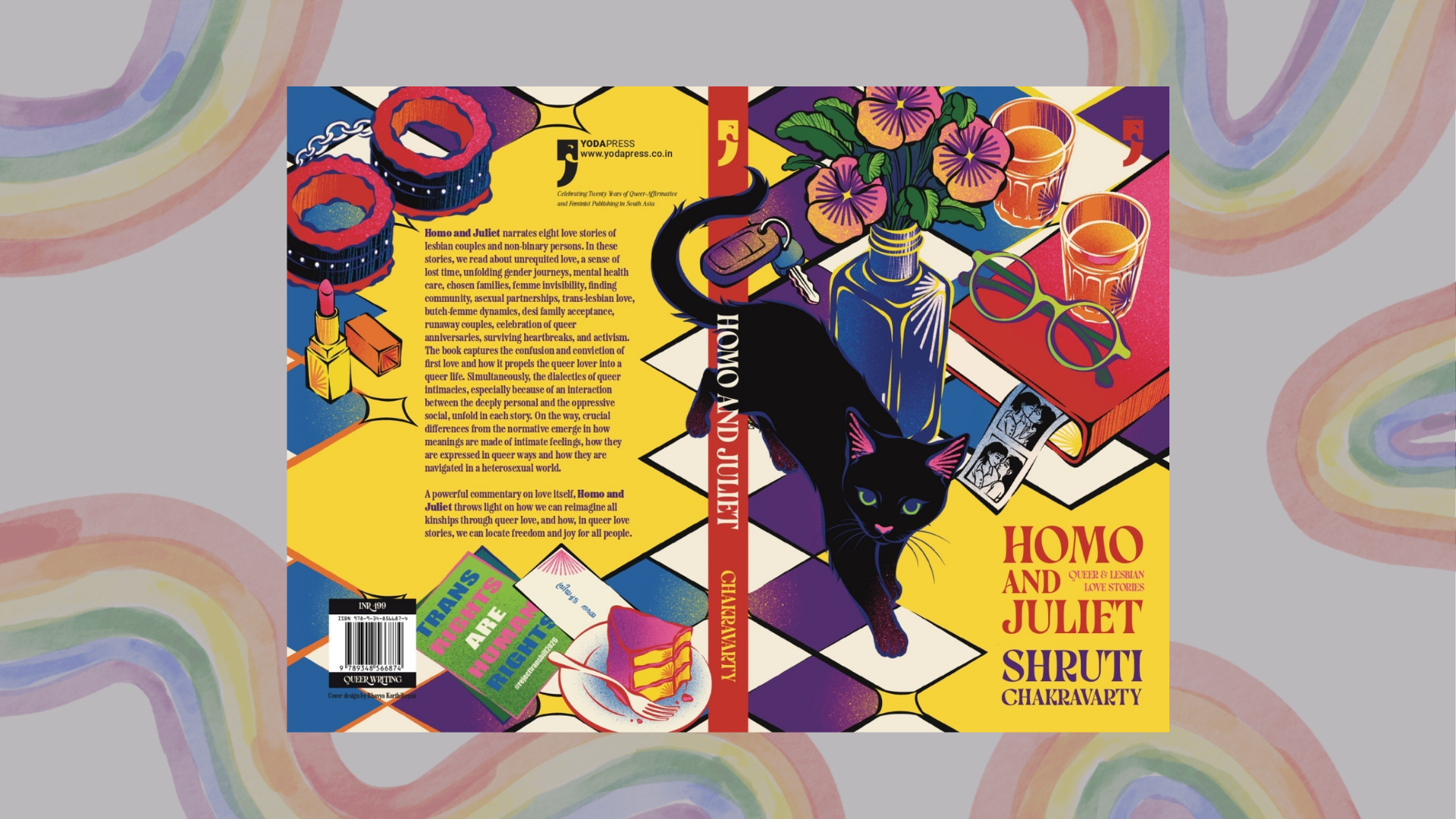
Excerpted with permission from “Homo and Juliet: Queer & Lesbian Love Stories,” by Shruti Chakravarty, Yoda Press.
Feminism In India is an award-winning digital intersectional feminist media organization with the aim of learning, educating and developing feminist sensibilities and decoding the F-word among the youth in India.
