
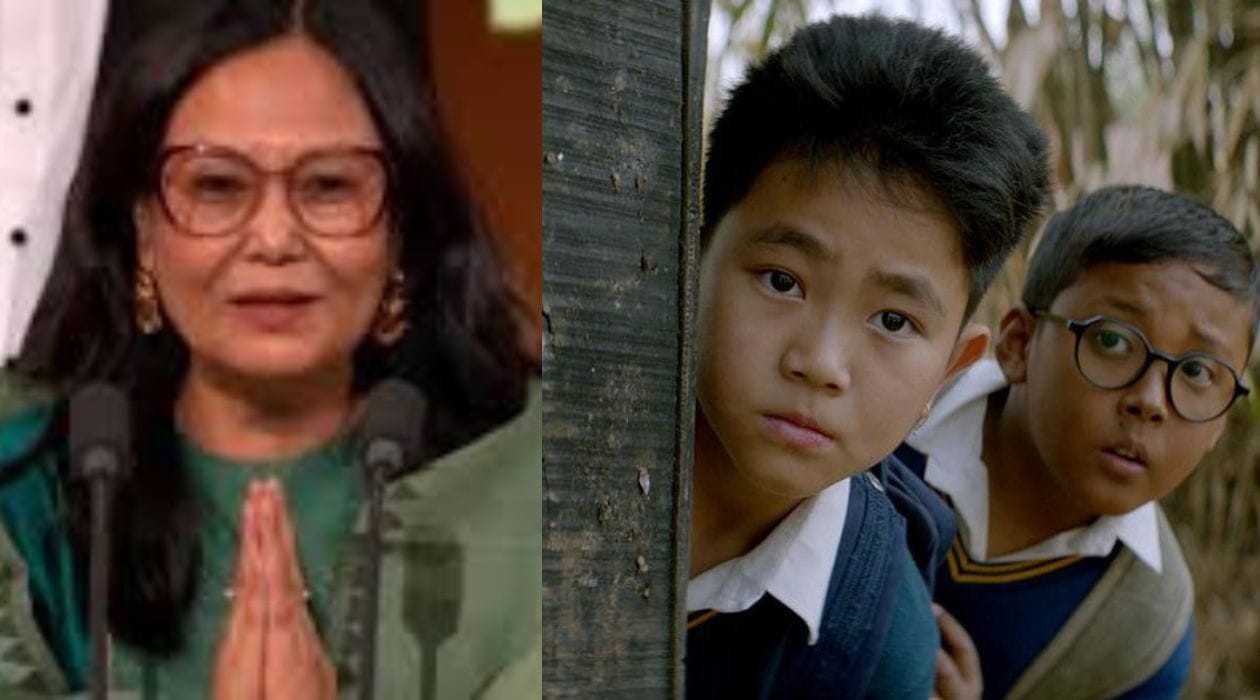

The Manipuri film Boong begins with a mischief. The character of Brojendro, also known as Boong (Gugun Kipgen) in the film, and his friend Raju (Sanamatum Angom) change the name of their school from Homochandra Boys School to “Homo Boys School” by using a catapult (locally known as Guelel), a recurring and poignant personal tool owned by Boong (Brojendro) in the film. Mandakini (Bala Hijam), who single-handedly raises a miserly young lad, Boong, sells handlooms and is expecting her husband Joy Kumar Singh (Hamom Sadananda), owner of The Best Burma Teak Furniture.
The film Boong won Best Children and Family Film at the 79th British Academy Film Awards, becoming the first Indian film to win a BAFTA alongside its world premiere in the Discovery section of the 2024 Toronto International Film Festival. Setting this tender story in the socio-cultural landscape of Manipur, far removed from many Indians, writer-director Lakshmipriya Devi builds a textured web of geography, language, people and culture, offering a portrayal that resists the homogenizing gaze often found in mainstream media.
Boong (2024). Photo credit: Excel Entertainment/Chalkboard Entertainment/Suitable Pictures
Devi’s ethnographic sensibility presents discrimination as a reminder for the “Indian audience” to change or expect the same. The transnational community in the film is a doorway to access the sprawling communities separated by the borders of nations. It features a clearly defined three-act screenplay structure that engages audiences from start to finish and provides visual foreshadowing from the start. There is an inciting incident, a rising action, and an emotional outcome. The film is masterfully written, with motifs as expositions. These displays include a catapult, Madonna’s song “Like A Virgin”, Madonna’s poster and the pink saree that Mandakini never sells, which are later used either as a catalyst in the story or when something within the character changes something.
Migration, belonging and outsider status
Boong, who misses his father, wants to give his mother the gift of the return of his father, who has been missing since he was two to three years old and moved to Burma (now Myanmar). Mandakini waits for her husband with Boong; But the truth about her silence and resilience proves to be an emotional climax. Raju, who belongs to the fourth generation of a business family that migrated to Manipur, and his father Sudhir Agarwal (Vikram Kochhar) face discrimination as they believe that they are loyal Manipuris and also become constant supporters of Boong and his mother.
Devi’s ethnographic sensibility presents discrimination as a reminder for the “Indian audience” to change or expect the same. The transnational community in the film is a doorway to access the sprawling communities separated by the borders of nations.
The second act of the script, when the film sets the mood and tone, opens a box full of surprises. Mandakini is mocked for still waiting for her husband or by family members who shame her for giggling with Sudhir, an ‘outsider’. The village also tries to prove that her husband has died with a fake certificate and arranges a funeral prayer. A cinematic scene where everyone is mourning and Mandakini comes into the frame in a pink saree (hinted at the beginning when she refuses to sell the same saree and decides to wear it when her husband returns), with Boong also dressed. She asks the family to “grieve for themselves” (they might be proud of Mandakini) and later meets with an accident while returning with Boong on her scooter. In between all this, Boong and Raju transfer from Homochandra Boys School to an English medium school, face discrimination because of their English, and become friends with Julian (Nemetia Ngangbam), whom they initially hated.
The film progresses as Boong finally decides to elope to find his father and bring him home, after which Raju agrees to join him. They take their classmate Juliana, who helps them reach Moreh, a town on the India-Myanmar border, where they show the locals a photo of Boong’s father and ask whether they have seen him or not. It is a powerful image that leads me as a viewer to political and emotional images of Kashmiri Muslims holding photos of their missing husbands, sons or fathers and addressing a larger political injustice.
Singer JJ’s on-screen presence is a spectacle as he gives two performances, one with the song “Nathou” (a Meitei song) and the second with “Like A Virgin” by Madonna, albeit sung in a Meitei dialect and with the traditional instrument Khol. The latter performance leads to a climax and a revelation about Boong’s father. Boong and Raju seek help from singer JJ, whose musical performance of “Like A Virgin” by Madonna (a spectacle for locals and audiences) attracts a large crowd. Boong meets a Burmese girl (Fairy Khoirom) who aims the catapult (an exhibition) at Raju in the same way as Boong, and he notices it. He follows her to ask where she learned this, but finds out the cathartic truth about his father’s second marriage, and the Burmese girl happens to be Boong’s stepsister from his father’s second marriage. A truth that is difficult for a child of this age to bear. Something is changing in Boong. He cries and returns to his hometown with Raju and Sudhir.
A Manipuri lens on gender and resilience
Boong meets his mother and lies to her that his father is no more, to which she responds with a question: “Is he okay?” A moving and poignant scene that changes Mandkini’s character and reveals so much. The story, which revolves around Boong and his search for his father, shifts the emotional center of the narrative to Mandikin, her silence, her strength and her resilience.
Through subtle silences within everyday domestic life, the author creates a character whose identity is shaped and constrained by the men in her life, and as an audience focused more on Boong,
Dealing with the social and emotional stresses of being a single mother, Mandakini has remarkable depth. She embodies the often unspoken sacrifices imposed on women in patriarchal structures. Through subtle silences within everyday domestic life, the author creates a character whose identity is shaped and constrained by the men in her life, and as an audience more focused on Boong, the film rewinds in the final scene and you shift the focus to Mandakini, who has already accepted her reality but found it difficult to say the same to her son, who is full of hope and longing for his father’s return. Boong burns Madonna’s poster and the idea of acceptance takes hold.
“Boong” is a simple cutscene story that makes you rewind the entire movie in your head because of the climax. A script that is worthy of discussion in screenwriting pedagogy. The story is about a political friendship between a local and a local who is called an outsider, a larger discourse on migration and “their” loyalty to the emigrated country (a question that has been popular in India for several years), a woman who falls victim to the patriarchal structures of society (there are many examples of this), a tender approach to the idea of longing, a poetic approach to acceptance and moving on with reality even when it feels heavy in one’s chest until the last breath and one Story This is a slap in the face against discrimination by keeping it real and unhinged, and an ode to the country that includes writer, director and first Indian film to win a BAFTA, Lakshmipriya Devi.
