
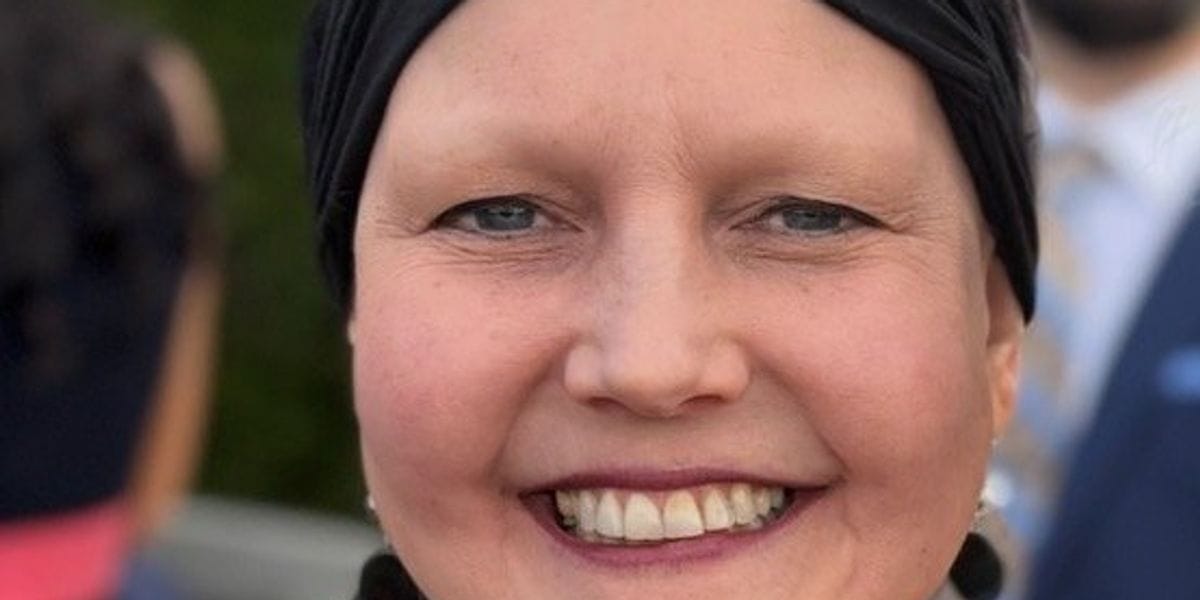

As Erica Rimlinger said
My children were 2 and 3 years old when I found a lump in my chest. I made an appointment for a mammogram and went to the appointment alone. I will never forget the radiologist’s face when she checked the results. When she told me I had to pursue an oncologist, I said I would call one. She said no, we made an appointment for her tomorrow. I realized that I shouldn’t have come to this appointment alone.
I had breast cancer, which ultimately led to a double mastectomy, reconstruction and chemotherapy. My children were so young that it was easy to get my energy to keep their life as normal as possible during my treatment. It stopped my mood and hers. I helped her shave my head at a razor party to demystify mom’s new look. My husband and I read books that explained cancer in a way that was appropriate for their age. We told them that Mama had a Boo Boo.
Emma and her family, 2008
Almost 10 years later, breast cancer seemed to be as long and far away as Sippy Cups and colored pencils. The children were middle and high school students, and I had a job in New York City that I loved. Then I found another lump and was withdrawn into this world because no time had passed at all.
My new chest surgeon in New York believed that the lump was only a left -wing seam – a stab – before my operations years ago, and I was able to ignore it. This explanation didn’t seem to me to be right. I am not a pessimistic person. My intestine just didn’t agree. I told my doctor, I would feel more comfortable if we continued to check, so she agreed to make an outpatient biopsy the following Monday. When I woke up from anesthesia, she gave me a judgment: my lump was no cancer. I was relieved. I could continue with my life.
But four days later my phone rang and showed my doctor’s name on the screen. I was at work in a meeting. I knew I had to answer. I knew something was wrong. I took the call in an empty office.
Emma with her son Peter, June 2024
“I’m never wrong with these things,” my doctor began. But this time she was wrong. My lump was cancer -like. Worse, it was stage 4 because the cancer was outside the chest wall. She told me I need a pet scan. I told her I would make the appointment. For the second time in my life, I let a doctor say: “We have already made the appointment. It is tomorrow.”
I called my husband, Bill. I told him the news and I didn’t know how I would go to my upcoming business trip to Hong Kong in my pet scan. Bill said, with kindness, patience and maybe less shock than I experienced: “I don’t think you’re going more.” I had lost so much trust in my doctor that I had relocated my medical care in Memorial Sloan Kettering Cancer Center.
The PET scan showed cancer in my lungs, and I immediately started treatment with a chemotherapy medication, which had arisen for slow growth of the type of metastatic breast cancer. I stayed in this drug for almost three years, didn’t enjoy it, but didn’t notice that it was one of my easier treatments. Chemotherapy kept my cancer in chess, except for a small tumor that appeared in my bone, which was treated by ablation.
After a few years of this routine, an MRI came back, showing that a place in my brain had grown. Although the doctors told me that they thought that the area was benign or not cancer, I had the feeling that they were wrong. I had a brain surgery shortly before Christmas and was not surprised to wake up from the operation and to find out that my cancer had entered my brain. Nothing was never harmless on my cancer trip! I started chemotherapy that exceeds the blood-brain barrier.
I had worked full -time during my illness and led to Philadelphia three days a week. My husband and I were busy raising the children. We had a great support system in our friends and our family. I was in my metastatic breast cancer diagnosis for five years, but life felt far away. I had too many goals to complete them.
On a local breast cancer walk, I remember that I looked around and thought: “Where is the metastatic community?” The event was a pink without representation of the flourishing community of people who live with metastatic breast cancer, whose colors are green, blue -green and pink. We are still here. Thanks to better treatments and the further development of medical care, we live a longer, fuller life.
Emma and her daughter Lexi, 2025
But my body let me know that I was pressing too hard to maintain my life of my life when I had a seizure in my hotel room during a trip to Philadelphia. An MRI revealed another brain tumor. I took some time for the treatment and not completely noticed that I would stop working forever forever. I had radiation and changed chemotherapy.
I currently have breast cancer in my kidney and liver and 11 tumors in my brain. In addition, in June 2024 I was diagnosed with a leptomen engineering, cancer in the cerebrospinal fluid, which results from a metastasis.
The blow hit me harder than any diagnosis that I had received until then. Leptomingeal disease is a very rare type of cancer with limited research and financing. Once diagnosed, a patient can expect to survive between three and six months.
Nevertheless, I am here a year later. I go through my seventh cancer treatment and have options for a eighth or ninth place if necessary. My amazing medical team uses treatments that did not exist in 2008. Now that people live with metastatic cancer longer, I have a living proof that the rate of leptomering diseases will continue to increase. This rare cancer becomes less rare with every new progress in the cancer duration. We only need more knowledge, awareness and financing for research.
Despite the chances of winning, I was able to see both the end and graduates of my son and daughter. My son Peter is now a junior at Purdue University and when I stop, I thought, the opportunity to drop Lexi at the university would be remote. But Lexi goes to the University of Miami and I am here to give her!
My next goal is to achieve my 25th wedding anniversary with my husband, the unsung hero of my cancer story. He kept us together, encouraged me and showed me unconditional love through every challenge. Even after all the years, I still have light when he enters the room. He and my whole family remind me that I may have more treatments in front of me, but I also have more life to live.
Do you have your own real women, real stories you want to share? Let us know.
From their site articles
Related articles related to the web
