

Juliana Stratton’s Big Senate Win, Kristi Noem’s Next Steps and the Origins of Women’s History Month

The Origins of Women’s History Month
This month, I’ve been thinking a lot about what it means to truly celebrate Women’s History Month. At RepresentWomen, one of the ways we honor it each year is through our Democracy Solutions Summit—a space where we bring together women leaders, researchers, policymakers and advocates to not only reflect on where we’ve been, but to actively shape where we’re going. Last week, as I listened to conversations spanning generations, sectors and lived experiences, I was reminded that women’s leadership has never been accidental. It has always been built, often against the odds.
But moments like that also invite us to zoom out. Because Women’s History Month itself began in much the same way, although not as a national tradition, but as a local act of recognition.
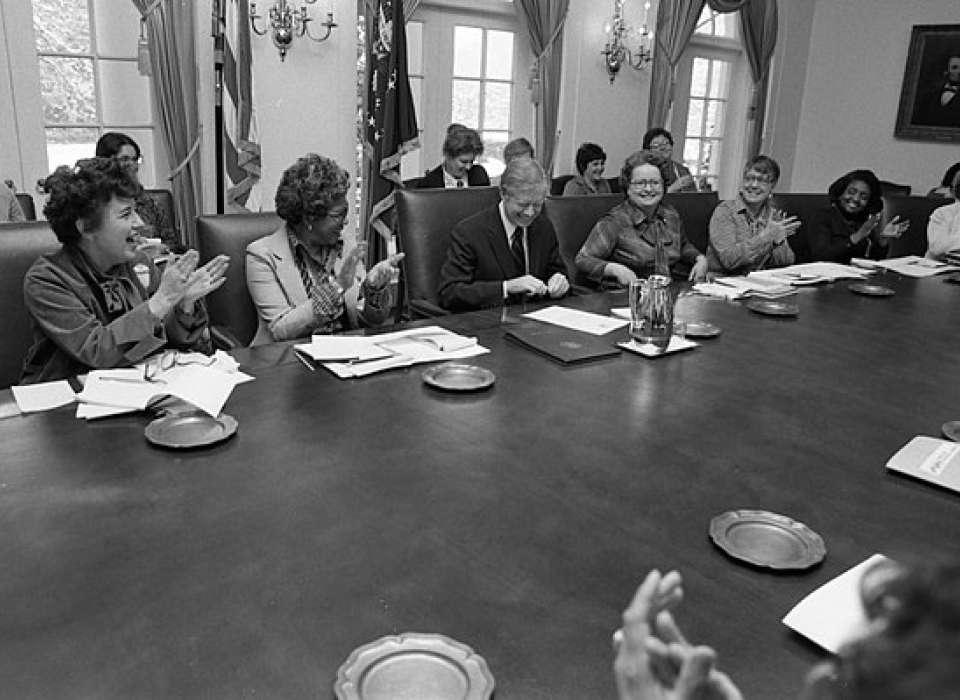
In 1978, a group of educators in Santa Rosa, Calif., organized a weeklong celebration to highlight women’s contributions to history, which had too often been overlooked. That effort quickly gained momentum. By 1980, President Jimmy Carter issued a proclamation declaring the first National Women’s History Week to be held between March 2-8, stating in his address to the nation:
“From the first settlers who came to our shores, from the first American Indian families who befriended them, men and women have worked together to build this nation. Too often the women were unsung and sometimes their contributions went unnoticed. But the achievements, leadership, courage, strength and love of the women who built America was as vital as that of the men whose names we know so well.
As Dr. Gerda Lerner has noted, “Women’s History is Women’s Right.”—It is an essential and indispensable heritage from which we can draw pride, comfort, courage and long-range vision.”
I ask my fellow Americans to recognize this heritage with appropriate activities during National Women’s History Week, March 2-8, 1980.
I urge libraries, schools and community organizations to focus their observances on the leaders who struggled for equality—Susan B. Anthony, Sojourner Truth, Lucy Stone, Lucretia Mott, Elizabeth Cady Stanton, Harriet Tubman and Alice Paul.
Understanding the true history of our country will help us to comprehend the need for full equality under the law for all our people.
This goal can be achieved by ratifying the 27th Amendment to the United States Constitution, which states that “Equality of Rights under the Law shall not be denied or abridged by the United States or by any state on account of sex.”
And within a few years, the movement had grown. In 1987, after continued advocacy led by the National Women’s History Alliance, Congress officially designated March as Women’s History Month; a recognition born from persistence, not permission.
That origin story matters because it reminds us that even the act of remembering women’s contributions had to be fought for. That visibility—something we now celebrate annually—was once something women had to demand.
For me, this month is both grounding and galvanizing. It connects us to the women who came before us, who challenged systems never designed for them, expanded what leadership could look like, and made it possible for more women to step forward today. At the same time, it reminds us that we are not at the end of that journey.
And, despite the progress made, in many ways, we are still in the middle of it. If history teaches us anything, it’s that progress does not move forward on its own. It requires intention, design, collective action and hope. And right now, supporting women in leadership, in public life, and in our communities, feels more important than ever.
That’s why we are continuing to invest in efforts like the Women’s Power Collaborative, and we invite you to be a part of it. The Collaborative is open to anyone who wants to accelerate women’s political power and support the structural changes needed for women to run, win, serve and lead. Because this work isn’t meant to happen in silos; it’s meant to be shared, expanded, designed and carried forward together.
So, this month, we hope that you’ll take a moment to honor Women’s History Month by reflecting on how far we’ve come. And perhaps, more importantly, we hope you will join us as we work to build what’s next.
Illinois Primaries Feature Big U.S. Senate Win for Juliana Stratton
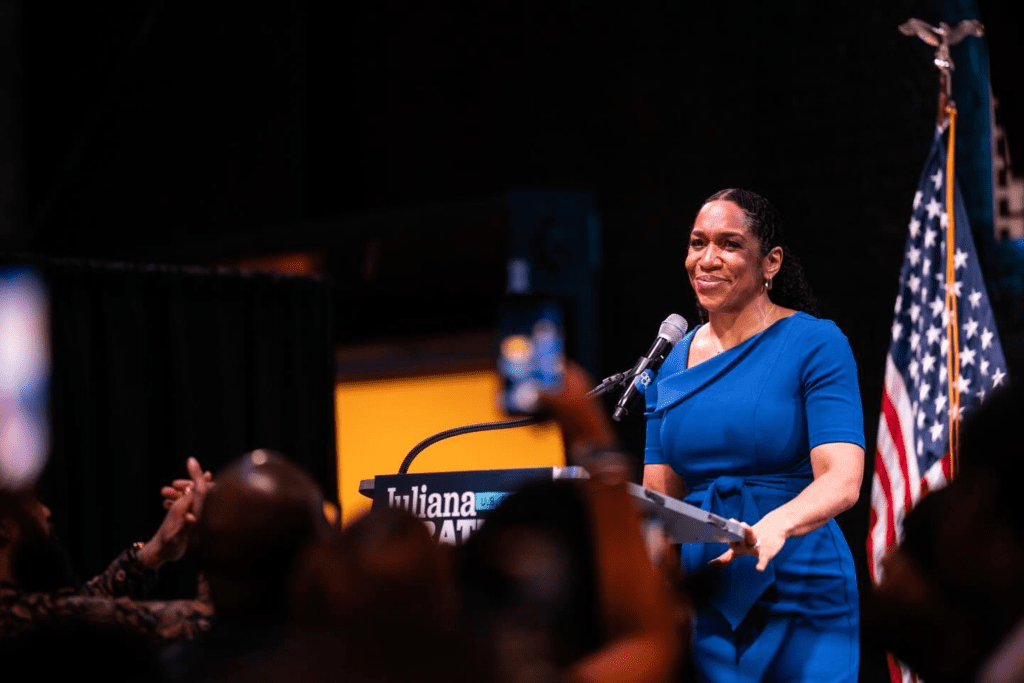
On March 17, Illinois held a number of consequential Democratic primaries for the open seats, where the winner will be heavily favored in November. Record amounts of outside money from interests representing the crypto and AI industries and pro-Israel policy poured in—more than $70 million in all. When the dust settled, there was one particularly big win for women. We’ll turn to The Center for American Politics for its write-up on the U.S. Senate primary.
“Lieutenant Governor Julianna Stratton (D) won the Democratic nomination for U.S. Senate in an open-seat contest currently rated as “Solid Democrat” by Cook Political Report. If she is successful in the general election, there would be a record three Black women serving in the U.S. Senate concurrently in the next Congress. She would also be the second Black woman to represent Illinois in the Senate.
With a Stratton win in November, Illinois would become the first state to send an all woman of color delegation to the U.S. Senate, joining Senator Tammy Duckworth, as well as the ninth state to have an all-woman delegation to the Senate. Eight states have been represented by two women senators simultaneously (AZ, CA, KS, ME, MN, NH, NV, WA), and four states currently have two women senators (MN, NH, NV, WA).”
CAWP, in its write-up, also summarized House primary results:
“Illinois is poised to increase its number of women in the U.S. House in 2027; women currently hold 6 of 17 (35.3%) seats in the Illinois delegation to the House. While 2 (2D) incumbent women representatives will leave office at the end of 2026, 3 (3D) non-incumbent women nominees and the remaining 4 (3D, 1R) incumbent women representatives are favored to win in November. Thirteen (8D, 5R) women are nominees for the U.S. House this year.
Among the non-incumbent women nominees currently favored to win in November is former U.S. Representative Melissa Bean (D), who represented Illinois in the U.S. House from 2005 to 2011. She is the nominee in Illinois’ 8th Congressional District.
Women nominees also currently favored in the general election are Cook County Commissioner Donna Miller (D) in the 2nd Congressional District and Patty Garcia (D) in the 4th Congressional District. Miller would be the fourth Black woman and Garcia would be the second Latina to represent Illinois in the U.S. House.”
Voters Agree: Illinois Primaries Showcase Case for Ranked-Choice Voting
_(2).jpg)
The crowded primaries and attempts to “game” the primaries ads lifting up potential spoilers drew much positive attention to ranked-choice voting in Illinois. FairVote and FairVote Illinois partnered on a poll that showed Illinois Democrats agree that it’s time for a change. From this week’s news release:
“FairVote and FairVote Illinois conducted a survey of 523 Illinois Democrats leading up to the state’s 2026 primary election. Two-thirds of Illinois Democrats support bringing ranked choice voting (RCV) to future Illinois elections. We chose to poll Illinois Democrats this month because of the party’s unusually crowded primary fields for an open U.S. Senate seat and four open U.S. House seats. 56 candidates ran for the Democratic nomination across these five primary elections, held on March 17.
- Question: Two states and dozens of cities use ranked-choice voting, including New York City, Minneapolis and Washington, D.C. With ranked choice voting, voters can rank the candidates in order of preference (first choice, second choice, and so on). If your first choice doesn’t have a chance to win, your vote counts for your backup choice. Would you support using ranked-choice voting in Illinois?
YES: 65 percent to 17 percent- Question: Three Illinois cities have voted to use ranked-choice voting but they can’t start using it without approval from the state. Would you support a state law that allows cities to use ranked-choice voting for local elections, like Mayor or City Council?
YES: 69 percent to 16 percent.”
Scranton’s “Scrappy Mayor” Paige Cognetti Featured in The New York Times

Scranton’s mayor Paige Cognetti, the presumptive Democratic nominee in a congressional race in Pennsylvania this year, has had a fascinating political career. Michelle Cottle featured her this week in The New York Times. Here are excerpts:
“Currently in her third term as the mayor of Scranton, Ms. Cognetti knows government corruption. She has, in fact, spent the past decade working various jobs to clean up her corner of Northeastern Pennsylvania, a region long known for public graft, grift and mismanagement.
Notably, some of her fiercest fights have been with her own party. She first ran for mayor as an independent in 2019, to replace a Democratic incumbent who had pleaded guilty to extortion, bribery and conspiracy. Pitching herself as a scourge of the local Democratic machine, she vowed to clean up City Hall. Her unofficial slogan became “Paige against the machine,” a play on the band Rage Against the Machine.
Cheesy but effective. Ms. Cognetti carried the crowded field to become Scranton’s first female mayor, then (mere weeks after giving birth to her first child) got to work overhauling how the city operated, in areas such as contractor hiring and data tracking. Voters were impressed. She cruised to re-election in 2021 and again last November on essentially the same reform platform—the one she is now counting on to take her to Congress.
“We’ve been running this same campaign from 2019 to date,” she said in a recent interview. “Make government work for the people. Public service is to serve others, not yourself.”
Republicans in the U.S. House have Undercut GOP Women’s Leadership
In the Solutions Summit, we heard from Jen Daulby of the Congressional Management Foundation on women’s leadership in Congress. She underscored the loss of women’s leadership roles under Speaker Mike Johnson. Below are two stories from last year that explain that loss of power—ones that I would argue Republicans should reverse and that Democrats would rectify if taking leadership after the 2026 elections.
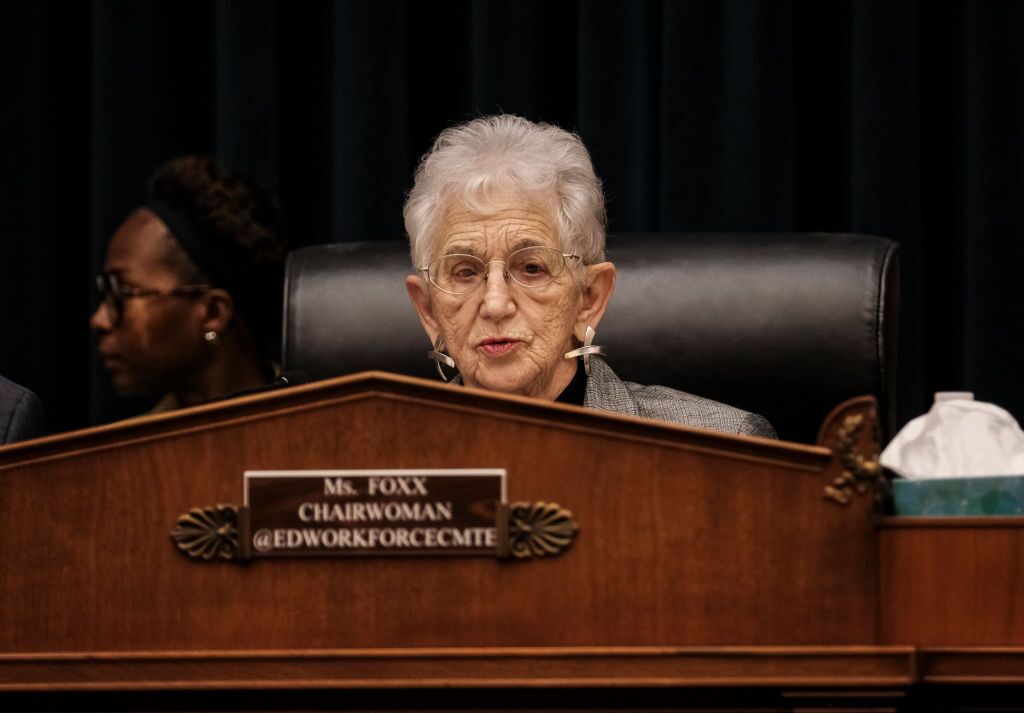
From January 2025, ABC News article “Virginia Foxx to be only woman leading House committees in 119th Congress”:
“North Carolina Rep. Virginia Foxx, 81, was tapped by House Speaker Mike Johnson to serve as the chairwoman of the powerful House Rules Committee, two GOP sources told ABC News, becoming the only woman to lead a House committee in the 119th Congress…The news follows the announcement of the chairs of the 17 standing committees, which will be dominated by white men, in December. No people of color were selected.”
From Febuary 2025 Government Affairs Institute article “Reversing Trends for Women Chairing House Committees”:
Last December, shortly before House Majority Leader Steve Scalise released the Republican Steering Committee’s recommendations for committee chairs in the incoming 119th Congress, former Republican representative from Virginia, Barbara Comstock, objected strongly to initial reporting that no women were being selected for these positions. Two days later when the majority leader’s office formally announced the names of the new chairs for 17 standing committees, the list did not include any women from the Republican conference.This was a notable and strikingly visual change from the previous Congress when three Republican women led House committees. It didn’t help that two of these lawmakers, Reps. Kay Granger (TX) and Cathy McMorris Rogers (WA), who chaired the prestigious Appropriations and Energy and Commerce Committees respectively in the 118th Congress, opted to retire. Perhaps cognizant of the optics and unfavorable public scrutiny, approximately two weeks into this new Congress House Speaker Mike Johnson used his discretion to name the chair of the key Committee on Rules, by selecting Rep. Virginia Foxx (NC) to take its gavel. Rep. Foxx is now the only woman in charge of a House committee.
What Are the Next Steps for Fired Cabinet Secretary Kristi Noem?
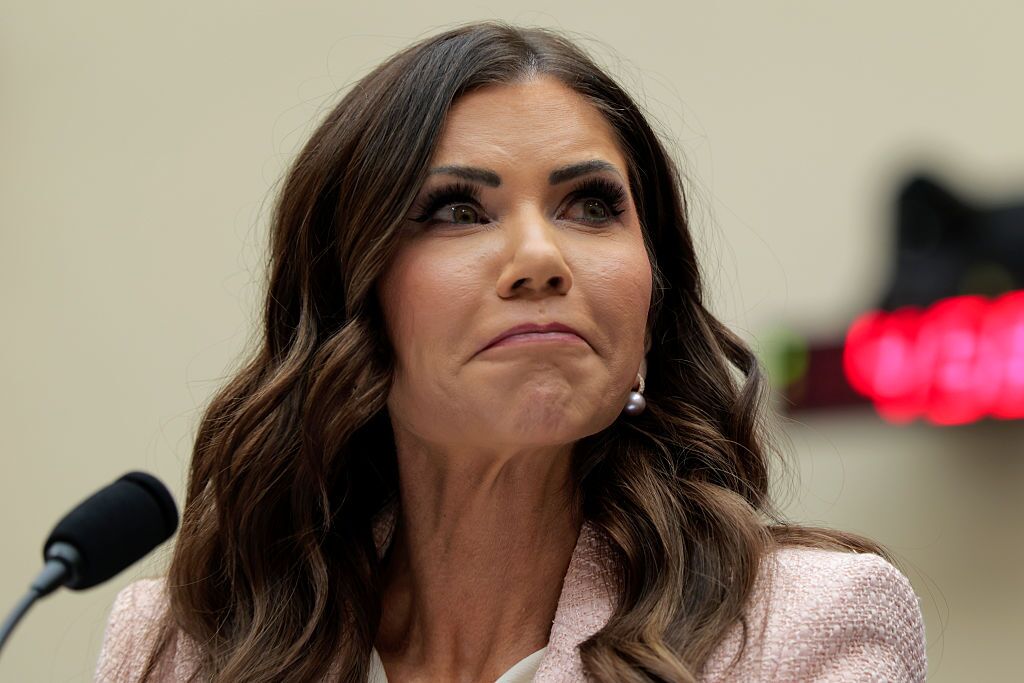
Michele Cottle in The New York Times examines another trend: the political reversals for leading Republican women who have embraced Donald Trump. Here are illuminating excerpts:
“Ms. Noem was hardly the most incompetent, embarrassing or dangerous member of Mr. Trump’s cabinet. The competition is too steep. No, I thought about how she owed her post to her laborious transformation into a particular kind of ultra-MAGA woman who kicks butt while always looking picture perfect—superfeminine and superaggressive—a role that comes with built-in challenges and limited room for error. The more furiously Ms. Noem contorted herself to fit this Trumpworld mold and catch the attention of the MAGA guys, the more she risked earning the contempt of the very people she wanted to impress, especially the president. Then, when she outlasted her usefulness, she was casually sloughed off…
Ms. Noem can take solace in knowing she is not the first ambitious woman who tried to remake herself in the MAGA image only to be misused and ultimately discarded. Elise Stefanik, a U.S. House member from New York, has traveled a similarly humiliating road. One of her party’s rising stars in the pre-Trump era, Ms. Stefanik followed the president down the dark MAGA path, visions of higher office dancing in her head. But time and again, she had her dreams sacrificed to Mr. Trump’s political needs—first her aborted nomination to the United Nations, then her aborted campaign for governor. She will leave the House at the end of this term with little to show for her self-debasement other than a reputation for shape shifting and sycophancy.
As Ms. Noem is finding out, it’s hard out there for a MAGA woman. You have to jump through trickier hoops than the men to get attention, but your efforts to please can work against you. The second your swaggering performance becomes a problem, the president kicks you to the curb. Just ask Marjorie Taylor Greene, who, after falling out with the president, fled the House and is now devoting herself to viciously critiquing his Iran policy. Maybe Ms. Noem should consider a similar route, using her newfound freedom to tell the public how she really feels about what she was asked to do and defend in Mr. Trump’s name. She might even claw back some of that self-worth she gave up along the way.”
A Sobering Global Snapshot: The IPU/U.N. Women Report on Women in Politics
The Inter-Parliamentary Union and U.N. Women released their annual Women in Politics report this week, and the findings represent more than a pause in progress, and in some areas, they represent a reversal. In a press release, they write:
“Across the world, women remain vastly under-represented in political leadership, with the most powerful decisions still overwhelmingly made by men. In 2026, only 28 countries are led by a woman Head of State or Government, while 101 countries have never had a woman leader.”
Women hold just 22.4 percent of cabinet minister positions globally, down from 23.3 percent in 2024. Parliamentary seats ticked up only 0.3 percentage points to 27.5 percent, the second consecutive year of the slowest growth since 2017. And for the first time in 21 years, the share of women serving as parliamentary Speakers declined, dropping nearly four percentage points to 19.9 percent. Meanwhile, 76 percent of women parliamentarians reported experiencing public intimidation, compared with 68 percent of men, a trend that actively deters women from running. Without structural electoral reforms, the data suggest, progress will continue to stall. In the press release, IPU President Tulia Ackson said:
“Parity is a moral imperative, because women have an equal right to shape the decisions that govern their lives. But it is also the smart thing to do. Institutions make better decisions when they reflect the societies they serve. They are better able to identify bias, design fairer responses, and earn public trust when women from all backgrounds are present, and influential, at every level.”
Groundbreaking Safety Legislation for Elected Officials Falls Short

Washington state Rep. Liz Berry has effectively championed a bill to protect elected officials, candidates and election workers from the rising tide of political violence, but her HB 2333 hit a wall in the state senate in this year’s short legislative session. Despite passing the House with bipartisan support, 71–21, in February, the bill will need to wait until next year.
The legislation would have prohibited the disclosure of residential addresses for state and local elected officials across property records, campaign finance filings, voter registrations and other public documents. It would also allow lawmakers to use campaign funds for security equipment and raise criminal penalties for harassing elected officials. Berry shared her own personal experience in making the case for the bill. In an interview, The Spokesman Review writes:
“Berry said she too has faced personal threats, which had required her to involve police and pay a commercial service to try and scrub personal information from the internet. She said she did not want to discuss details out of safety concerns.
Berry said she has heard the objections to her proposal from open-government advocates and others and is willing to discuss changes to her proposal. Even if the bill cannot prevent all harassment, she said removing addresses from easily findable public records would stop “random people Googling” lawmaker home addresses from “being drunk and coming to your house and doing crazy stuff.”
CAWP Release: “Mississippi Will Remain the Only State That Has Never Sent a Woman to the U.S. House”
Thanks to our friends at the Center for American Women and Politics for their rapid-fire analysis of the low-key primaries on Tuesday in Mississippi:
Primary elections were held on Tuesday in Mississippi. Full results for women candidates in federal races are available on this post on our Election Analysis page; there are no undecided races from yesterday’s primaries, so the full post is the final results for women congressional candidates in the 2026 Mississippi primaries.
Among the most notable results for women:
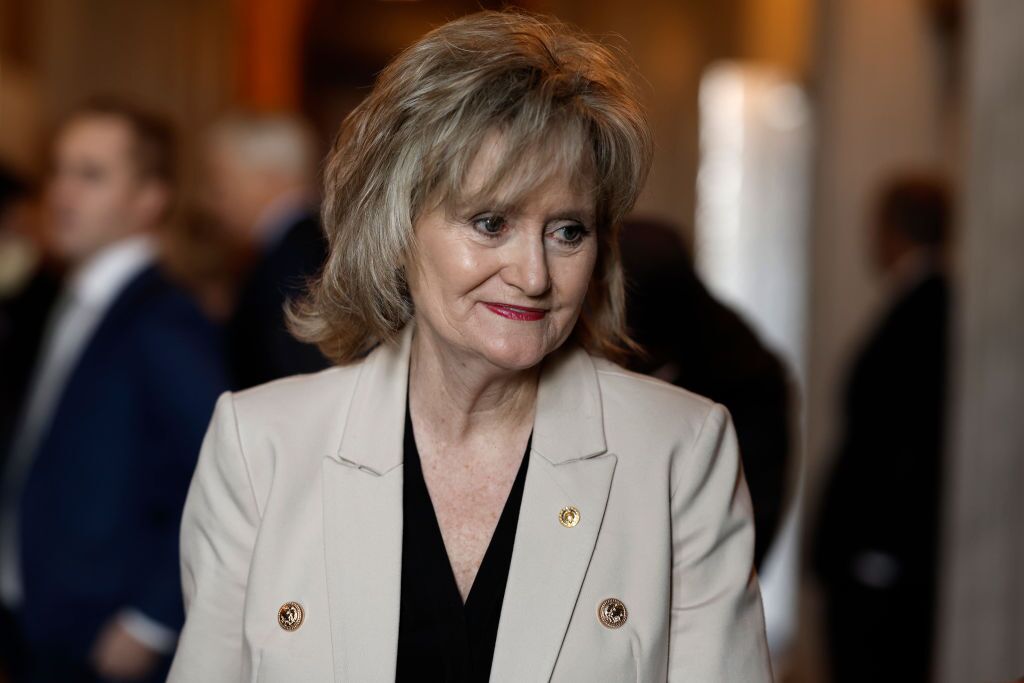
- Incumbent U.S. Senator Cindy Hyde-Smith (R) won the Republican nomination to run for re-election in November in a contest currently rated as “Solid Republican” by the Cook Political Report. First appointed in 2018, she is the only woman who has ever represented Mississippi in Congress.
- No women filed as candidates for U.S. House seats in Mississippi in 2026, ensuring that Mississippi will continue to be the only state that has never sent a woman to the U.S. House.
New Hampshire Special Election Winner Bobbi Boudman
Coverage of a special election for a woman in the New Hampshire state legislature from The Guardian:
A Democrat won a special election for a state house seat in New Hampshire on Tuesday, flipping a Republican district that Donald Trump carried and marking the latest in a string of 28 Democratic upsets that could usher in a blue wave in the midterms
Bobbi Boudman beat Republican Dale Fincher in New Hampshire’s Carroll county district 7. It was Boudman’s third try at the seat—she lost to incumbent representative Glenn Cordelli in the last two cycles by several points. Cordelli resigned from the seat after moving, leading to the special election on 10 March.
Unofficial results show Boudman winning with about 52 percent of the vote among the more than 4,000 voters who turned out. Marissa Hebert, a spokesperson for the New Hampshire Democratic party, noted on X the swing Boudman made in the district: she lost in 2024 by more than 13 points.
CAWP on Prospects for Women in the U.S. Senate in 2026

Kelly Ditmar with the Center for American Women and Politics (CAWP) provides a detailed rundown of the prospects for women in U.S. Senate races, including women candidates having chances to become new Senators in at least eight states. Below is an excerpt from the article’s start and its end.
There are 35 U.S. Senate elections in 2026, including 33 regularly-scheduled and two special election contests. While we begin the cycle with a net deficit of women senators due to departures, there are possible pick-ups that could yield stasis or even a slight increase in women’s representation in 2027. If non-incumbent women are unsuccessful in their Senate bids, however, the number of women in the U.S. Senate could drop as a result of the 2026 election…
As the 2026 cycle continues, CAWP will track how women fare in U.S. Senate elections as part of Election Watch 2026.
Sobering Inter-Parliamentary Union Report on Women Internationally
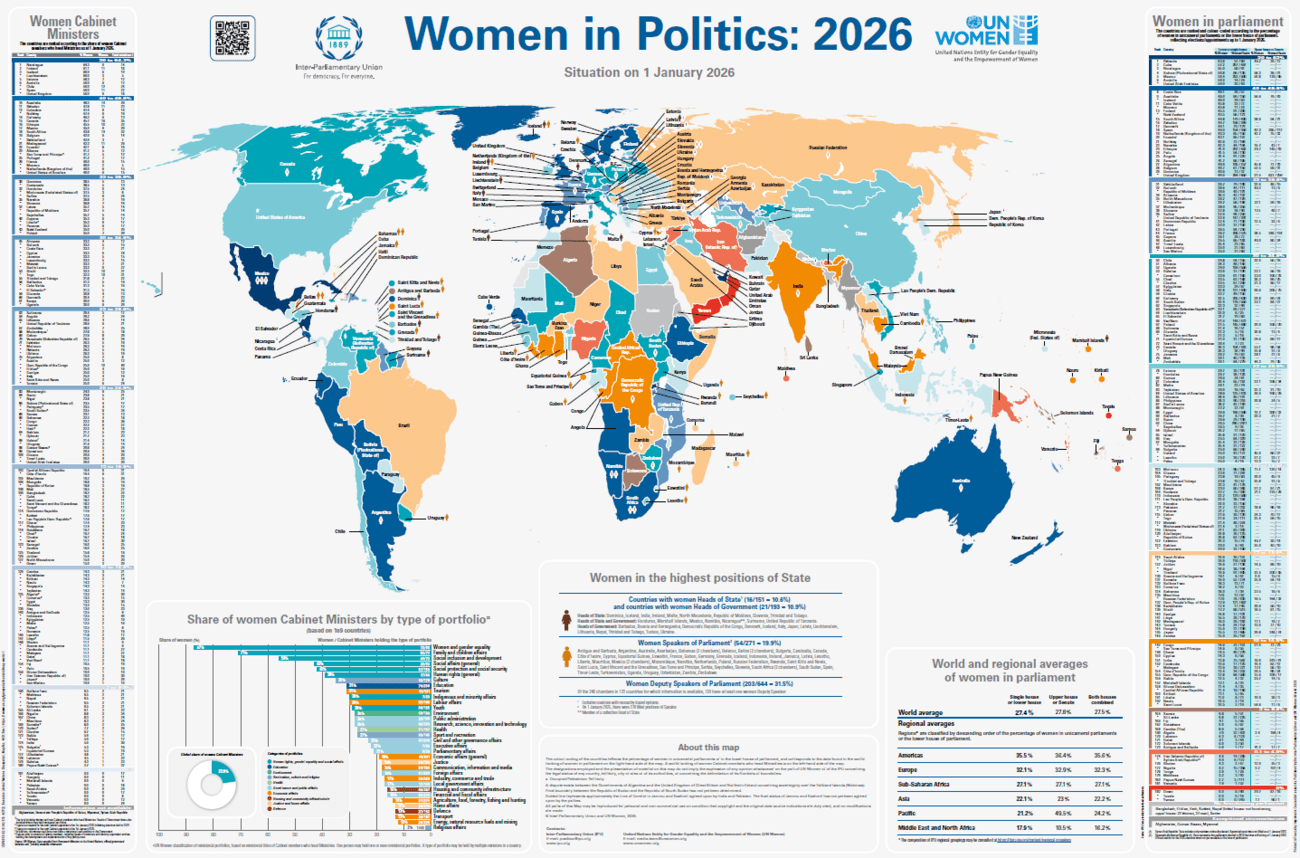
The Inter-Parliamentary Union this week released a sobering report based on U.N. Women data that “shows women remain far from having equal political power, holding just 22.4 percent of cabinet posts and 27.5 percent of parliamentary seats worldwide.” Here is from the release:
“Across the world, women remain vastly under-represented in political leadership, with the most powerful decisions still overwhelmingly made by men. In 2026, only 28 countries are led by a woman Head of State or Government, while 101 countries have never had a woman leader, according to the latest data released by the IPU and UN Women.
When women are shut out of political leadership, decisions shaping peace, security, and economic priorities are made without half the world’s experience at the table. The new global data reveal stagnation and, in some cases, regression in women’s political leadership, particularly in executive government.
Key findings from the data released by IPU and UN Women include:
- Women hold just 22.4 percent of cabinet minister positions globally, down from 23.3 percent in 2024, marking a reversal after years of gradual progress.
- 14 countries have achieved gender parity in cabinet, demonstrating that equal representation is possible, yet eight countries still have no women ministers at all.
- Women hold 27.5 percent of parliamentary seats worldwide, up slightly from 27.2 percent in 2025. The increase of just 0.3 percentage points marks the second consecutive year of the slowest growth recorded since 2017, highlighting how slowly women are advancing in political decision-making.
- Women are also losing ground in parliamentary leadership. As of January 2026, 54 women serve as Speakers of Parliament globally, representing 19.9 percent of all Speakers. This represents a nearly four-percentage-point decline from the previous year and the first drop in women Speakers in 21 years.
- Women in politics face rising hostility and intimidation from the public, both online and offline. 76 percent of women parliamentarians surveyed reported experiencing intimidation by the public, compared with 68 percent of men, a trend that deters women from seeking office and is slowing progress toward equal political power.
- Even when women reach leadership positions, they are often concentrated in a narrow range of portfolios traditionally linked to social sectors.”
Growing Gap between Young Women and Men on Equality
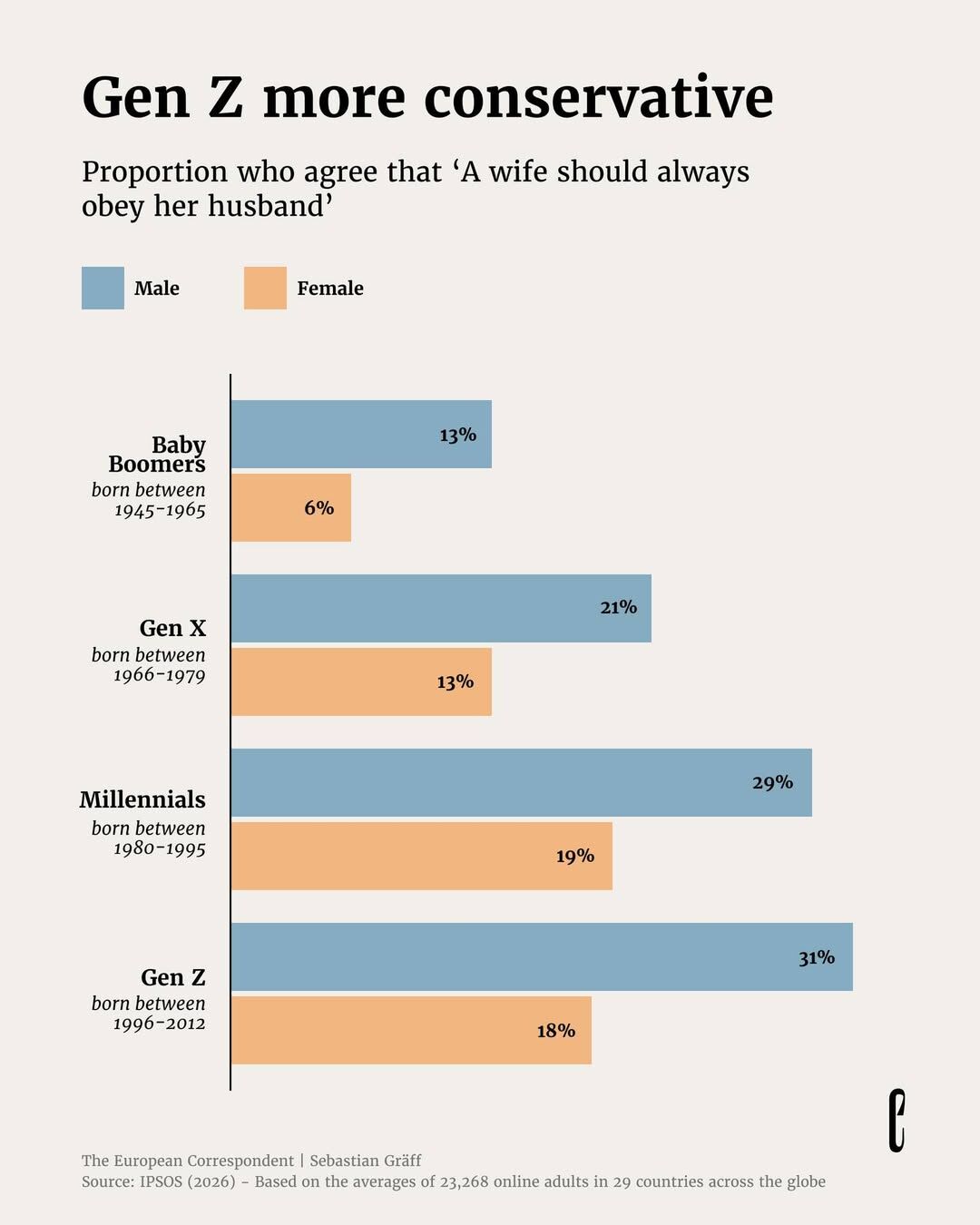
Younger people around the world, in general, are less committed to equality than older people, with gaps between young men and women particularly striking. The Guardian editorial addresses the challenge for us in an editorial with this excerpt:
Last week, results from a global survey signalled a rise in worrying attitudes towards women among young men. A team from the pollsters Ipsos and King’s College London found that nearly a third (31 percent) of gen Z men believe that a woman should always obey her husband, a fifth (21 percent) believe that she should never initiate sex, and 33 percent believe that women should let their husbands have the final word on important decisions…Social media also plays a destructive role, offering the scapegoat of women’s rights rather than real solutions. The “manosphere” offers little beyond bigotry dressed up as self-respect and get-rich-quick fantasies that prey on male anxiety. You don’t have to look far to see the effect. When asked by Ipsos/King’s College, “When it comes to giving women equal rights with men, things have gone far enough in my country”, in the UK almost half of men agreed—just below the 29-country average..
Researchers argue these attitudes will not shift until the reality does: more jobs, higher wages and better living standards for young people. Yet prosperity alone does not erase misogyny. A cultural shift is also needed—one that can’t happen without young men first taking accountability for their attitudes towards women. They also need compassion – to be told that they do not need to wear the faulty armour of machismo; and that wealth does not define them. Above all, it is rising inequality that blocks their path to a good life—not women.
A July 2024 Guardian story on political trends in the United States, based on Gallup polls, was telling about evolving gaps in the United States.
Ranked-Choice Voting Used for Student Elections at Over 100 Colleges and Universities

I’m always impressed with the number and diversity of American colleges and universities electing their student leaders with ranked choice voting—well above 100 schools and rising every year, with recent adoptions in the past month, including the University of Tulsa, the University of Maryland, and the University of Utah. Here is coverage in the Rice Thresher of Chelsea Asibbey’s win with RCV this week:
In one of the most crowded races in the Rice Student Association’s history, Chelsea Asibbey has been elected RSA president for the 2026-27 school year. After five rounds of ranked choice voting, she received 50.6 percent of the vote. Asibbey beat second-place candidate Jenny Karsner by only 19 votes in an instant runoff.
A Baker College junior and current director of communications for the RSA, Asibbey ran on a platform focused on “action, affordability and accessibility.” ..With five candidates and numerous write-ins, the Election Committee used the instant runoff voting method. The candidate with the fewest votes is eliminated, and their votes are redistributed to the remaining candidates according to the next-ranked preference on each ballot. This process continues until a candidate holds a majority of the votes. ..The election also saw an increase from last year’s turnout. 1,713 students voted in a turnout of 35.8 percent compared to last year’s 29.02 percent.
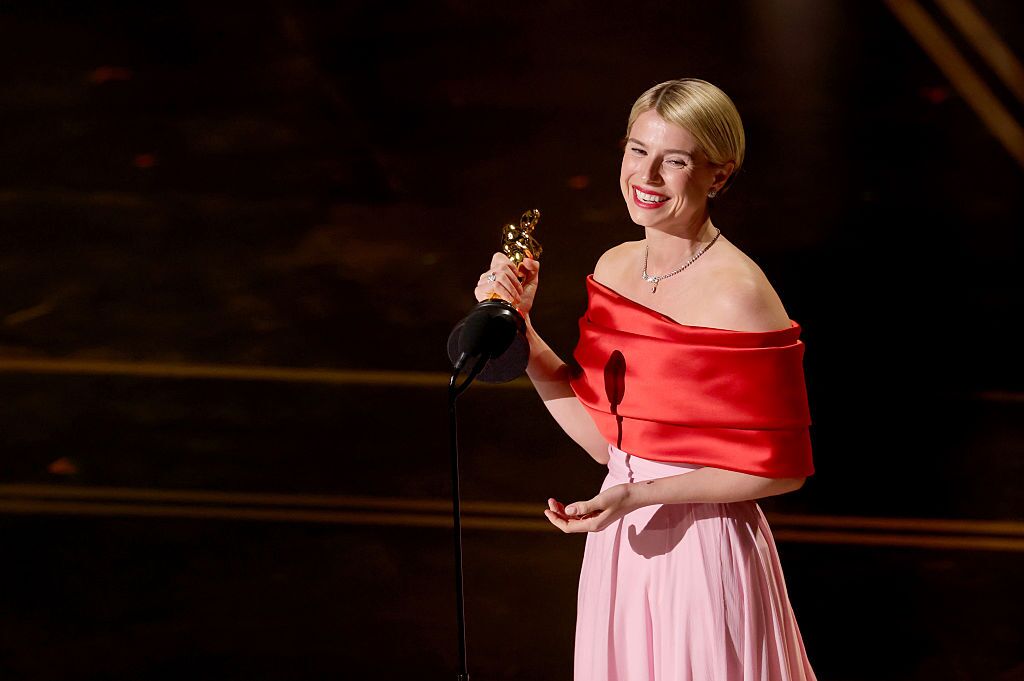
I enjoy watching the Oscar Award ceremony every year, because the Academy of Motion Picture Arts and Sciences uses three of my favorite things:
gender categories to ensure women are nominated and win acting awards
ranked-choice voting for nominations,
Proportional ranked-choice voting for Best Picture
These policies work in tandem to build women’s political power as well. I would argue that these policies are the most effective strategies to achieve gender balance in government in our lifetimes.
