
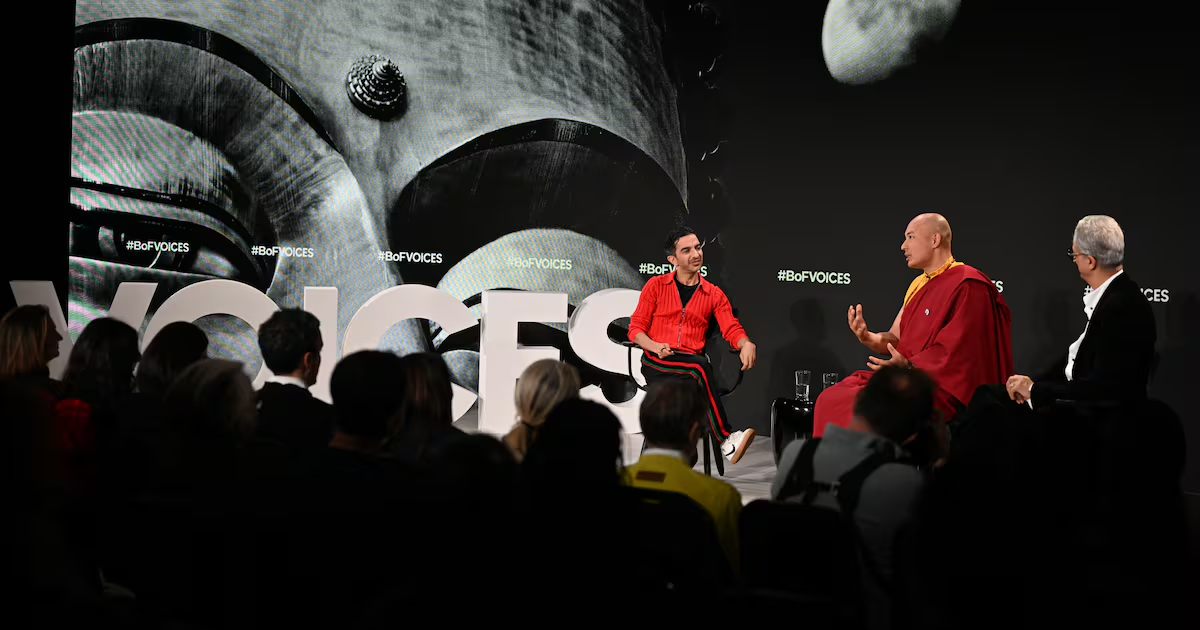


OXFORDSHIRE, United Kingdom — To kick off the third and final day of VOICES 2025, BoF’s annual gathering of big thinkers, a number of creatives across industries, from chefs to a stuntwoman to an Academy Award-nominated director, looked at how their respective industries play a role in fostering connection, as well as their sectors’ overlaps with fashion.
“Call Me By Your Name” director Luca Guadagnino gave a peek into his world-building process and discussed how fashion plays a role, while the South African DJ Black Coffee spoke about how his heritage shapes his work today.
Donatien Grau, the head of contemporary programs at the Musée du Louvre in Paris and the artist Alvaro Barrington, meanwhile, separately discussed what fashion can learn from art — and vice versa — from how to evolve heritage to the pressure to embrace mediocrity.
Ayesha Hussain spoke about how she overcame self-doubt to become the first stuntwoman of South Asian heritage working in Europe, while Academy Award-winning documentarian Kartiki Gonsalves issued a powerful reminder of the importance of connection, to both each other and the world around us.
Closing out the insights-packed session was a discussion with His Eminence Kalu Rinpoche and photographer Max Vadukul about their creative collaboration, what they learned from one another and more.
The Power of Connection
Thanks to technological innovation, it may seem that we are more linked than ever — but as surveys show self-reported loneliness growing in tandem, it’s clear that connections in a digital world only go so deep. Kartiki Gonsalves, the director of the Academy Award-winning documentary “The Elephant Whisperers,” said that the danger of this lack of connection is that it will extend not only to how we treat others, but how we treat the world.
“When we do not consider ourselves part of the living world, we lose the instinct to care for it,” she said. “We protect what we are connected to.”
To reconnect with one another — and the world around us — Gonsalves recommends looking to nature and the simple yet meaningful connections that can come with animals. As well, taking a cue from indigenous communities, whose traditions have always remained rooted in a respect for the world around us. In fashion, that means marrying apparel with initiatives that support something bigger — animal populations, for instance, or empowering local communities.
“Connection is the language of survival,” she said. “It allows us to live alongside nature, and not above it.”
What Fashion Can Learn From Museums
In a world of near-perfect dupes, what gives a fashion item value? What makes it special? To answer that question, Donatien Grau, the head of contemporary programs at the Musée d’Orsay in Paris, shared lessons from the art world that can apply to fashion.
Humans are the ones who decide where heritage begins, Grau said. It’s not just the object itself — whether it’s a painting or a handbag — but the meaning behind it. As he said, “We don’t think of Raphael or Leonardo as ashes somewhere in Tuscany, we think of them as real beings. And that is the power of presence.”
To that point, legacy is constantly being reinterpreted as new audiences experience and take in art. That means having comfortable spaces to experience it, where viewers can take it in with a space for personal reflection. That reinvention of heritage continues to add more meaning, which is then passed on to the next generation — as long as it’s done with care.
“The making of history is something we do every day,” he said. “But when we do it, we need precision, we need scholarship, we need intent, we need thought and we need respect.”
Art and Fashion’s Overlap
Art and fashion are strange bedfellows, said BoF contributor and former global director of Art Basel Marc Spiegler, but two that are increasingly intertwined. Spiegler sat down with Venezuelan-born, London-based artist Alvaro Barrington to discuss that intersection, what the two have in common, and how their respective industries separate them.
Whether they’re a painter, a designer or a rapper, artists across mediums face similar pressures — to constantly produce new work, to evolve their creativity and find ways to move and change people. As Barrington said, it’s not an easy task.
“To come up with one idea that people find really meaningful is impossible,” said Barrington.
Even when an artist then goes on to achieve the impossible, there can be downsides. Barrington said that his own success was met with mixed responses from those around him, and he faced an expectation of mediocrity to make other people feel more comfortable. Fighting that has become a driving force in his life.
“I want everything I feel to be real, and I refuse to let anyone take that away from me,” he said.
Finding Your Purpose — and Changing Perceptions
Ayesha Hussain admits that for the first three decades of her life, she was decidedly “unathletic.” Cut to five years later, and she’s a professional stuntwoman — the first South Asian and MENA (Middle East and North African) woman to do so in Europe — who has appeared in blockbuster films like “Gladiator 2” and “Deadpool & Wolverine.”
“I had no business being in the business that I’m in,” she said. “I never saw anyone like me, a queer brown woman, in sport, on TV, in fashion and on screen.”
Why did it take her so long to discover this side of herself? For one, young girls are six times more likely to drop out of sports than boys — they’re not encouraged to be strong, as men are, but to be slim. Those challenges are even more pronounced for minority women. Hussain said that as a child of immigrant parents, she grew up feeling a constant desire to fit in. It’s with the memory of those feelings in mind that fuel her mission both on-screen and off, advocating for female visibility in sports and in action films. It starts, she said, with changing minds and expectations.
What Food and Fashion Share
Food has increasingly taken on a similar role as fashion in our lives. As chef Pierce Abernathy said, “For so long, people judge you by what you wear. Now, they judge you by what reservation you can get.”
But for most people, the origins of both the food on our plates and the clothes in our closets are unknown. It points to a shared lack of understanding around how these fundamental elements of our lives make their way to us, both in terms of their physical journey but also their cultural roots.
Abernathy spoke about his own journey to widen his knowledge of food, from cooking with vegetables he was less familiar with to creating new recipes for his audience on social media. Indonesian chef Rahel Stephanie, too, has used food as a way to not only explore her own culture, but expose it to others in a way that informs them without watering it down for a Western audience.
“It’s always about ensuring that credit is given to the cultural and historical context,” said Stephanie. “That is the least you can give, especially when taking from a marginalised culture.” The same lessons, in many ways, can be applied to fashion.
The Conscientious Auteur
From a family retreat in the Italian countryside to a road trip across the American Midwest in the 1980s, director Luca Guadagnino is a master of world-building. He also knows how to use fashion as a tool in his films, partnering with designers, including Jonathan Anderson, on the costumes for his film “Challengers.”
In conversation with BoF editor-at-large Tim Blanks, Guadagnino said that his inspiration is both internal and external. The script is the starting point, but it has to conjure something new in him, too. “Sometimes, they offer you a book, a script, and that is very intuitive,” he said. “But at the same time … I have to feel something that I have not really formalised in my imagination properly.”
For Guadagnino, filmmaking is about tackling subjects that he’s unfamiliar with, and introducing something new to audiences, too. It’s for that reason that Guadagnino is not afraid to tackle challenging subjects in his films, from the life of OpenAI founder Sam Altman in the upcoming film “Artificial” to cannibalism in “Bones and All.” (One subject he has no interest in tackling, he said, is convicted sex offender Jeffrey Epstein.)
Growing up, he saw movie theatres as a “cathedral,” a window to a world outside his own. Even in today’s altered media landscape, he believes that’s still possible.
“I still believe there will be a legacy for a movie, if it finds its way,” he said. “If a movie can find its way to a new person, a new audience, that’s always good.”
Bringing Africa to The World Through Music
South African DJ Black Coffee said he’s one of the African continent’s “few exports,” to the rest of the world. Sometimes, that’s led to being overlooked — in conversation with BoF founder Imran Amed, he remembered a time he won an award, but wasn’t invited to sit at the awards show itself.
“We are not given opportunities on the same level as the world players,” he said.
He’s experienced that inequity his entire life. Growing up under apartheid introduced him to institutionalised racism at a young age. The same night Nelson Mandela was released from prison in 1990, Black Coffee, then 13, was in a car crash that led to his left arm being paralysed. But just as his own country was going through a rebirth, so did he: That injury prompted him to sign up for music classes, which ultimately led to his career as a DJ.
Today, he makes a point to bring more African DJs to his residencies in destinations like Ibiza. His motivation, he said, is “not just because I’m from Africa, but because I know how much we like opportunity and how much we are ready for a global platform.”
Ancient Wisdom in Contemporary Life
At just two years old, His Eminence Kalu Rinpoche was identified as a reincarnation of the lama by the Dalai Lama himself. It was a distinction that forever altered the course of his life. He began his monastic training at age seven, which included three years and nine months of solitary silence. While it brought challenges, it also sharpened his sense of purpose.
“When your mind has nowhere to turn … then the teachings of the Buddha become meaningful,” he said. “That has been quite a blessing.”
More recently, Rinpoche collaborated with photographer Max Vadukul on “The Buddha Relic Project,” a series of photographs depicting their travels across Rinpoche’s home nation of Bhutan with a Buddhist relic. Seeing the devotion that both Rinpoche and the relic inspired, as well as the time getting to know Rinpoche, changed Vadukul’s perspective.
“I just learned to let go,” Vadukul said. “Whatever doesn’t fit in my little head doesn’t need to be there — relationships, grudges, whatever it is.”
BoF VOICES 2025 is made possible in part by our partners McKinsey & Company, Amazon Fashion, Pixel Moda, Value Retail, Certilogo, Swap Commerce, Soho House, Wheely and Getty Images.
