
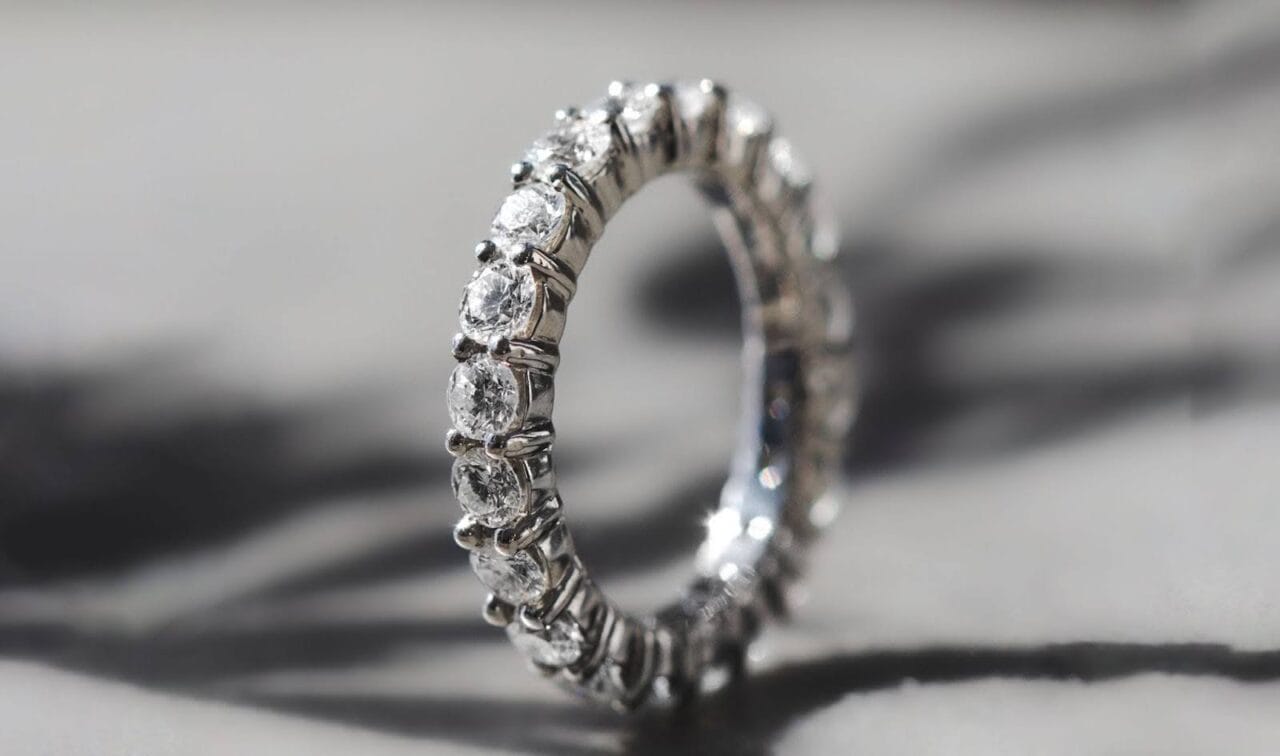

What is an Eternity Ring?
An eternity ring is a band with a continuous line of gemstones all the way, or almost all the way, around the finger. This symbolizes unbroken commitment and continuity.
They are often given as anniversary gifts, gifts after childbirth, or can be stacked with a wedding set to mark significant milestones. For those looking to explore options, the largest diamond and jewelry forum can provide valuable insights.

What are the practical style choices you’ll face?
Design choices can be grouped into two main types: full eternity, where stones run around the entire band, and half eternity, where stones cover only part of the band. The settings can also differ, including prong, shared-prong, channel, and micro-pave, and each type affects sparkle, security, and comfort.
For larger stones, prongs show off more of each gem, but make edges more prone to wear. On the other hand, channel settings hide girdles and give better protection for the stones, but they show less individual brilliance. In the end, the style you choose should depend on things like how often the ring will be worn, if it will be stacked with other rings, and whether it might need resizing later.
How should you compare quality and price?
When shoppers evaluate eternity rings, they quickly discover that total carat weight tells only part of the story. A one-carat total made from many small melee stones looks and costs differently from a ring with fewer, larger diamonds.
Cut and consistency are more important with melee, as slight differences add up across a full band. While color and clarity trade-offs can be reasonable when dealing with tiny stones, the type of setting and grade of metal affect long-term value and maintenance costs just as much as the gem specifications.
Why do sizing and durability affect your purchase?
Resizing full eternity rings is often impossible without breaking the stone run. This leads to a durability-versus-service trade-off. Full rings provide smooth limit-size flexibility but can make regular maintenance more difficult, while partial rings offer greater size flexibility but can make regular maintenance harder.
On the other hand, half eternity rings solve this problem. They allow resizing while maintaining the same visual effect at the top. Think of it like choosing between a locked instrument and one with removable parts: the locked version looks perfect, but it limits future options.

What are the challenges of researching vendors?
Most shoppers research across many vendor listings because it feels thorough and familiar. The hidden cost is that prices and descriptions differ so much that the effort becomes noise instead of clarity. Buyers waste time comparing apples to oranges, miss out on realistic per-carat benchmarks, and either overpay or doubt a practical choice. Platforms like PriceScope change that by centralizing searchable listings, price charts, and community feedback. This way, buyers can compare the same types of settings and total carat weights side by side. They can get focused second opinions that shorten decision time and reduce costly mistakes.
How should you care for an eternity ring once you own it?
Routine checks and occasional tightening are important, especially for shared-prong and prong settings where small impacts can loosen several stones. Full bands usually gather dirt where the stones meet the metal. While ultrasonic cleaning is helpful, getting a professional inspection once a year is crucial to keep both the sparkle and value intact. If you are doing heavy work, it’s a good idea to take off the ring or choose a more protective setting.
A well-cared-for eternity ring can become a handed-down heirloom, but neglect can speed up small, avoidable losses.
What deeper meaning can you find in an eternity ring?
Consider the ring not just as jewelry, but as a string of tiny commitments. Each stone represents a promise that can still be protected, changed, and measured against practical needs. This balance is where the purchase becomes fascinating.
What differentiates an eternity ring from other types?
This clarity feels complete until one realizes what truly separates an eternity ring from other types of rings.
Further Insights
What Makes Eternity Rings Different From Other Rings?
Eternity rings offer a unique set of choices compared to most other bands because. They focus on a continuous line of matching stones. This focus affects important things like cost, repair options, and how well the ring holds up over time, which buyers need to think about carefully.
An eternity ring should be evaluated based on the seller’s promise about matching and service, not just by headline carat weight or shine. Engaging in discussions at the largest diamond and jewelry forum can help buyers gain insights on these aspects.
How does the number and size of stones change value and risk?
When many small stones are used, the buying math changes. The average carat weight for eternity rings is around 1.5 carats, meaning that buyers get many small melee diamonds instead of just one big center stone.
Because of this, per-stone consistency, setting security, and vendor replacement policies become much more important than single-stone certificates.
These melee stones can be compared to pixels on a screen; tiny differences in cut or color blend into a different overall look. Also, replacing one small pixel is more complicated than just changing out a centerpiece.
What manufacturing stresses get hidden behind the photos?
Because Eternity rings typically feature a continuous line of identically cut gemstones, usually diamonds, that encircle the entire band, jewelers have to work with exact measurements. This precision brings up two problems that buyers often don’t notice at first.
The first issue is that repairs can be complex, and the second is finding replacement stones. If you try to match a slightly different stone later on, it can make the ring look mismatched. Also, tight measurements can lead to more labor time when stones need to be reset, resulting in unexpected bills from the shop after the sale.
What practical service questions should you ask before you buy?
Most shoppers stop at the photos and the price. While that is understandable, the hidden costs often show up when a stone becomes loose.
Before you decide, ask for three things: a documented vendor policy for replacing lost stones, a clear written schedule for inspections and tightening, and actual turnaround times for repairs, along with cost estimates. This pattern applies in both custom and retail situations.
For example, full eternity rings need careful handling because of possible wear on the underside stones and challenges with resizing due to the continuous setting. So, make sure to check whether the vendor offers a matching melee, whether it offers a lifetime refit plan, and whether there are any time limits or fees associated with that plan.
How do lifestyle and usage change the proper setting choice?
If you work with your hands, expect shared prongs and exposed girdles to need more attention. This is the failure mode customers refer to when a single bump causes multiple loose stones.
If you want maximum daily sparkle and can handle going to the shop sometimes, prongs give the brightest shine. For those who wish to lower-maintenance options, channel or bezel styles can hide edges and reduce the risk of snagging, but these styles also tend to mute individual fire in the stones.
Key points to think about include trade-offs based on patterns. Choose what fits your lifestyle, not just the perfect look shown in the listing.
How can you compare listings effectively?
Most buyers compare listings across stores because it feels thorough. But that familiar approach breaks down when service and replacement policies differ. As more vendors appear, you get apples-to-oranges comparisons, hidden terms, and unexpected repair costs. Platforms like PriceScope centralize listings, show vendor warranty details, and display community reports on repair outcomes. This helps reduce those surprises and lets you compare realistic lifetime costs instead of just sticker prices. Our largest diamond and jewelry forum provides you with insights that can further enhance your comparison process.
What simple checklist can you use right now?
- Request close-up macro photos of the setting from several angles, not just top-down.
- Confirm the vendor’s process for sourcing a matching melee if a replacement is needed.
- Ask for documented inspection intervals and estimate servicing costs over five years.
- Compare service terms across vendors, not just the initial price, to see the actual value.

What personal question about eternity rings remains?
One question remains, and it is personal in a way that price and photos cannot answer.
Full vs. Half Eternity Rings
Whole and half eternity rings are best understood by their long-term tradeoffs, not just how they look. Full bands give you uninterrupted sparkle and have a stronger symbolic meaning. On the other hand, half bands give up some of that continuity for benefits such as easier sizing, more straightforward repairs, and lower ongoing risk. Your choice should depend on how you plan to wear the ring, how much maintenance you are willing to handle, and how comfortable you feel with potential resale and insurance issues.
How will this choice change insurance and resale outcomes?
When someone insures or later sells an eternity ring, insurers and buyers treat many small stones differently from a single prominent gem. Continuous stone runs increase the chance of a multi-stone repair after a single incident. This raises claim problems and can lead to higher renewal quotes. Additionally, resale markets prefer pieces that can be serviced easily and resized without visible patchwork. For example, think of a full band like a finely tiled floor; it looks nice when intact, but becomes awkward when one tile needs to be replaced and can’t match the existing ones.
