

You may have heard of Sofía Bassi as many different things: the first Mexican surrealist, the sister of the inventor of the tortilla maker, a master of the unconscious, the imprisoned self-taught painter, the prison activist, the subject of Kati Horna’s photographs, the lady always in white. Outsider knowledge of a public figure makes us selective, mythologies build around the few facts we have in order to cement the person’s aura in collective memory. Sofía Bassi’s legacy is peppered with anecdotes and moments, reinvention, memory work and rebirth.

by Kati Horna (1967).
Image courtesy of Fundación Sofía Bassi.

(The Awakening of a Woman), 1966.
Sofía Bassi.
Courtesy of Fundación Sofía Bassi.
The connection established between the artist and her audience was felt: her dreamlike alchemy, as she called it, touched deep into the soul of whoever saw her work, communicating secrets and messages from another dimension.
The work of the Fundación Sofía Bassi in Mexico City, spearheaded by her daughter-in-law Tere Touyet, brings all facets, dark and light, of Bassi’s life back to the forefront of art history. It is a terribly important effort to channel powerful winds as they continue to bluster. Through these special efforts, we remember that the shadows in her life were eclipsed, always, by the bright light within her. Portales a Otros Mundos, the book written, published and distributed by the Fundación, opens with a touching personal message from Tere Touyet to Bassi herself. “Quid pro quo is a Latin expression that literally means ‘something in exchange for something.’ And this posthumous tribute is ‘that something’ that I want to give you in return for everything that you gave me during your life. Thank you very much my dear Sofía.” To discontinue the memory of Sofía Bassi, to stop remembering the sensitivity within each of her worlds would be to forget a force of her time who fought for her community, who never extinguished her inner fire and who continues, decades later, to mystify and do very, very good things to the eye and mind.

Sofía Bassi.
Courtesy of Fundación Sofía Bassi.
Bassi’s Initial Exhibitions
Her place in the arts started on her own terms. Though encouraged by her husband, Franco Bassi, the results of the first time she picked up a paintbrush were awe-inspiring renditions of her experience of the beautiful and innocent scenes of magic within her. Reference to fairies and forest mythologies, paintings of nature and trees in all their welcoming states, depictions of woodland blessings and the softest scenes of instinctive alliance. The art world and public immediately responded with graceful enthusiasm: she had started painting in 1963 and had her first solo exhibition in 1965. “The connection established between the artist and her audience was felt: her dreamlike alchemy, as she called it, touched deep into the soul of whoever saw her work, communicating secrets and messages from another dimension, inviting them to visit other planes, other worlds.”
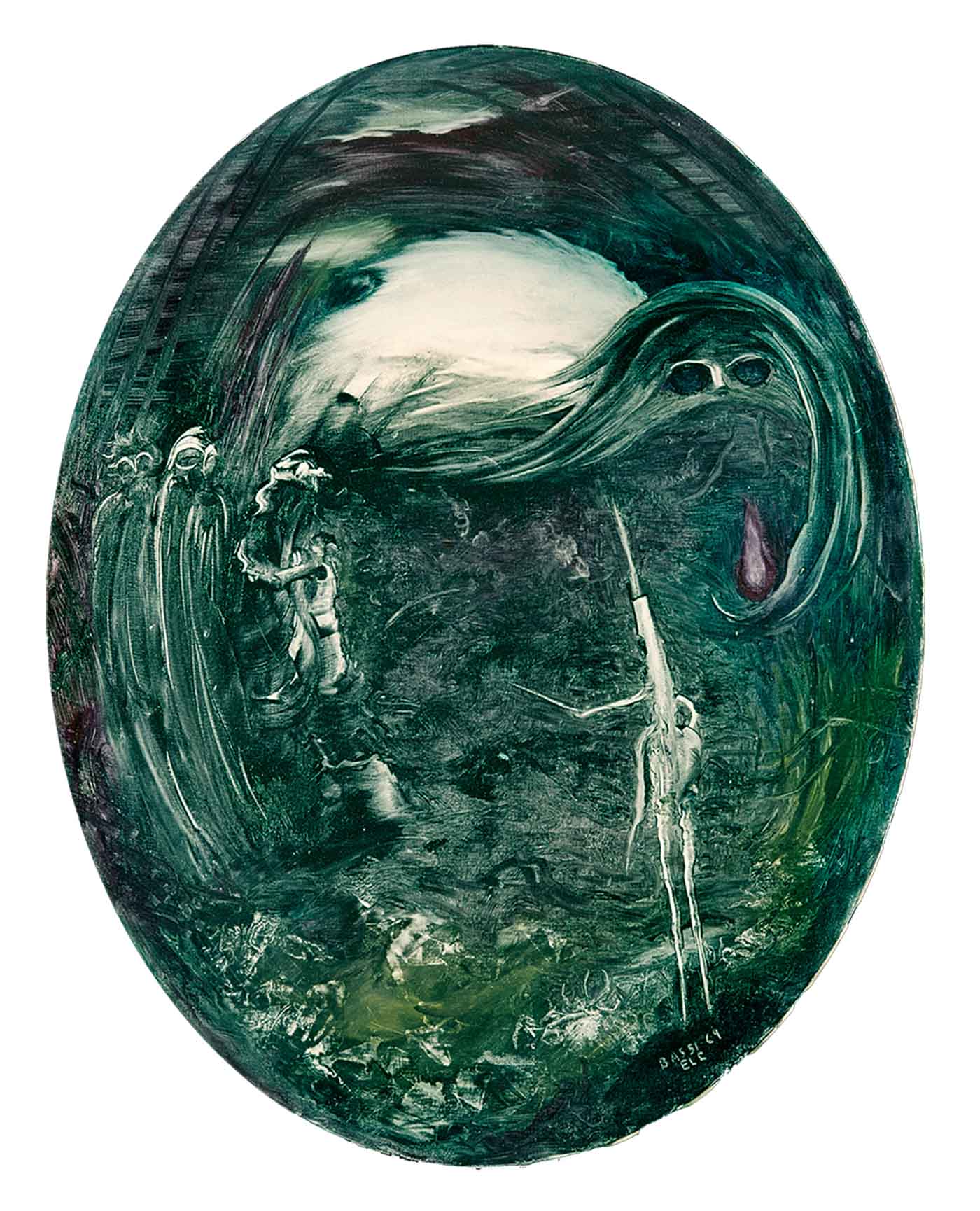
“They never imprisoned her imagination,” and 250 works were created within her cell walls, all signed ELC (En La Carcel—In Jail.).
When asked to join an exhibition of self portraits at the Museo de Arte Moderno, Sofía struggled to come to terms with how she would be able to portray her lived experience. Just as intuitively as she’d become a painter, she had an extra sensory experience and a strong mystic vision of herself came to her. Autorretrato (Self Portrait, 1965) came to be without tracing, no sketches, only a guiding force. These extra sensory experiences continued to visit her artistic process: she was led down her creative path by a duende (elfin goblin-esque creature) named Alfolí. In her natural empathetic ways, she courted and welcomed her guide. The duende once told her he had communicated with Franz Anton Mesmer, who theorised mesmerism and the concept of nonphysical forces and universal fluids. “Sofía Bassi predicted that humanity would overcome the limitations imposed by the three dimensions, and that by elevating consciousness, one could ascend to other planes.” Experiencing her work decades after their original creation reverberates the qualities she harnessed whilst painting. The qualities remain just as strong now as they were then.
The 1968 Tragedy and Its Impact on Sofía Bassi
Her glittering ways were unquestionable and so was the tragic accident that took place on the 3rd January 1968 pierced through her admirers. She pleaded guilty for the murder of her son-in-law, though the incident remained shrouded in mystery. What followed was a 10-year sentence that brought significant change into the psyche of the artist. Her renditions of poetic boscage made way for darkened mist, caves to hide in, watchful eyes thrashing within the pounding pulse of her personal resistance. “They never imprisoned her imagination,” and 250 works were created within her cell walls, all signed ELC (En La Carcel—In Jail.).

Sofía Bassi.
Courtesy of Fundación Sofía Bassi.
She experienced the outside world from within confinement, news and current affairs trickling through access to a TV and an endless stream of visitors and admirers. She was never separated cosmically from the world around her. Her response to progress and beauty was never silenced, and after the historical arrival of man on the moon, she painted the masterpiece Space Voyage (1970,) later placed in the NASA Hall of Fame. She wrote of her experience through Sofía Bassi, Prohibido Pronuciar Su Nombre sharing her routine and suffocations but demonstrating her innate inability to transform her suffering. Mobilised artists and members of the public organised marches to protest her incarceration, Guerilla leaders wanted to free her. A very concerned Leonora Carrington came to visit her and removed the necklace she had around her neck to give to Bassi. Not once did the lady, always dressed in white, abandon her dignity. She stated, “[the] sun that had persisted even in the midst of the darkest darkness, because I felt it lived inside me, in every drop of my blood, in every moment of my spirit. A sun that I had captured to carry inside like a second nature.”


(The Quixotes of Sofía Bassi), 1969.
Sofía Bassi.
Courtesy of Fundación Sofía Bassi.
In 1968, José Page Llergo, the founder and director of the Mexican news magazine Siempre! Commissioned her to paint a portrait of Don Quixote for the 16th Anniversary cover (July 1969.) Wanting to thank and honour the strength of all those offering their continual support she created 17 versions of the character, all published in the magazine. “One after the other the Quixotes of Sofía Bassi came out dreamy and blue, or golden and spirited, or tired, defenseless, immensely sad with only their broken bones dressed in tenderness, riding—soul inside and prison outside.” (Luis Suarez.) She also created La Quijota (1969,) a self-portrait of herself as the character emerging victorious, partly broken but held together by her robust entrails, inner ribbons symbolising the entanglement of life and compassion.

Sofía Bassi.
Courtesy of Fundación Sofía Bassi.
El Club de Periodistas held a major exhibition of her œuvre in 1970. It featured a wide selection of her ELC paintings. Salvador Elizondo, the editor of the experimental literary publication S.NOB and the author of the beautiful book about Bassi, Continentos del Sueño (Continents of Dreams,) coordinated a phone call with the artist herself, audible through speakers for the opening of the exhibition which allowed her to welcome visitors to the exhibition. This resulted in an emotional, multisensory experience for all attendees as her presence was felt throughout the auditorium. Around that time, her precious series, El Huevo (The Egg,) was exhibited at El Salón de la Plástica Mexicana. The director, Lourdes Chumacero, had covered the walls of the entire gallery with her work. News reports featured jealous artists attempting to take her work down to feature theirs. “As long as I am the director, Sofía Bassi’s paintings will remain hanging even if I am later removed from my position.” The shimmer she was bringing to artistic consciousness was producing the most singular reverb, and no one was going to give up on her freedom.
Channeling inner strength through her tirelessly creative work, she continuously denounced and resisted the shockingly poor conditions within prison infrastructure, donating generous portions of her sales to support innocent female inmates struggling to pay their legal bills and offering help for their children to be accompanied to school. “Her presence in prison was considered a blessing by many.” Her cell, beautified by her many murals, was mirroring her flowing need to embellish the rest of the prison. Her activism resulted in an early release, and Sofía was freed in June 1972. The rest of her life, though never liberated from the shadow of her experience, was dedicated to her art, her family and her activism.
The Enduring Glow of Sofía Bassi
Today, I still believe Sofía Bassi holds an enchanted way of demonstrating how her work should be experienced. The way she came into my own life was just like her paintings: unexpected, bewitching and mysterious. Two precious friends of mine and myself were investigating an artist forgotten by art history. That particular day we found ourselves emotionally bending through time, desperately trying to find which personal symbolics were being communicated by this late artist within his marvellous paintings. We were told there was another we really needed to see (“una mujer this time!”) The collector had a piece of hers, an egg shaped totem of supreme rarity that would have a similar effect on us. We were ushered through darkened car parks, mysterious apartment buildings, darkly-lit storage rooms with countless remarkable pieces of work. Though all silently frightened, we kept walking: three artists, haunted by another, in single file, soon to be visited by one more. It wasn’t until we were shown a revolving egg with scenes delicately depicted atop of it, its surface made of faces and formations that we began to question what message might be held within it. It felt like a communal embrace welcoming us into disturbing scenes only to spin themselves around, revealing gentle forms and the purest essence of nature.

(The Ovosarcophagus), 1988–1998.
Sofía Bassi.
Courtesy of Fundación Sofía Bassi.
We’d been welcomed into Sofía Bassi’s world with an Ovosarcófago nonetheless. “The egg became a central symbol of Bassi’s vision, a vessel of cosmic travel. After her release, the egg motif remained, although her works turned toward personal and collective renewal. Its most striking expression is the Ovosarcófago, a fiberglass, egg-shaped sarcophagus she designed over a decade and in which she was ultimately buried. Conceived as a vehicle for the soul’s journey beyond matter, it gave tangible form to her belief in the transformative power of art.” (Mariano Vilalba) From that moment on she would reveal herself in conversation always unexpectedly, appear to me on bookshelves randomly and be personally present in the archives of the artist I was researching in Mexico City. As it turns out, she’d been there all along: they had been good friends in Art School. I tell this personal tale to cement the knowledge that the bugs and flames in her bay of dreams are still twitching and burning, ready to perform on all planes of existence. The gentle glow of Sofía Bassi is like no other as it makes its way, coagulating and hatching into the caves of your mind and the egg of your existence… but that is something you already knew, albeit subconsciously.
“My paintings are portals to other worlds that we can inhabit. Careful observation and meditation of my work will take you to those worlds. Each painting is a spaceship… The Ovosarcófago is the master ship of my personal adventure.”
Featured image: “El Huevo” series (The Egg), 1970. Sofía Bassi.
