

Abstract
Mahabala (Sida rhombifolia) is an important Balya (strength-promoting), Vata-shamaka (Vata-pacifying), and Rasayana (rejuvenative) herb described in classical Ayurvedic texts. It is widely used to strengthen muscles and nerves, enhance vitality, and manage Vata disorders, including neurological conditions, musculoskeletal weakness, and degenerative diseases. Mahabala is especially valued for its therapeutic role in Vatavyadhi (Vata-related disorders), Shukra Kshaya (depletion of reproductive tissue), and Dhatukshaya (tissue depletion) conditions.
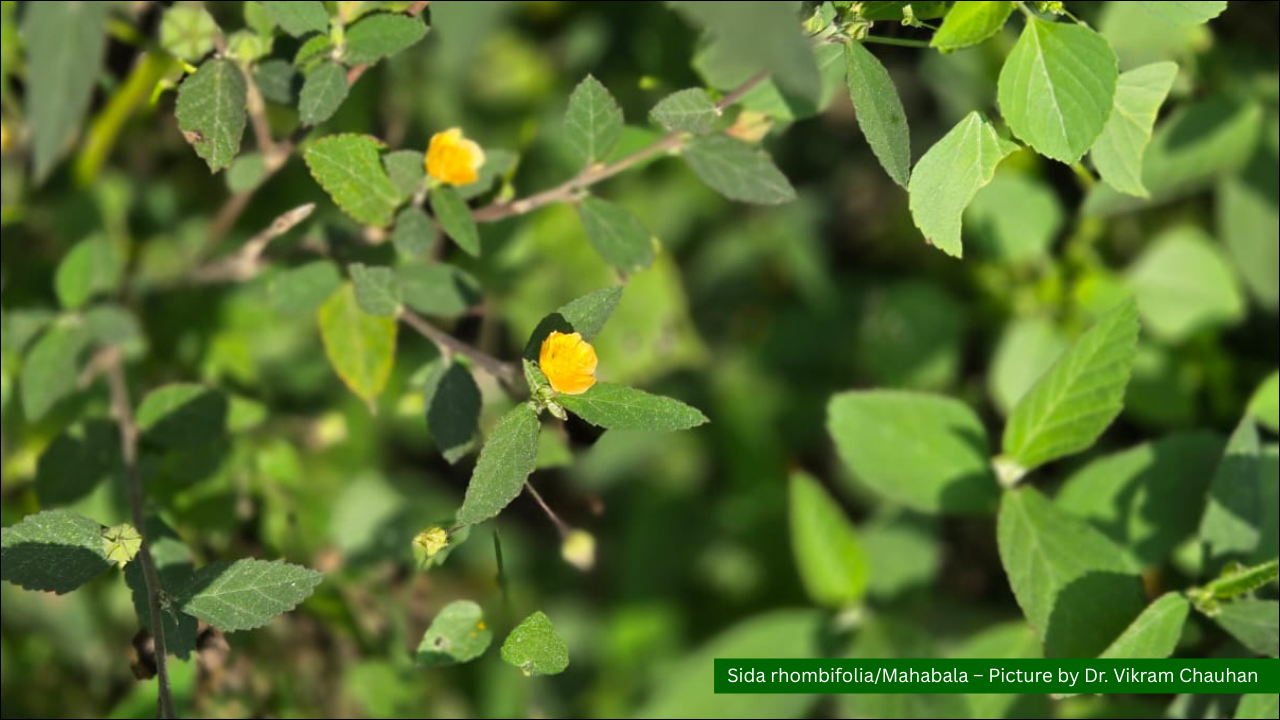
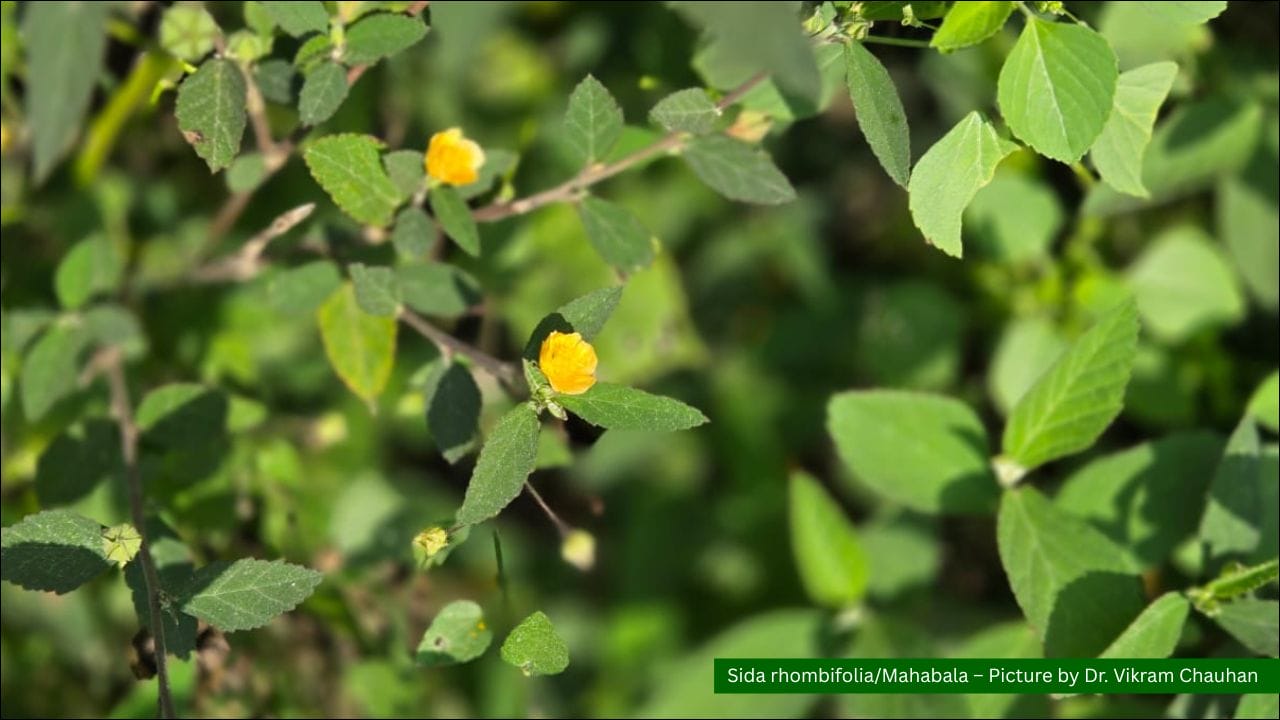
Sida rhombifolia / Mahabala – Picture by Dr. Vikram Chauhan
Classical Reference Of Mahabala (Sida Rhombifolia)
Dhanwantari Nighantu – Guduchyadi varga Shloka Number 272-273
Scientific Classification Of Mahabala (Sida Rhombifolia)
- Kingdom: Plantae
- Division: Angiosperms
- Class: Eudicots
- Order: Malvales
- Family: Malvaceae
- Genus: Sida
- Species: Sida rhombifolia
Synonyms Of Mahabala (Sida Rhombifolia)
- Bala: Which is useful in strengthening muscles, nerves, and body.
- Nagabala: Which is especially useful for nervous system disorders.
- Peetpushpa: Which has yellow flowers.
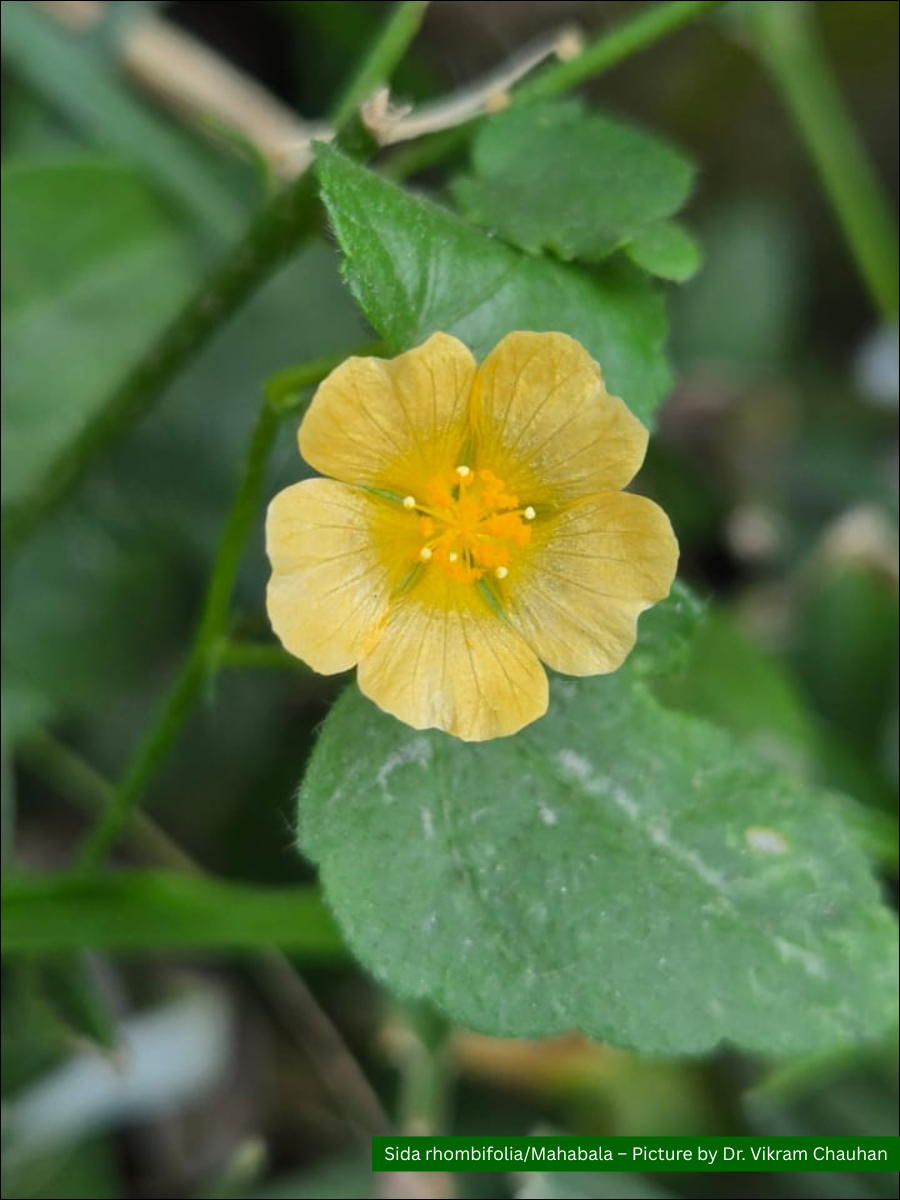
Sida rhombifolia / Mahabala – Picture by Dr. Vikram Chauhan
Vernacular Names Of Mahabala (Sida Rhombifolia)
- Sanskrit: Atibala, Pitapuspa
- Hindi: Pitabala, Pitabariyar
- English: Country Mallow
- Gujarati: Mahabala
- Bengali: Pitabedala, Kheriti
- Kannada: Kisangihettutti-gida
- Malayalam: Anakkuruntotti
- Marathi: Mahabala
- Tamil: Kurunthotti
- Telugu: Gubatada, Pedda Mutheera Pulagu
Habitat Of Mahabala (Sida Rhombifolia)
Mahabala grows abundantly in tropical and subtropical regions of India, especially along roadsides, wastelands, fields, and moist areas. It is also found in Sri Lanka, Southeast Asia, Africa, and Australia.
Morphology Of Mahabala (Sida Rhombifolia)
Mahabala is an erect annual or perennial undershrub reaching about 1.5 m in height. It is widely distributed throughout India, particularly in moist regions, and occurs up to an altitude of 1800 m in the Himalayas. The drug is mainly used in the form of its root, which occurs as entire roots or cut pieces of varying lengths. The roots are brownish-yellow, rough due to scars of lateral roots and lenticels, and show a hard, splintery fracture.
Ancient Verses For Mahabala (Sida Rhombifolia)
महाबला वात्यपुष्पी तथा वातायानी स्मृता।
सहदेवा देवसहा पीतपुष्पा बृहत्फला ।।
Dhanwantari Nighantu – Guduchyadi varga Shloka Number 272
This ancient verse states that Mahabala is known by several other important names, which include: Vatyapuspi, Vatayani, Sahadeva, Devasaha, Pitapuspa, and Brihatphala.
महाबला तु हृद्रोगवातार्श:शोफनाशिनी।
शुक्रवृद्धिकरी हन्याद् विषमं च ज्वरं नृणाम्॥
Dhanwantari Nighantu – Guduchyadi varga Shloka Number 272
This ancient verse states that Mahabala is excellent for the heart and helps reduce swelling or inflammation in the body. It is also a natural remedy for painful piles (hemorrhoids) and is very effective at breaking stubborn or recurring fevers. Additionally, it acts as a strength-building tonic that improves reproductive health and overall physical energy in humans.
Ayurvedic Properties Of Mahabala (Sida Rhombifolia)
- Balya (strength promoting)
- Grahi (absorbent)
- Sukravrddhikara (enhances sperm count)
- Ojovardhaka (immunomodulator)
- Kantivardhaka (improves complexion)
Action On Tridosha Of Mahabala (Sida Rhombifolia)
Vata-pitta Shamaka (Pacifier)
Chemical Composition Of Mahabala (Sida Rhombifolia)
The phytochemical analysis of Mahabala reveals the presence of multiple bioactive alkaloids and supporting compounds in both roots and aerial parts, contributing to its wide therapeutic utility.
1. Root
The root is the officially used and pharmacologically most important part.
Active Alkaloids Identified
- Ephedrine
- Si-ephedrine
- Quinazoline alkaloids: Vasicine, Vasicinone, Vasicinol
Total alkaloid content in the root is reported to be approximately 0.054%.
2. Aerial Parts (Stem And Leaves)
The aerial parts also contain several bioactive alkaloids, though generally in lower concentration than the root.
Active Alkaloids Identified
3. Leaves
Leaves mainly contribute to local and supportive actions.
Active Alkaloids Identified
- Trace amounts of ephedrine-type alkaloids
Actions And Properties Of Various Chemical Constituents Of Mahabala (Sida Rhombifolia)
1. Ephedrine
Ephedrine is a sympathomimetic alkaloid known for its stimulant action on the central and peripheral nervous systems.
Actions And Properties
- Acts as a central nervous system stimulant
- Enhances neuromuscular strength and tone
- Improves peripheral circulation
- Exhibits bronchodilatory and mild cardiotonic effects
- Supports anti-fatigue and adaptogenic activity
2. Si-Ephedrine
It is an isomer of ephedrine with similar but relatively milder pharmacological activity.
Actions And Properties
- Mild neuro-stimulant
- Supports muscle strength and endurance
- Enhances alertness and physical vitality
- Contributes to anti-asthenic effects
3. Quinazoline Alkaloids (Vasicine, Vasicinone, Vasicinol)
These alkaloids are well documented for their anti-inflammatory and tissue-supportive actions.
Actions And Properties
- Anti-inflammatory and analgesic
- Antipyretic activity
- Supports tissue regeneration and repair
- Exhibits bronchodilatory and smooth muscle relaxant effects
- Contributes to immunomodulatory activity
4. Cryptolepine
It is an indoloquinoline alkaloid known for its antimicrobial and anti-inflammatory potential.
Actions And Properties
- Antimicrobial (antibacterial and antiparasitic)
- Anti-inflammatory
- Supports wound healing
- Exhibits antipyretic and immunomodulatory effects
5. Trace Amounts Of Ephedrine-Type Alkaloids
These minor alkaloids collectively enhance the pharmacological activity of the plant.
Actions And Properties
- Synergistic neuro-stimulant and tonic effect
- Supports adaptogenic response
- Enhances overall vitality and strength
- Assists in nerve signal transmission
Therapeutic Indications Of Mahabala (Sida Rhombifolia)
Mahabala is therapeutically indicated in:
- Sukra Kshaya (semen depletion)
- Kshata (injury)
- Kshaya (debility)
- Vishama Jvara (intermittent fever)
- Daurbalya (general weakness)
- Vatavyadhi (neurological disorders)
- Vatarakta (gout)
- Raktapitta (bleeding disorders)
- Shotha (inflammation / swelling)
Systemic Actions Of Mahabala (Sida Rhombifolia)
Bahya Karma (External / Systemic-Peripheral Action)
- Vedanasthapana – relieves pain
- Shothahara – reduces swelling and inflammation
- Useful in external applications (lepa) for inflammatory and painful conditions
Nadisamsthana (Nervous System)
- Acts as Balya (nourishing) for nerves
- Pacifies Vata-related neurological disorders
- Useful in Pakshaghata (Hemiplegia), Ardita (Facial Paralysis / Bell’s palsy), and other Vataj disorders
Pachana Samsthana (Digestive System)
- Exhibits Grahi action (absorbent and bowel-stabilizing effect)
- Helpful in Atisara (diarrhea) and Grahani disorders (IBS or malabsorption syndrome)
- Supports stabilization of digestive function
Raktavaha Samsthana (Circulatory System)
- Acts as Hrudya (cardioprotective)
- Supports Rakshaprasadana (blood purification and nourishment)
Prajanana Samsthana (Reproductive System)
- Shukrala – enhances semen quality
- Prajasthapana – supports fertility and reproductive strength
- Useful in Shukra Kshaya (low sperm count and quality) and reproductive debility
Mutravaha Samsthana (Urinary System)
- Acts as Mutrala (diuretic)
- Helpful in Mutrakrichchhra (dysuria)
Tapakrama (Action In Fever)
- Exhibits antipyretic properties
- Useful in Jvara (fever), especially Vata-dominant types
Rasayana (Rejuvenative Therapy) And Sthairyakara (Stabilizing / Strength-Providing Action)
- Balya (strength-promoting)
- Brimhana (tissue-nourishing / anabolic)
- Ojovardhaka (Ojas-enhancing, vitality and immunity-boosting)
- Helps in Daurbalya (physical weakness), Kshaya (tissue depletion / wasting) and chronic disorders
Practical Uses / Health Benefits Of Mahabala (Sida Rhombifolia)
- Enhances strength, stamina, and vitality (Balya, Rasayana).
- Supports nerve and muscle function; useful in Vata-related weakness.
- Helps reduce pain and inflammation in joints and muscles.
- Improves reproductive health and fertility (Shukrala).
- Supports digestion and bowel regulation (Grahi).
- Aids urinary function and recovery in chronic illness.
Part Used Of Mahabala (Sida Rhombifolia)
- Root (main medicinal part)
- Seeds (also used)
Dosage Of Mahabala (Sida Rhombifolia)
- Root powder (Churna): 3–6 g per day
- Decoction (Kwatha): 20–40 ml
- Seed powder: 1–3 g
Classical Ayurvedic Products With Mahabala (Sida Rhombifolia)
- Mahabala Tailam
- Maha Vishagarbha Tailam
- Balaswagandhadi Tailam
- Baladhatryadi Enna
- Bhoonaga Thailam
Planet Ayurveda’s Products With Mahabala (Sida Rhombifolia)
Conclusion
Mahabala (Sida rhombifolia) is a classical Balya, Vata–Pitta shamaka, and Rasayana herb with wide therapeutic relevance in Ayurvedic practice. Classical references, supported by modern phytochemical research, confirm its role in strengthening muscles and nerves, enhancing vitality, and nourishing depleted tissues. The presence of ephedrine-type alkaloids, quinazoline alkaloids, and cryptolepine explains its neuro-supportive, anti-inflammatory, adaptogenic, and immunomodulatory actions. Mahabala is especially valuable in the management of Vatavyadhi, Daurbalya, Shukra Kshaya, Dhatukshaya, inflammation, and chronic debilitating conditions. Thus, Mahabala stands as an important medicinal plant whose traditional uses are well supported by scientific evidence, making it a significant herb for both classical and integrative therapeutic applications.
