


Abstract
Brassica campestris, commonly known as field mustard, is an important member of the Brassicaceae family with diverse applications in agriculture, food, and traditional medicine. Valued for its seeds, which yield edible oil, and its leafy parts used as vegetables, this plant plays a significant role in sustainable farming systems and rural economies. Due to its adaptability and fast growth cycle, it holds an important place in crop rotation and intercropping systems. The global demand for mustard continues to grow, driven by its multifunctional uses and increasing awareness of the health benefits associated with its oil and phytochemicals. This article aims to provide detailed information about Mustard, its Ayurvedic overview and therapeutic properties, etc.
Introduction
Mustard is one of the most significant oilseed crops in the global economy and serves as a major source of vegetable oil worldwide. These species are grown primarily for their seeds, which yield high-quality vegetable oil rich in unsaturated fatty acids, especially omega-3 and omega-6. Mustard oil is not only a staple cooking medium in many Asian countries but also finds applications in traditional medicine, cosmetics, and biofuel production. In addition to its oil-producing potential, mustard is valued for its green leaves, which are consumed as nutritious vegetables in many cultures. The crop is well-adapted to a wide range of climates and soil types and is particularly suited to marginal lands, making it an ideal choice for sustainable agriculture and crop diversification. Furthermore, mustard plants contribute to soil health by serving as cover crops, reducing erosion, and suppressing weeds and pests through natural biofumigation properties.
Scientific Classification
- Kingdom: Plantae
- Phylum: Tracheophyta
- Class: Magnoliopsida
- Order: Brassicales
- Family: Brassicaceae
- Genus: Brassica
- Species: campestris
Synonyms
- Sarshapa
- Katuka
- Sneha
- Tutumbha
- Kadambaka
- Siddhartha
Vernacular names
- Hindi: Sarson, Peeli Sarson
- English: Field Mustard, Yellow Mustard
- Nepali: Tori
- Tamil: Kadugu
- Chinese: Yóucài
- Punjabi: Sarson
- Bengali: Shorshe
- Marathi: Mohari
- Kannada: Sasive
- Telugu: Avaalu
- Sanskrit: Siddhartha, Rajika
- Assamese: Tora, Methi Tora
- Gujarati: Rai, Saragvo
- Oriya (Odia): Sorisha
- Thai (Thailand): Phak Kat
- Malayalam: Kaduku
- Garhwali: Sarson, Tori
Habitat
It is extensively cultivated in India, China, Canada, and parts of Europe such as Germany, France and Ukraine. The crop is also grown in North America, especially in the United States and Canada, as well as in Australia and emerging areas of South America, including Argentina and Brazil.
Morphology
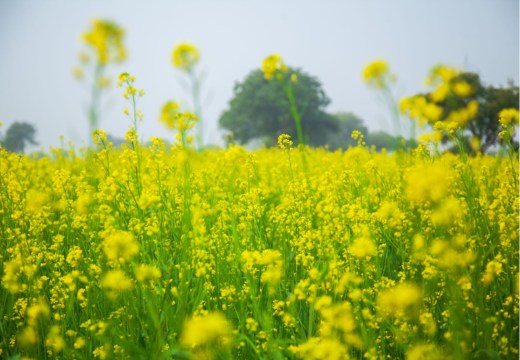
The morphology of Brassica campestris (field mustard) is characterised by an erect, herbaceous structure with a well-developed, branching stem. The plant typically grows between 30 to 120 cm in height, depending on the variety and environmental conditions. The leaves are alternate, deeply lobed, or sometimes pinnate, with a rough texture on the upper side and a lighter, almost hairy underside. The flowers are bright yellow and arranged in clusters at the top of the plant, forming a typical racemose inflorescence. Each flower has four petals, and the plant produces small, round seeds that are generally yellow or brown. These seeds are encased in long, slender siliques (seed pods) that are characteristic of the Brassicaceae family.
Varieties
According to Bhavprakash Nighantu, there are two varieties of Mustard that are given below:
- White mustard or Gor Sarshapa- It is considered as best as compared to other varieties.
- Raktasarshapa
Classical categorisation:-
- According to Bhavprakash Nighantu: Dhanya Varga
- According to Raj Nighantu: Shalyadi Varga
- According to Dhanvantari Nighantu: Karveeradi Varga
Parpatadi Varga
सर्षपस्तु रसे पाके कटुः स्निग्धः सतिक्तकः।
तीक्ष्णोष्णः कफवातघ्नो रक्तपित्ताग्निवर्धनः।।
रक्षोहरो जयेत्कण्डूं कुष्ठकोष्ठक्रिमीग्रहान। (Bhavprakash Nighantu Dhanya varga 70-71)
According to the above shloka, Mustard is unctuous, contains pungent and bitter taste, hot potency, pungent post-digestion effect and balances Vata and Kapha dosha. It is effective in the management of bleeding disorders, improves digestive fire, relieves itching, skin disorders, helminthiasis and disease caused by unknown causes.
Ayurvedic properties
- Taste (Rasa)- Bitter (Tikta), Pungent (Katu)
- Physical property (Guna)- Unctuous (Snigdha)
- Potency (Veerya)- Hot Potency (Usna)
- Post-digestion effect (Vipaka)- Katu (Pungent)
- Effect on tridosha- Balance Vata and Kapha dosha
Therapeutic properties
- Improve digestive fire
- Splenomegaly
- Anthelminthiasis
- Dysuria
- Bleeding disorders
- Relieves itching
- Skin diseases
Systemic actions
External- Its paste is used to manage skin diseases and pain. It is used as a mouthwash in case of pyorrhea. Oil massage is used to improve the body’s strength.
Internal use-
- Digestive System: It is effective in the management of low digestive fire and helminthiasis, etc.
- Circulatory System: It acts as a Cardiac stimulant.
- Reproductive System: It is effective amenorrhea management.
- Excretory System: It helps in the case of urine retention management.
- Skin (Tvak) System: It is really effective in the management of skin diseases.
Chemical composition
- Glucosinolates
- Rutin
- Erucin
- Arabinogalactan
- Sinigrin
- Glucoraphanin
- Isoleucine
- Leucine
- Lysine
- Valine
- Linoleic acid
Modern overview
Anticancer activities
Glucosinolates are the primary compounds responsible for the anticancer properties of mustard plants. Additionally, various chemical derivatives formed from glucosinolates also contribute significantly to their anticancer effects.
Antiinflammatory activities
Chronic inflammation is a key factor in the development of many diseases. Sinigrin shows strong potential in reducing this risk by modulating immune responses. It influences macrophage activity by inhibiting lipopolysaccharide-induced nitric oxide production, suppressing tumour necrosis factor, and reducing interleukin-6 (IL-6) levels. By suppressing inflammatory mediators, Sinigrin exhibits significant immunomodulatory effects.
Antidiabetic activities
Glucosinolates (GLS) and their derivatives possess notable anti-diabetic properties. Benzyl isothiocyanate, a derivative of glucotropaeolin, helps prevent and manage type 2 diabetes by boosting antioxidant defences and reducing hepatic glucose production. Additionally, studies on glucoraphanin have demonstrated its ability to enhance insulin sensitivity.
Practical uses
- In the Management of Rheumatoid Arthritis: It is used for massage after mixing with camphor.
- For Low Digestive Fire: Seed powder of Mustard is used to improve low digestive fire.
- For Skin Problems and Pain Management: Seed paste is used to manage skin problems and pain management.
- To Improve Body Strength: Seed oil massage is used to improve the strength of the body.
- In Case of Pyorrhea: Seed oil is used for oil pulling. It is also applied to teeth after mixing with rock salt.
- For Urine Retention: Seed powder is given to manage urine retention.
Part used
Dosage
Ayurvedic medicines
Classical medicine:
Conclusion
Brassica campestris, commonly known as rapeseed or mustard, is a nutritionally and medicinally valuable plant. Rich in bioactive compounds like glucosinolates, flavonoids and essential fatty acids, it exhibits strong antioxidant, anti-inflammatory, anticancer and antidiabetic properties. Regular consumption or therapeutic use of Brassica campestris may contribute to the prevention and management of various chronic diseases, including cardiovascular disorders, diabetes, and certain cancers. Its wide-ranging health benefits make it a promising functional food and a vital component in traditional and modern medicine.
