
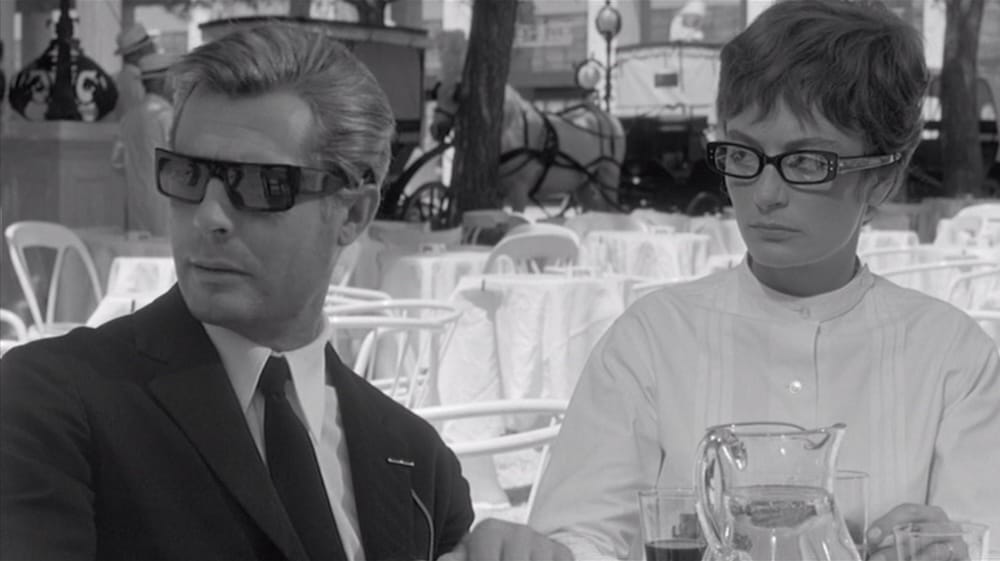


There’s a thin line between real life and reel life in Federico Fellini’s 1963 comedy 8½ (Otto e mezzo). More self-deprecating than self-aggrandizing, the auteur’s avant-garde masterwork is considered the quintessential movie about moviemaking.
Its semi-autobiographical script by writer/director Fellini (with Ennio Flaiano and Tullio Pinelli) follows writer/director Guido Anselmi (Marcello Mastroianni) during preproduction of a sci-fi epic. Guido wants to use the big budget flick to deliver a meaningful message but doesn’t know what to say.
Not only is he suffering from writer’s block and Imposter Syndrome, Guido struggles with a Madonna Whore Complex brought on by his Catholic upbringing. Flashbacks conjure up visions of his mother (Giuditta Rissone) and a prostitute (Eddra Gale) from the past while his present-day wife (Anouk Aimée) contemplates divorce.
There’s also trouble in Guido’s sexual fantasies as seen in the film’s iconic harem scene wherein his dream women rebel against him. They challenge the 43-year-old’s double standards on age, arguing that they have the right to be loved until they’re 70. Donning little more than a sheet and fedora, Guido combats the cougars by wielding a whip like a ringmaster in a circus.

Yes, the film offers several circus references as well as nods to Pinocchio and Carl Jung. There’s a lot to unpack and while it’s tempting to overanalyze the content, it’s also unnecessary since much of the movie’s pleasure exists in its mise en scène. From the imaginative costumes and sets by designer Piero Gherardi to the sweeping long takes by cinematographer Gianni Di Venanzo, 8½ bursts with creativity. Its black-and-white imagery is further enhanced by a colorful cast of characters that dance in and out of frame with comic effect.
As zestful as the visuals are (and they are), the soundtrack is equally lively. In addition to Nino Rota’s catchy score, the film makes amusing use of “Dance of the Sugar Plum Fairy” from Tchaikovsky’s The Nutcracker; the overture from Rossini’s rom-com opera The Barber of Seville; and Wagner’s “The Ride of the Valkyries” from Die Walküre — years before Francis Coppola deployed it in Apocalypse Now (1979).

8½’s musical influence also pops up in Quentin Tarantino’s Pulp Fiction (1994) when Uma Thurman and John Travolta channel Barbara Steele and Mario Pisu’s twist. Similarly, Adam Sandler’s surprise shuffle in Paul Thomas Anderson’s Punch-Drunk Love (2002) is akin to Mastroianni’s unexpected moves as his character literally tap dances past producers.
If imitation is the sincerest form of flattery, there’s no doubt 8½ is revered in the entertainment industry. Lina Wertmüller, who served as Fellini’s assistant director, went on to cast Mastroianni as her alter ego too.
Callbacks to 8½ appear in other movies, from Paul Mazursky’s Alex in Wonderland (1970) and François Truffaut’s Day For Night (1973) to Todd Haynes’s I’m Not There. (2007) and Charlie Kaufman’s Synecdoche, New York (2008). Bob Fosse and Woody Allen blatantly used the film’s template in their semi-autobiographical pics All That Jazz (1979) and Stardust Memories (1980), respectively.

R.E.M. appropriated 8½’s opening sequence for its “Everybody Hurts” (1992) video while The Simpsons (S33/Ep9) spoofed the film’s finale in 2021. In between, a 2004 episode from The King of Queens (S6/Ep16) hints at 8½’s aforementioned harem scene.
And then there’s Nine (2009), a musical remake that makes the mistake of replacing 8½’s delightful score with cloying Broadway tunes. The drama features Fergie and Kate Hudson along with Oscar winners Daniel Day-Lewis, Marion Cotillard, Penélope Cruz, Judi Dench, and Nicole Kidman — all doing cringey cosplay.
Joyless and phony, Nine is the antithesis of 8½ since Fellini pushed for truth and beauty — casting Claudia Cardinale as Claudia, Rossella Falk as Rossella, and Madeleine Lebeau as Madeleine. To retain 8½’s authenticity, real life production pros Bruno Agostini, Cesarino Miceli Picardi, and Mario Conocchia portray fictionalized versions of themselves.
For her role as Guido’s secret mistress, Sandra Milo won a Nastro d’Argento in the Supporting Actress category and, according to her, became Fellini’s secret mistress for 17 years. In this sense, 8½ is as much an example of life imitating art as it is of art imitating life.
_________
With Five by Fellini (July 4-10), Music Box Theatre will show three of Fellini’s four Best Foreign Language Films: 8½, La Strada (1954), and Amarcord (1973). The special series also includes screenings of the Palme d’Or winner La Dolce Vita (1960) and the 8½ sequel La città delle donne (1980).
The post Review: Fellini’s ‘8½’ is a 10 appeared first on Rebellious Magazine.
