


Abstract
Maha Nimba (Melia azedarach), commonly known as Persian Lilac, is an important medicinal tree described in Ayurvedic texts for its potent Pitta–Kapha pacifying properties. It is traditionally used in the management of skin disorders (Kushta), itching (Kandu), wounds (Vrana), fever (Jwara), and parasitic infestations. The bark, leaves, fruits, and seeds possess detoxifying actions, making the herb effective in inflammatory and infective conditions. Maha Nimba is well known for its antimicrobial, antifungal, anti-inflammatory, and blood-purifying effects. Modern studies have identified bioactive compounds such as limonoids, flavonoids, and alkaloids, which support its traditional uses. Overall, Maha Nimba plays a significant role in Ayurvedic formulations aimed at skin health, detoxification, and infection control.
Classical Reference Of Mahanimba (Melia Azedarach)
Bhavprakash Nighantu Guduchyadi Varga Page no. 318
Scientific Classification Of Mahanimba (Melia Azedarach)
- Kingdom: Plantae
- Subkingdom: Tracheobionta (Vascular plants)
- Superdivision: Spermatophyta (Seed plants)
- Division: Magnoliophyta (Angiosperms)
- Class: Magnoliopsida (Dicotyledons)
- Order: Sapindales
- Family: Meliaceae
- Genus: Melia
- Species: azedarach
Synonyms Of Mahanimba (Melia Azedarach)
- Mahodreka: It has a powerful or intense action on the body.
- Karmuka: It is effective in action (like a bow and arrow).
- Keshamushtika: Its fruits resemble a fistful of hair.
- Kakanta: It is a plant that is attractive or useful to crows.
- Ramyaka: It is beautiful and pleasing to the sight.
- Akshashira: Its seeds are hard and shaped like a head/bead.
- Mahatikta: It is extremely bitter in taste.
- Himadruma: It is a tree with a very cooling nature.
- Jiva: It is life-giving and promotes longevity.
- Vishamushtika: It is useful in treating rat poisoning.
Vernacular Names Of Mahanimba (Melia Azedarach)
- Sanskrit: Maha Nimba, Mahanimba, Girinimba
- Hindi: Bakayan, Pahadi Neem, Mahaneem
- English: Persian Lilac, Chinaberry Tree, Bead Tree
- Tamil: Malai Vembu
- Telugu: Turaka Vepa, Kondavepa
- Kannada: Bettada Bevu
- Malayalam: Malavembu
- Marathi: Bakain, Nimbara
- Gujarati: Bakayan
- Punjabi: Drek
- Urdu: Bakain
Habitat Of Mahanimba (Melia Azedarach)
- Geographical Distribution Maha Nimba is native to the Indian subcontinent and is widely distributed across India, Pakistan, Nepal, Sri Lanka, and Southeast Asia. It has also been introduced and naturalized in parts of Africa, Australia, and the Americas due to its medicinal and ornamental value.
- Climate Preference The tree grows well in tropical and subtropical climates, preferring warm temperatures and moderate rainfall. It tolerates seasonal dryness and adapts well to varied climatic conditions.
- Soil Requirement Maha Nimba thrives in well-drained loamy, sandy, and red soils. It can also tolerate slightly alkaline and poor soils, reflecting its hardy nature.
- Altitude Range It is commonly found from sea level up to about 1500 meters above mean sea level.
- Ecological Adaptability This species is drought-resistant and commonly seen along roadsides, open lands, village outskirts, and urban landscapes, demonstrating strong ecological adaptability.
Morphology Of Mahanimba (Melia Azedarach)
- Habit Maha Nimba is a medium- to large-sized deciduous tree, usually reaching 10–20 meters in height, with a spreading crown and straight trunk.
- Root The plant has a strong taproot system with well-developed lateral roots, providing firm anchorage and drought tolerance.
- Stem / Bark The trunk is erect and cylindrical. Bark is grayish-brown, rough, and fissured in older trees. Young branches are smooth and greenish.
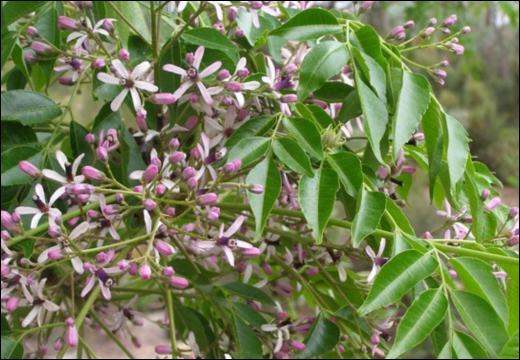
- Leaves Leaves are alternate, large, and bipinnate to tripinnate. Leaflets are ovate to lanceolate with serrated margins and pointed tips. Leaves emit a characteristic bitter odor when crushed.
- Flowers Flowers are small, fragrant, and lilac to pale purple, borne in axillary panicles. Each flower has five narrow petals and prominent staminal tubes.
- Fruits The fruit is a globose drupe, green when young and turning yellow on maturity. It contains a hard endocarp.
- Seeds Each fruit encloses one to several seeds, which are hard, bitter, and rich in bioactive compounds.
Classical Categorisation Of Mahanimba (Melia Azedarach)
- Bhavprakash Nighantu Guduchyadi Varga
- Raj Nighantu Prabhadradi Varga
- Dhanwanthari Nighantu Guduchyadi Varga
Ancient Verses For Mahanimba (Melia Azedarach)
Verse No. 1
महानिम्बो मदोद्रेकः कार्मुकः केशमुष्ट्रिकः ।
काकाण्डो रम्यकोऽक्षीरो महातिक्तो हिमद्रुमः ॥
महानिम्बस्तु शिशिरः कषायः कटुतिक्तकः ।
अस्त्रदाहबलासघ्नो विषमज्वरनाशनः ॥
Raj Nighantu / Prabhadradi Varga / Verse No. 191–192
Explanation Of Verse No. 1
- Mahanimba – Literally means the “Great Neem.”
- Madodreka – Refers to its strong, potent, or intoxicating essence.
- Karmuka – Indicates that the plant is highly effective or useful in treatment.
- Kesamustika – A name related to its traditional use for hair health.
- Kakanda – Describes the fruit, which resembles a crow’s egg.
- Ramyaka – Means pleasing or beautiful, likely referring to the appearance of the tree.
- Aksira – Indicates that the plant does not produce a milky sap.
- Mahatiktaka – Highlights its extreme bitterness, even more so than regular Neem.
- Himadruma – Describes it as a “cool tree,” referring to its cooling medicinal nature.
Properties Described In The Verse
It is naturally cooling (Shishira) for the body. It has a combination of Astringent (Kashaya),
Pungent (Katu), and Bitter (Tiktaka) taste. It is used to treat blood-related disorders (Asra)
and internal burning sensations (Daha). It is effective at reducing or destroying excess Kapha
(Balasa) and is specifically used as a cure for Vishamajvara, which refers to malarial or irregular fevers.
Verse No. 2
अपक्वं पाचयेच्छोफं पक्वं विशोधयेत्।
महानिम्बः स्मृतो ड्रेको कार्मुको विषमुष्टिकः।
केशमुष्टिनिम्बवरो रम्यकोऽक्षीव एव च ॥
कैडर्यः पिचुमन्दश्च निम्बोऽक्षीव एव च।
छर्दिघ्नो हिङ्गुनिर्यासाः प्रियशालश्च पार्वतः ॥
Dhanwanthari Nighantu / Guduchyadi Varga / Verse No. 30–31
Explanation According To The Verse
According to the above verse, Mahanimba (Bakayan) possesses the ability to ripen or digest an unripened swelling (apakwa shotha) and purify or cleanse a ripened swelling (pakwa shotha). It is recognized as a potent wound-healing and anti-inflammatory medicinal plant.
Synonyms Of Mahanimba
- Dreki – A regional name, similar to the Punjabi term “Drek,” indicating its local identity.
- Kamuka – Meaning desirable or pleasing, often associated with reproductive or restorative uses.
- Visamustika – Derived from “Visha” (poison) and “Mushti” (fist), indicating its role in treating toxic conditions, especially rat poisoning.
- Kesamustika – Refers to hair-like structures or usage in conditions involving hair-like growths.
- Nimbavara – Meaning “the excellent Nimba,” denoting its superiority among Neem-like plants.
- Ramyaka – Meaning beautiful or delightful, referring to the tree’s attractive appearance.
- Aksiva – Meaning non-intoxicating, associated with mental clarity and relief from giddiness.
- Kadrya – Refers to its bitter nature or specific terrain-based growth.
- Picumanda – A classical name implying destruction of skin diseases.
- Nimba – Generic name due to its bitter medicinal qualities similar to Neem.
- Arista – Meaning imperishable or pain-relieving, symbolizing longevity and health.
- Vartvaca – Refers to the medicinal importance of its bark (Twak).
- Chardighana – Destroyer of vomiting.
- Hinguniryasa – Indicates its resin resembling Asafoetida.
- Priyasala – Meaning beloved tree, signifying high medicinal value.
- Parvata – Refers to its growth in mountainous or hilly regions.
Verse No. 3
महानिम्बः स्मृतो ड्रेका रम्यको विषमुष्टिकः ।
केशमुष्टिर्निम्बकश्च कार्मुको जीव इत्यपि ॥
महानिम्बो हिमो रूक्षस्तिक्तो ग्राही कषायकः ॥
कफपित्तभ्रमच्छर्दिकुष्ठहृल्लासरक्तजित् ।
प्रमेहश्वासगुल्मार्शोमूषिकाविषनाशनः ॥
Bhavprakash Nighantu / Guduchyadi Varga / Verse No. 17–19
Synonyms Mentioned In The Verse
- Mahanimba – The great Neem.
- Dreka – Common name for Bakayan.
- Ramyaka – Beautiful or attractive.
- Vishamustika – Refers to potent seeds.
- Keshamusti, Nimbaka, Karmuka, Jiva – Traditional names based on botanical and therapeutic identity.
Physical Properties (Guna And Rasa)
- Hima – Cooling potency.
- Ruksha – Dry in nature.
- Tikta – Bitter taste.
- Kashaya – Astringent taste.
- Grahi – Absorptive property, useful in diarrhea and excessive secretions.
Therapeutic Benefits
- Pacifies Kapha and Pitta dosha.
- Relieves dizziness (Bhrama).
- Stops vomiting (Chardi).
- Effective in skin diseases (Kustha).
- Reduces nausea (Hrullasa).
- Purifies blood and treats bleeding disorders (Raktajit).
- Useful in diabetes and urinary disorders (Prameha).
- Supports respiratory health in asthma (Shwasa).
- Helps manage abdominal masses and bloating (Gulma).
- Beneficial in piles (Arsha).
- Acts as an antidote in rat-bite poisoning (Mushika Visha Nashana).
Ayurvedic Properties Of Mahanimba (Melia Azedarach)
- Rasa Tikta (Bitter), Kashaya (Astringent), Katu (Pungent)
- Guna Laghu (Light), Ruksha (Dry)
- Veerya Sheeta (Cooling)
- Vipaka Katu (Pungent)
Action On Tridosha Of Mahanimba (Melia Azedarach)
Pacifies Pitta and Kapha; excessive use may aggravate Vata.
Therapeutic Indications Of Mahanimba (Melia Azedarach)
- Kushta (skin disorders)
- Kandu (itching, pruritus)
- Vrana (infected and non-healing wounds)
- Jwara (fever, especially Vishama Jwara)
- Krimi Roga (intestinal and external parasitic infestations)
- Rakta Dushti (blood impurities)
- Daha (burning sensation)
- Prameha (urinary disorders including diabetes)
- Chardi (vomiting)
- Hrullasa (nausea)
- Shwasa (asthma, breathing difficulty)
- Gulma (abdominal lumps, bloating)
- Arsha (hemorrhoids)
- Mushika Visha (rat-bite poisoning)
Systemic Actions Of Mahanimba (Melia Azedarach)
- Circulatory And Blood System Purifies blood and reduces inflammatory toxins; useful in blood impurities, burning sensation, and infective conditions.
- Integumentary System Supports skin health by reducing infection, inflammation, itching, and chronic dermatological disorders.
- Digestive System Improves digestion, reduces internal toxins, and controls parasitic infestations; helpful in nausea, vomiting, and metabolic imbalance.
- Urinary System Regulates urinary function and metabolism; beneficial in urinary disorders including diabetes.
- Respiratory System Reduces Kapha accumulation; supports management of asthma and respiratory congestion.
- Musculoskeletal System Alleviates swelling and inflammatory conditions affecting muscles and soft tissues.
- Immune And Defense System Enhances resistance against infections and toxins; indicated in toxic exposures such as rat-bite poisoning.
- Tissue Repair And Healing System Promotes cleansing and healing of damaged tissues; effective in infected and non-healing wounds.
Chemical Composition Of Mahanimba (Melia Azedarach)
Bark
- Limonoids (Meliatoxins) – Antimicrobial and antifungal; useful in skin infections and ulcers
- Triterpenoids – Anti-inflammatory; supports wound healing
- Flavonoids – Antioxidant; reduces oxidative stress and inflammation
- Tannins – Astringent; promotes skin repair and healing
- Alkaloids – Antimicrobial; helps in infection control
Leaves
- Quercetin and Kaempferol (Flavonoids) – Antioxidant; protects against oxidative stress
- Limonoids – Antimicrobial and antiparasitic; useful in skin disorders and parasitic infections
- Phenolic compounds – Anti-inflammatory; supports fever and skin inflammation
- Essential oils (trace) – Antimicrobial; helps in minor infections
Fruits And Seeds
- Azadirachtin-like limonoids – Anthelmintic and insecticidal; effective in intestinal worms and ectoparasites
- Meliatoxins – Antimicrobial and antifungal; useful in skin infections
- Steroids and fatty acids – Anti-inflammatory; supports immune response
Roots
- Triterpenes – Anti-inflammatory; supports wound healing
- Alkaloids – Antimicrobial; helps in skin and systemic infections
- Bitter principles – Detoxifying; beneficial in Pitta disorders and inflammation
Practical Uses And Health Benefits Of Mahanimba (Melia Azedarach)
- Supports management of chronic skin disorders such as eczema, dermatitis, and fungal infections
- Helps relieve itching, redness, and inflammatory skin conditions
- Useful in cleansing and healing infected and non-healing wounds
- Assists in reducing fever, especially irregular and recurrent fevers
- Helps control intestinal and external parasitic infestations
- Acts as a natural blood purifier and supports detoxification
- Beneficial in urinary disorders and metabolic imbalance, including diabetes
- Supports respiratory health by reducing Kapha-related congestion
- Helps reduce swelling and inflammatory conditions
- Traditionally used as an antidotal support in toxic conditions, including rat-bite poisoning
Parts Used Of Mahanimba (Melia Azedarach)
- Root
- Bark
- Fruits
- Leaves
- Oil extracted from the seeds
Dosage Of Mahanimba (Melia Azedarach)
- Bark powder 1–3 g per day in divided doses
- Leaf powder 1–3 g once or twice daily
- Decoction (Kwatha) 20–40 ml prepared from bark or leaves
- Seed oil (external use) applied locally as required
- Paste (Kalka) for external application only
Home Remedies With Mahanimba (Melia Azedarach)
- For itching and skin infections prepare a decoction of Maha Nimba leaves and use it for washing the affected area
- For wounds and ulcers apply a paste of fresh leaves externally to cleanse and promote healing
- For fever and blood impurities consume a mild decoction of bark under professional supervision
- For parasitic infestations leaf decoction is traditionally used as supportive therapy to reduce intestinal worms
- For scalp and hair-related infections wash the scalp with diluted leaf decoction to reduce dandruff and microbial growth
Classical Products With Mahanimba (Melia Azedarach)
Planet Ayurveda’s Products With Mahanimba (Melia Azedarach)
Research On Mahanimba (Melia Azedarach)
Modern scientific studies support many traditional uses of Mahanimba and highlight its pharmacological potential:
- Antimicrobial Activity Extracts from the leaves and seeds have been shown to inhibit the growth of various pathogenic bacteria, including both Gram-positive and Gram-negative strains, confirming its traditional use in infections
- Antifungal And Anti-Inflammatory Effects Leaf extracts demonstrate strong antifungal properties and significant anti-inflammatory activity, supporting its role in managing skin infections and inflammatory conditions
- Cytotoxic And Anticancer Potential Laboratory studies indicate that Mahanimba leaf extracts can inhibit the growth of cancer cells in vitro, suggesting possible anticancer effects attributed to its bioactive compounds like flavonoids and alkaloids
- Analgesic And Anti-Inflammatory Effects In Animals Animal studies reveal that root and bark preparations reduce pain and inflammation, corroborating traditional use in inflammatory and painful conditions
- Phytochemical Basis Of Activity Mahanimba contains a variety of bioactive compounds including flavonoids, alkaloids, terpenoids, saponins, and limonoids, which contribute to its antimicrobial, anti-inflammatory, antioxidant, and detoxifying properties
Conclusion
Mahanimba (Melia azedarach), or Persian Lilac, is a potent medicinal tree extensively used in Ayurveda for its Pitta Kapha pacifying, detoxifying, and antimicrobial properties. All parts, including root, bark, leaves, fruits, and seeds, exhibit therapeutic benefits, particularly in skin disorders, wounds, fever, parasitic infestations, and blood purification. Classical texts and modern research validate its antimicrobial, antifungal, anti-inflammatory, antioxidant, and cytotoxic activities, providing a strong scientific basis for traditional use. It supports multiple body systems, including circulatory, integumentary, digestive, urinary, respiratory, musculoskeletal, and immune systems. Both internal and external applications are safe when used appropriately, making Mahanimba a valuable herb in Ayurvedic formulations, home remedies, and modern herbal therapeutics aimed at promoting overall health and managing chronic and acute conditions effectively.
