


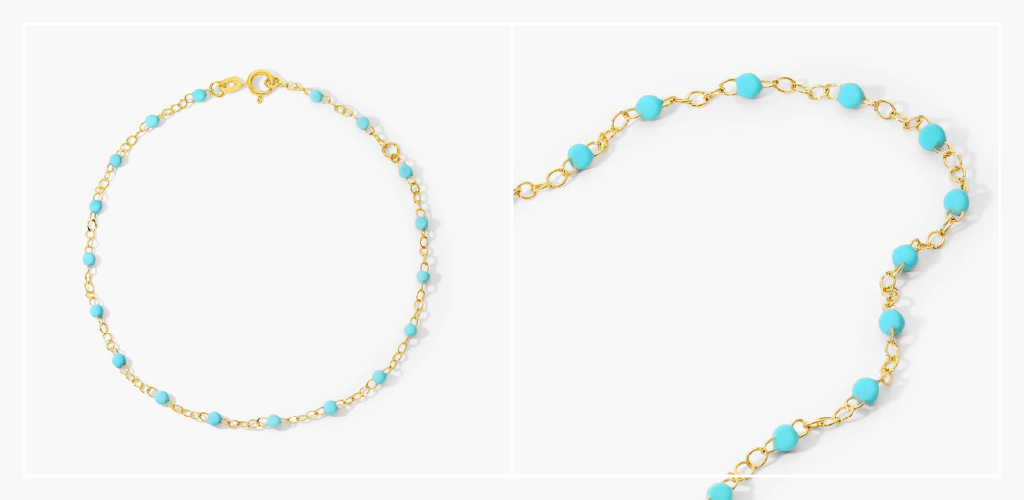
Turquoise, the next December birthstone, is known for its striking blue-green color and the beautiful dark veins that often ribbon through it. This gemstone forms when acidic groundwater from rain seeps into the earth and reacts with other minerals in the veins of rocks or nestled in pockets of clay.
History and Meaning
One of the oldest known gemstones, turquoise has been prized in many civilizations throughout history. Researchers have found turquoise beads that date back to 5,000 BCE in ancient Mesopotamia, and Chinese craftsmen made turquoise talismans over 3,000 years ago.
Though it is now found across the globe, turquoise has been mined in the Nishapur district of Iran for more than 1,000 years. The stone derives its name from the French word for Turkish, because turquoise made its way to Europe through Turkish traders in the 17th century.
The ancient Egyptians connected turquoise with fertility and vegetation. For the Aztecs, it was more valuable than gold, so they gave turquoise offerings to fertility goddesses.
Color Characteristics
Turquoise is opaque, with colors ranging from green to blue. The higher its copper content, the bluer it appears, while the higher its iron content, the greener it appears.
The gemstone often, but not always, has darker veins, known as the “matrix,” running across it. These veins are remnants of the host rock in which the turquoise formed.
The Nishapur region’s turquoise is especially prized for its intense blue shade, dubbed “robin’s egg blue,” “sky blue,” and “Persian blue.” Some trade professionals now use these terms to describe the quality of turquoise regardless of where it is mined.
Care Tips
Turquoise is on the softer side, rating a 5-6 on the Mohs hardness scale, so it’s especially important to treat it with care. It is also a very porous stone, though it is sometimes treated professionally with resin or epoxy to improve its durability.
Here are some care tips to keep your turquoise jewelry in beautiful shape:
- Minimize contact with fluids and oils. Because turquoise is porous, it can absorb skin oils, makeup, and sunscreen, affecting its color. Put on turquoise jewelry after you apply makeup and sunscreen to minimize its impact.
- Keep out of the pool and shower. Minimize damage from chemicals and water by taking off turquoise jewelry before swimming and bathing.
- Clean gently. Dab with water and a cloth to clean your turquoise. Avoid leaving it in water and contact with harsh cleaners.
- Keep out of high heat. Keep turquoise pieces out of prolonged sunlight to protect them from cracking and fading.
