
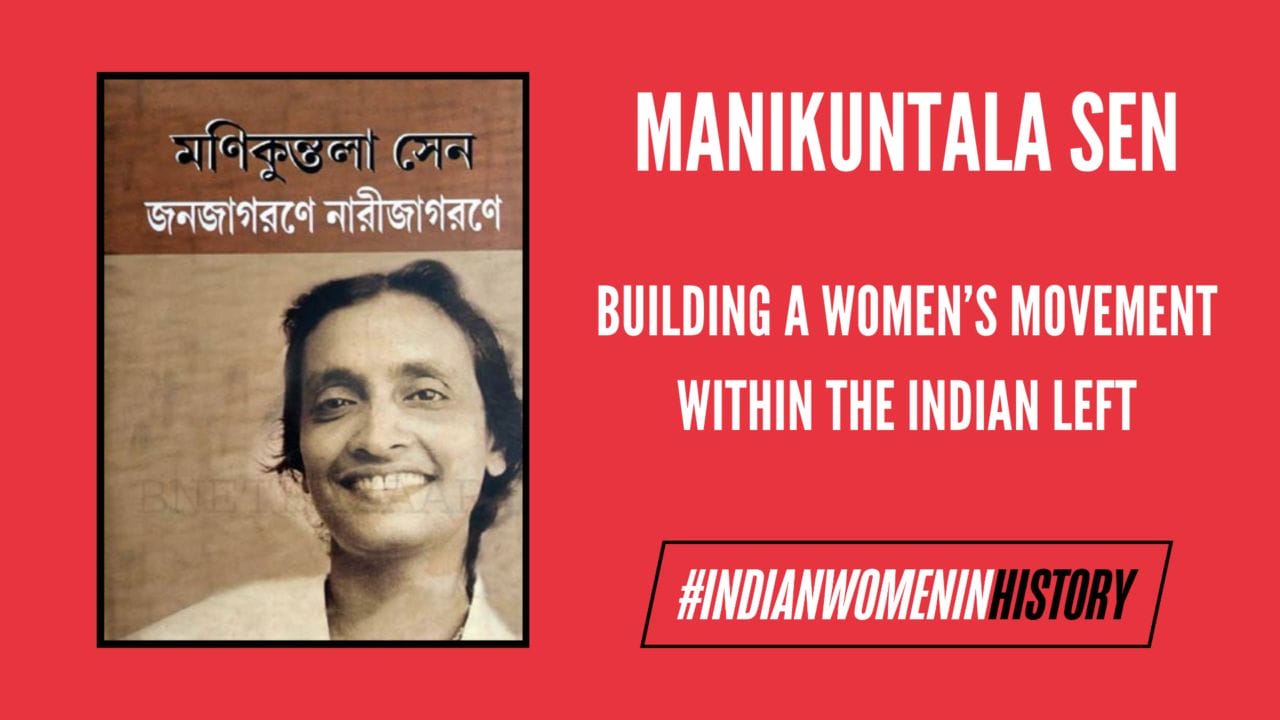

The memoirs by Manikuntala Sen, “In Search of Freedom: An Unfinished Journey,” is pivotal as it documents the work of women activists in West Bengal. It is an erudite account of an activist and women’s leader who had worked tirelessly to create a unique grassroots movement in India.
Manikuntala Sen was born in Barisal (now Bangladesh) in 1910 (the exact date of birth is unknown). She grew up in a conservative, spiritual household but was one of the few educated women in her society. The students at that time were influenced by the freedom struggle and revolutionary politics that were brewing in the country. Manikuntala was no exception. Despite her misgivings, she secretly began reading books about revolutionaries and communism and eventually joined the freedom movement and then the Communist Party of India. She emerged as a pioneering women leader and activist who played a crucial role in mobilizing women at the grassroots, particularly during the most turbulent times of the Bengal famine in 1943 and the Tebhaga struggle in 1946.
Her connection to her hometown is clear in her memoirs. Recalling her childhood in Barisal, one can almost feel both her love and longing for this place. She could never come to terms with the division and the changes in the city. This was her greatest regret as she says, “How can I share the pain I felt about the division of the country, how can I explain how it tore me apart?”
Organizing at the grassroots level
Manikuntala Sen came to Calcutta in 1936 to do her master’s degree, where she first came into contact with the Communist Party of India. She addresses her ambivalent attitude at the beginning: “What was the relationship between the Communist Party and the freedom movement, which was led by the Congress?” She soon realized that while the two remained in alliance, there was a dissonance between them over the development of the freedom movement. She began organizing women at the grassroots alongside farmers and workers. Although it began with a clarion call for the release of prisoners and the freedom struggle, they also used these forums to discuss the emerging communist movement worldwide and its ideology. These forums were truly intersectional and their members were women from different classes and caste backgrounds. This was different than that All India Women’s Conference (AIWC) Members who lacked representatives of the working class.
When communist leaders like Manikuntala Sen began building the movement, their main focus was on establishing village-level samitis. The membership fees for these samitis were kept low (three annas) to ensure that they remained accessible to women of all castes and classes. The main function of the samitis was to open shops at fair prices and set up large canteens to supply khichdi to the people. These groups also provided relief work, organized food for the people, provided educational facilities for children and set up a milk cabin. This work was initiated during the Second World War when Bengal was hit by one of the worst famines. The grassroots movement proved to be a lifeline during these turbulent times that resulted in the deaths of millions of people in Bengal.
The Samitis were first established at the village level across Bengal. They eventually culminated in the founding of Mahila Atma Raksha Samiti (MARS) 1942 in Calcutta. The work of these women through the samitis and canteens became very popular throughout Bengal. The movement soon spread and samitis were formed in every district and then within the villages. The movement to secure food for the starving people was crucial at a time when women were selling their bodies to buy a meal for their families.
Sen’s work discusses in depth the challenges women leaders face in mobilizing women in groups. She talks about fundraising, ensuring women attend meetings, and sustained engagement within the movement. Getting the kitchens operational was a difficult task as pressure had to be put on the government machinery to provide food. They also faced challenges due to patriarchal bias towards their work. For example, the significant marches and protests they organized against food shortages and looting received little or no newspaper coverage. They also received only weak feedback in support of their work from men within the Communist Party.
Even when Manikuntala expressed her concerns during a party meeting, no attention was paid to her. Sen’s work, similar KondapalliIn his memoir “The Sharp Knife of Memory,” he alludes to the apathy of communist party leaders toward the struggles of grassroots activists. They suffered from a lack of food and basic supplies, which negatively affected their health. Sen recalls an incident when she became a full-time party employee and got a salary of Rs. 20. She says, “Initially I was a little hesitant, worried about whether I would be able to live on that amount, which earned me a leader’s rebuke: ‘Why are you a princess, that you won’t be able to do this?'” There was no further protest from me. This culture of denigrating the causes of its members was paternalistic and demotivating for activists, many of whom had joined the movement at the cost of distancing themselves from their families and society.
During a farmers’ conference in 1944, leadership chastised the women organizers for not being “inclusive” in their approach to women in the farmers’ movement. This, according to Sen, was far from the truth. This devastating public insult was very demotivating for several workers who had worked tirelessly to build the movement under such hostile conditions. Leaders like Kanak Mukherjee, who played a crucial role in building the student movement in Bengal, resigned from their full-time positions within the party. This public humiliation by a male leader also shows a lack of sensitivity to understanding the issues and challenges that female cadres may face in their work at the grassroots level, such as the challenge of mobilizing women who would otherwise be relegated to the domestic sphere
Reconcile political ideology with reality on the ground
The memoir reflects the dilemmas women face in negotiating political culture and the distribution of power. During the Quit India Movement, the CPI adopted a wavering stance. They initially decided to support Congress’s demand that the British war effort be supported only if freedom from colonial rule was guaranteed. However, after Nazi Germany attacked Soviet Russia, the party changed its stance and called the war a “people’s war” against fascism and called for support from the British. Manikuntala Sen puts it candidly: “It was no less difficult for us to implement the party line. We really failed in explaining the international situation and our stance to the common people. When just the day before we had claimed ‘Not a single life or paisa for this war’, how can we explain today that this is a people’s war!” Other grassroots activists also faced this problem as they were considered the “dalals” of the colonial empire. They were met with harsh words and even had trash thrown at them. Yet despite this hostility, they mobilized over 20,000 women – an extraordinary achievement.
An Unfinished Journey of Manikuntala Sen
Another unresolved tension concerned atheism in communist ideology. Sen grew up in a spiritual household and struggled internally with this contradiction. Her mother’s reassurance—that serving people was itself a form of religion—offered some reconciliation. Sen later reflected that communism’s aggressive distancing from religion alienated many potential supporters. She rightly points out: “If, at the very beginning of our campaign, we ask middle-class families to get rid of their household deities, are we not alienating them by wounding the most tender part of their hearts?” This would pose many challenges, particularly in mobilizing women as they are expected to maintain traditions and religious practices in the household. By portraying the relationship as antagonistic, it became even more difficult to encourage women’s participation without exposing them to the disapproval or wrath of their families.
Contextualizing Sen’s memoirs in contemporary times
Manikuntala Sen’s work offers invaluable insight into the emergence of a women’s movement and the everyday challenges and dilemmas faced by an activist. It is important for contemporary feminists to understand the historical foundations of women’s mobilization in India. Her narrative is not just autobiographical; It is a chronicle of political education. Many of the themes that are at the forefront of her work are still relevant to the women’s movement today. An Unfinished Journey feels prophetic as we continue to strive for economic, social, legal and political equality and continue to challenge patriarchal structures and the glass ceiling today. By highlighting aspects of emotional and physical labor as well as ideological contradictions, she provides a candid account of how shaping movements is also fraught with challenges and difficulties, both internal and external.
References
- Chakravartty, Renu. Communists in the Indian women’s movement, 1940-1950. New Delhi: People’s Publishing House, 1980.
- Kondapalli Koteswaramma, The Sharp Knife of Memory: A Memoir, trans. VB Sowmya (New Delhi: Language, 2015).
- Loomba, Ania. Revolutionary Desires: Women, Communism and Feminism in India. London and New York: Routledge, 2019.
- Sen, Manikuntala. In Search of Freedom: An Unfinished Journey. Calcutta: Stree, 2001.
