
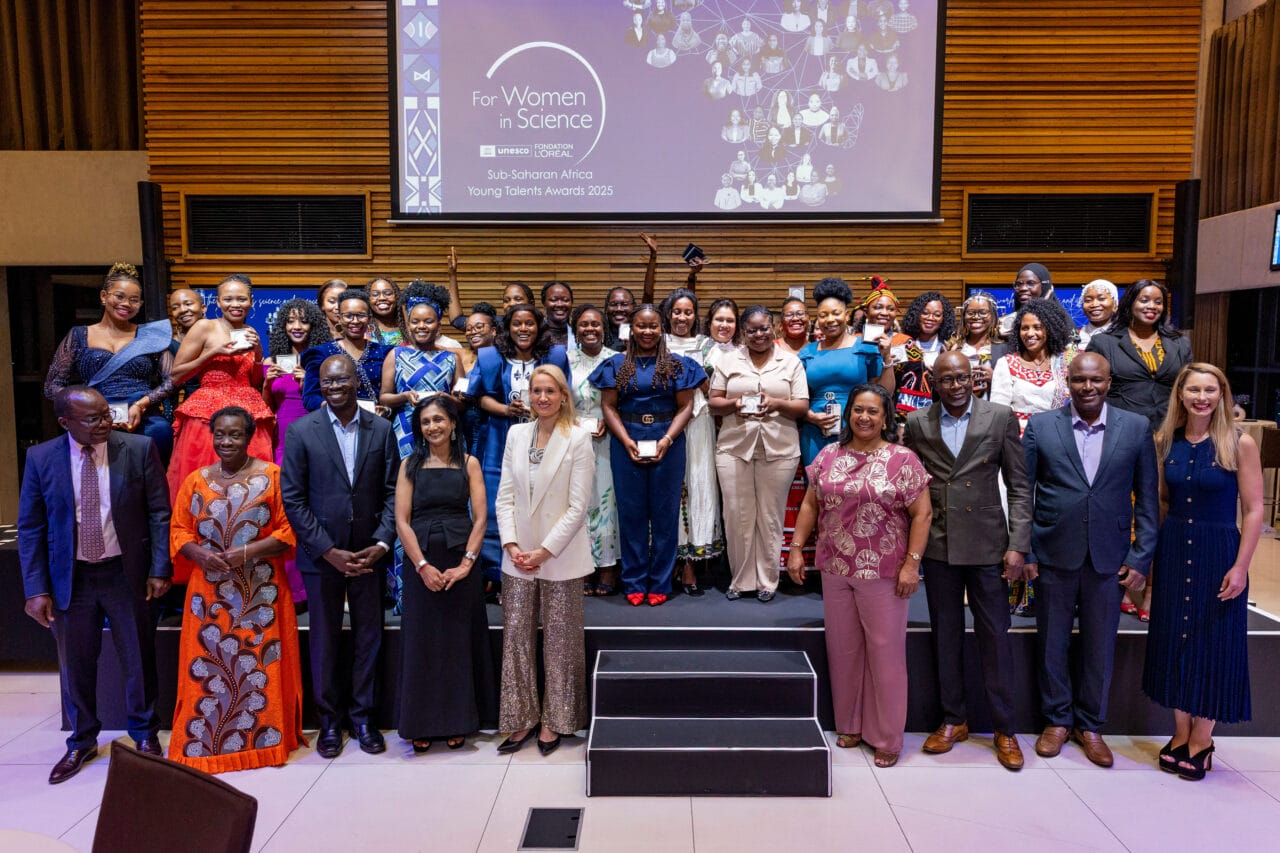
L’Oréal-UNESCO For Women in Science 2025: Celebrating 30 Gamechanging Sub-Saharan Africa Young Scientists

Across Sub-Saharan frica, a new generation of young women scientists is rising with emphatic zeal. They are not only participating in scientific research, but leading and embracing it with laudable Afri-CAN confidence. This week in Johannesburg, South Africa, 30 exceptional young researchers received recognition that validates what they have already been proving in laboratories and field stations: that African women can, and are driving scientific breakthroughs the continent and the world urgently need. Their stories reveal both how far women in science have come, and how much further the journey toward equity still stretches. Our Editor reGina Jane Jere was there to celebrate with them.
In a laboratory in Kenya, Margaret Murage peers through a microscope at cells that could hold the key to more effective cancer treatments for African patients. Hundreds of miles away in Chad, Ramal Cyrielle Ndougonna sequences the genome of cassava plants, searching for varieties that can withstand drought, resist disease, and feed millions across a warming continent. Meanwhile, further down the continent in landlocked Lesotho, Keneuoe Cecilia Nthontho research could have profound implications for breast cancer patients across the African continent. Her work focuses on two critical genes that determine how the body processes and eliminates cancer drugs. Her findings could reshape how oncologists prescribe medication, potentially saving countless lives by matching treatments to patients’ unique genetic profiles.
Until this week, these young scientists had never met, but they share something profound: they are part of a generation of young African women researchers boldly transforming and contributing to science on the continent – which by and large, still marginalises girls in this crucial field..
Murage, Ndougonna, and 28 other exceptional young scientists were named laureates of the 2025 L’Oréal-UNESCO For Women in Science Young Talents Sub-Saharan Africa Awards. Selected from a competitive pool of more than 550 applications spanning 18 countries, these 25 PhD candidates and 5 postdoctoral researchers represent something larger than individual achievement. They embody a quiet revolution taking place in laboratories, field stations, and universities across the continent.
“We believe that the future of science in Sub-Saharan Africa relies on recognizing and supporting women scientists,” Pauline Avenel-Lam

“This year we celebrated here in Johannesburg 30 amazing talents in science from Sub-Saharan Africa. And these young women are not just amazing but passionate and truly talented. They are solving some of the world’s greatest challenges – from food security to cancer treatments. The impact of their work is not only local, but very global as well, and this is why it is important to ensure that such talent is made more visible and the voices of these girls are heard, because that will also encourage the younger generation to embrace science,” Pauline Avenel-Lam, Executive Director of The Fondation L’Oréal, ((Pictured above) tells NewAfricanWoman
Since its inception in 1998, the For Women in Science programme has supported more than 4,700 researchers from over 140 countries.

The jury that selected this year’s awardees, was chaired by Professor Priscilla Baker, (pictured above) a seasoned chemistry professor at South Africa’s Western Cape University. She is herself a 2025 International L’Oréal-UNESCO For Women in Science laureate. Baker and nine fellow scientists evaluated candidates across diverse fields – from life and environmental sciences to material sciences, engineering, technology, and formal sciences.
Professor Baker reflects on the selection process with evident pride and candor. “The applicants for this round of awards were truly exceptional. The academic quality of the applications and the scholarship in their writing was impressive,” she tells NewAfricanWoman. “We did our due diligence to examine the dossiers and come up with this top list of winners, but it was a very challenging exercise—such good quality science by strong young women representing Sub-Saharan Africa.”
Beyond the academic credentials, Baker notes what struck her most during personal engagement with the laureates. “The things that they worry about are the things that all women worry about: how to balance work life, our ambitions as women for motherhood and raising a family, and our ambition to be excellent in science,” she observes. “This is an ongoing challenge for women in science, and we really need mentors and senior women to come alongside our young talents -to live the example, but also to encourage and mentor them in finding that balance that works for each individual, because it’s so different for everybody’s journey.”
What unites the 2025 winners wasn’t just academic excellence, but a shared commitment to addressing the challenges that matter most to Africa: food security, public health, sustainable development, and inclusive digital transformation.
Growing Momentum

Across the cohort of 30 laureates, the pattern repeats: young women scientists placing their considerable talents in service of solutions that Africa urgently needs.
The recognition comes at a pivotal moment for women in African science. Across Sub-Saharan Africa, the landscape is shifting, though unevenly. Kenya offers perhaps the most striking example of what’s possible: in just one decade, the proportion of women researchers has surged from 25.7% in 2013 to 38.4% in 2023 – a remarkable 12 percentage point leap that UNESCO’s latest report highlights as evidence of growing momentum.
In higher education, the numbers tell an even more encouraging story. Women now represent 58% of graduates in Namibia and 60% in South Africa, suggesting a pipeline of talent that could reshape the continent’s scientific future.
Yet these bright spots illuminate a persistent shadow. Despite such progress, women scientists still comprise only one in three researchers across Sub-Saharan Africa – a ratio that mirrors the global average and reveals how far the journey toward equity even in the science world remains – as the 2030 deadline for achieving the UN SDGs fast approaches.
The glass ceiling in science, is indeed a global phenomenon, and breaking through requires sustained, deliberate action. As such the support given to young scientists like these is an ever growing need.
Science as Solution
What makes this year’s laureates particularly compelling is how directly their work addresses Africa’s most pressing challenges. Murage’s cancer research, for instance, isn’t abstract bench science—it’s driven by the reality that cancer treatments developed primarily for Western populations often prove less effective for African patients with different genetic profiles and disease presentations. Her work could save countless lives by tailoring therapies to the populations that need them most.
Ndougonna’s cassava research carries equally profound implications. As climate change intensifies droughts and new diseases threaten crops, her genomic work to identify resilient, high-yielding, nutritionally enhanced varieties could prove crucial to food security for millions who depend on cassava as a staple. It’s the kind of research that doesn’t just advance scientific knowledge—it prevents hunger.
These aren’t isolated examples. Across the cohort of 30 laureates, the pattern repeats: young women scientists placing their considerable talents in service of solutions that Africa urgently needs. They’re developing new materials, advancing digital technologies, protecting ecosystems, and pioneering innovations that will ripple far beyond the continent’s borders.

Building a Movement
“We believe that the future of science in Sub-Saharan Africa relies on recognizing and supporting women scientists,” she explains. “Through the L’Oréal-UNESCO For Women in Science Sub-Saharan Africa Young Talents Awards, we showcase women scientists who are pioneering sustainable change and delivering solutions for Africa and the world,” emphasises Avenel-Lam.
For Lidia Brito, UNESCO’s Assistant Director-General for Natural Sciences, the awards demonstrate the power of strategic partnership. “UNESCO champions women researchers at the heart of Africa’s scientific transformation,” she notes, adding: “The L’Oréal–UNESCO For Women in Science Sub-Saharan Africa Young Talents Awards show how partnership can open doors, amplify voices, and accelerate impact. By celebrating these remarkable young researchers, we reaffirm our commitment to their success and to Africa’s sustainable and equitable future.”
The support extends beyond recognition. Each PhD candidate receives a €10,000 grant, while postdoctoral researchers receive €15,000—funding that can make the difference between abandoning research and pushing through to breakthrough. But perhaps more valuable than the money is what comes with it: training in leadership, scientific communication, and career development, skills that transform talented researchers into influential scientific leaders.
These young talents’ larger mission is broad and apt – to help build a scientific ecosystem in Africa ( and beyond) where talent, not gender, determines opportunity.
A larger mission
The 30 new laureates join a community that has been building for over 16 years. Since the L’Oréal-UNESCO For Women in Science Young Talents Sub-Saharan Africa programme launched, it has supported more than 270 women scientists from over 35 countries. These women now work in universities, research institutes, government agencies, and private companies across the continent and beyond – with their influence multiplying with each student they mentor, each paper they publish, each policy they inform.
They are also part of something even larger: a global network of more than 4,700 women scientists supported by the international programme since its creation in 1998. It’s a network that spans continents and disciplines, united by the experience of being women in science and the determination to make the path easier for those who follow.
For the 30 women honoured this year, the award marks both an arrival and a beginning. They have proven their excellence, secured recognition, and gained resources to advance their work. But their larger mission – to help build a scientific ecosystem in Africa where talent, not gender, determines opportunity. Sadly, this gender equality in fields of science, remains a work in progress.

In laboratories and field sites across Sub-Saharan Africa, that work continues. Cells divide under microscopes. Data streams from sequencers. Experiments succeed and fail and succeed again. And slowly, steadily, the face of African science is changing, and these young women are the chnagemakers. We celebrate them.
EDITOR’s NOTE: Look out for the full Profiles of the 2025 FWIS Laureates to be published soon.
