
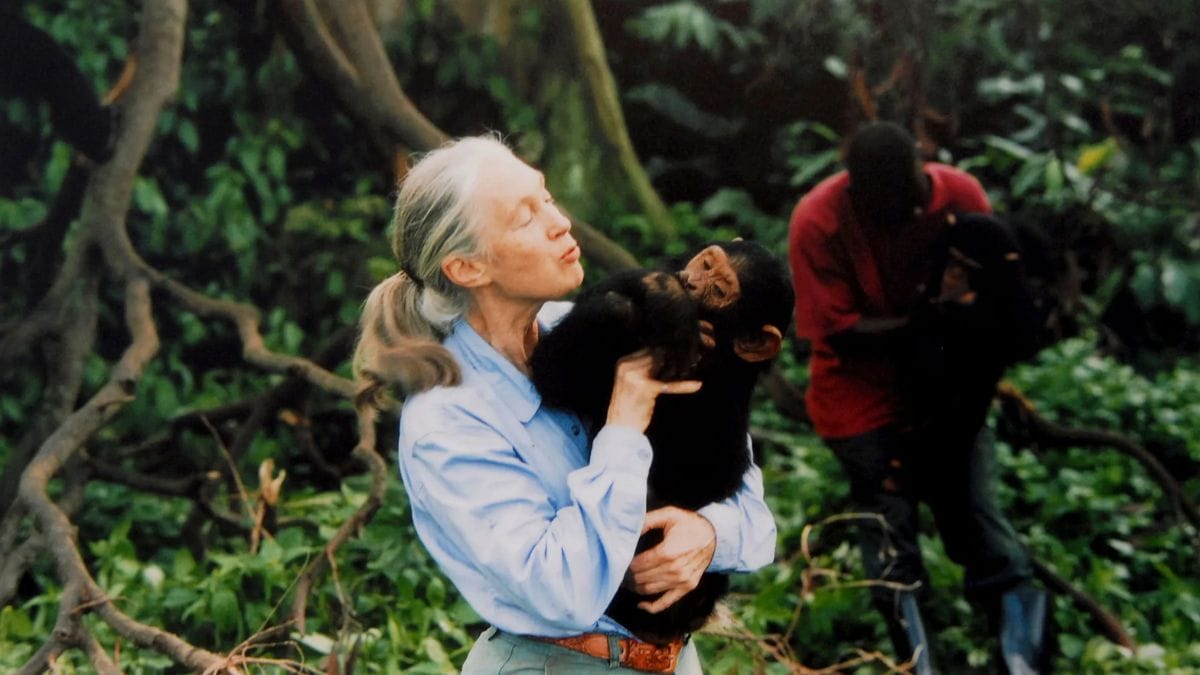

Jane Goodall, the celebrated British primatologist, conservationist and activist, died a natural death on October 1, 2025, during a speaking tour in California. She was 91 years old. Over six decades, with her groundbreaking research on chimpanzees in Africa’s Gombe Stream National Park, Goodall had not only become an unconventional but formidable scientist in the predominantly male scientific community of the 1960s, but she had also earned a reputation as one of the most influential public intellectuals, through her numerous nonprofit educational ventures involving many young people used nature conservation. Goodall was a trailblazer who paved the way for this Women in sciencein particular the involvement of female scientists in field research in the natural sciences.
Jane Goodall was born Valerie Jane Morris-Goodall in London in 1934 and grew up primarily in the rural counties of Bournemouth, England. Jane Goodall’s childhood was spent with long, patient hours exploring the landscape and its wildlife habitats, which would later become her life practice. Her lifelong passion for Africa came from a toy chimpanzee named Jubilee that her father gave her when she was one year old. Goodall’s extraordinary life is unforgettably documented in the documentary film Brett Morgen’s documentary Janeproduced by National Geographic, which offers exquisite insights into the unconventional paths of a young woman determined to visit Africa “to live with animals.” “Going to Africa and living with animals: that’s all I ever thought about,” Goodall explains in the documentary.
Goodall’s life-changing journey
Goodall worked odd jobs to earn her passage to Kenya in 1957, where she had a chance meeting with the anthropologist, archaeologist and paleontologist Louis Leakey changed her life forever. At first, Leakey employed Goodall as his secretary. In 1960, after securing a research grant, Leakey looked for someone with a “mind unbiased by scientific theory… a passion for knowledge, with a love of animals, and with enormous patience” to work on his project studying chimpanzees in the wild. Leakey believed that studying chimpanzees would provide better insight into chimpanzee behavior early humanswith the great apes being our closest relatives on the evolutionary ladder. Before the Gombe expedition, there had been no studies of chimpanzees in the wild.
Getty Images
Goodall’s natural curiosity and endless patience for spending hours in the wilderness observing animals with just a pair of binoculars impressed Leakey. In 1960, Leakey sent Goodall as his research assistant Studying chimpanzees in the wild in Gombe Stream National Park in Tanzania. The priceless historical footage of Goodall in Gombe, taken by Goodall’s first husband, the outstanding nature photographer Hugo van Lawickshown in Jane, depicts the everyday life of a 26-year-old Goodall in khaki shorts and a shirt with binoculars and a notebook in hand, traversing miles of treacherous forests on foot, in the sun, in the rain, perching on hills, crossing rivers and ravines, documenting wildlife and patiently waiting in silence and good humor for the chimpanzees to pass before her watchful eyes turn up. “My mission,” Goodall later recalled, “was to get close to the chimpanzees, live among them and be accepted.”
Goodall and the first family of chimpanzees
All the best has written extensively about the challenges researchers face when studying a wild animal in its natural habitat. Animals are afraid of humans, the apex predator, and will flee from any human who observes them, even if they pose no threat to the animal. You have to wait until the animal trusts you and approaches you. In the fifth month of a six-month research fellowship, Goodall finally found acceptance among the chimps when the chimps revealed themselves to Goodall and remained in her presence and went about their activities without paying attention to her or running away from her.
Goodall’s findings about chimpanzee behavior in the wild shocked the 1960s scientific establishment when they were published. Goodall learned that the chimpanzees used tools the same way humans do: They used sticks to fish termites out of termite mounds and holes in the ground.
Goodall, “the white monkey,” as she called herself, began a close association with chimpanzees that would last over six decades. Goodall named the first chimpanzee family she studied: David Greybeard, an older, gentle man; Flo, the powerful matriarch of the “F” family; Fifi, Flo’s daughter; Figan, Frodo and Flint, three of Flo’s sons; and the other males Goliath, Mike, Stan, Humphrey and Mr McGregor as well as the female chimpanzee Passion.
Goodall’s findings about chimpanzee behavior in the wild shocked the 1960s scientific establishment when they were published. Goodall learned that the chimpanzees used tools just like humans: they used sticks to fish termites out of termite mounds and holes in the ground; They sharpened twigs into spears in “object modification,” or the beginning of tool making. They used leaves like sponges to absorb water from crevices; they used stones to crack nuts; and they used pumpkins as toys to play with each other. Goodall’s work revealed striking similarities between chimpanzees and humans: they craved touch and comfort, carefully raised their young, mourned their dead, lived in communities, and even attacked enemies. These groundbreaking observations suggested that chimpanzees solve problems, show imagination and experience emotions – challenging the scientific community to think outside the traditional framework.
These empirical findings, extensively documented through photographic images and research protocols, caused uproar because they appeared to challenge the very definition of what it means to be human at an evolutionary level. The uniqueness and uniqueness of humans didn’t seem so unique and unique after all. When Louis Leakey looked at Goodall’s results, he simply stated: “We must now redefine humans or accept chimpanzees as humans.” Of course, Goodall’s initial findings have now become common wisdom in primatology.
From research to activism
In 1977, Goodall founded the Jane Goodall Institute to expand the scope of their work from scientific research to more active conservation and protection of chimpanzees in the wild and environmental protection. Goodall had become increasingly aware of the ongoing illegal trade, habitat destruction and poaching that were directly impacting chimpanzees’ natural habitat. The Jane Goodall Institute established community-based conservation education programs in which local communities acted as stewards of their environment, which was critical to ensuring the long-term welfare of animals in the wild. Since then, the Institute has become a primary research facility for ongoing studies of chimpanzee and other primate behavior, conservation efforts, and community development programs throughout Africa.
“My mission,” Goodall later recalled, “was to get close to the chimpanzees, live among them and be accepted.”
In particular, the Roots and Shoots initiative of 1991 Establishing the institute was Goodall’s solution to the problem of youth restlessness and hopelessness that she witnessed firsthand in Tanzania and elsewhere in Africa. By encouraging young people to identify issues that matter to them, pursue their passions, and then support them in leadership skills, community and civic engagement, and service-learning projects, the Roots and Shoots Project empowers young people to take their lives and those around them in a positive direction.
Getty Images
Roots and Shoots programs operate in over 75 countries with over a million youth volunteers and activists working on service projects ranging from tree planting and coastal cleanup to beekeeping, creating sustainable urban vegetable gardens, and many other environmental activities. In India, the Jane Goodall Institute’s Roots and Shoots program oversees the Vanya Bharat initiative which brings schools and students together to rediscover, protect and celebrate the diversity of India’s wilderness.
Goodall’s two mothers
Goodall’s extraordinary life was, above all, a beacon for women in science, particularly in disciplines such as primatology that are based entirely on field research. Goodall studied chimpanzees without a college degree, but received her doctorate in ethology, the science of animal behavior, from the University of Cambridge in 1965, based on her groundbreaking data on chimpanzee behavior. Their methods were initially viewed by the male establishment as unscientific and unconventional; For example, giving chimpanzee “subjects” names instead of numbers and interacting with the animals instead of observing them from a distance. Several well-known ethologists such as Dian Fossey, Birute Galdikas, Alison Behie, Cheryl Knott, Mireya Mayor and others pay tribute to Goodall for inspiring her to pursue her passion and study primates in the wild and to pursue the fearless freedom of claiming a home in the wild with animals.
Goodall himself credited her mother for supporting her passion for studying animals. Goodall found that the sources of maternal care had more similarities than differences between species and their models of motherhood for her own son HugoAffectionately known as “Grub,” her mother was Vanne and Flo, the chimpanzee mother. Her legacy is a life filled with empathy for nature, love for animals, and the courage to go where no one has gone before to enrich our understanding of the planet we call home.
Gayatri Devi, writer, translator, gardener and home cook, was born and raised in Kerala and now lives and works in the United States.
