


MILAN — Iconic Italian luxury brand for sale. An array of fashion labels, a booming licensing business for beauty and eyeglasses, not to mention hotels, restaurants and prime Milan real estate. Price negotiable.
On paper, it looks like an asset that would soon find a buyer eager to seize the once-in-a-generation opportunity to snag one of Europe’s last independent luxury giants.
So why, almost six months after the death of Giorgio Armani, have there been no firm offers for the company that bears his name? Check the fine print: the company’s core fashion business is losing money, its brand architecture needs a revamp, and the drawn out timeline stipulated in Mr Armani’s will mean a buyer can only acquire a 15-percent stake initially and may never have total control.
Six different share classes further muddle the situation, as does the task of trying to sell a fashion company two and a half years into a luxury downturn that has battered the industry, in particular aspirational brands like the sporty Emporio Armani and others in the company’s portfolio.
As Milan Fashion Week kicks off, the future of Armani Group remains a subject of fascination. Behind the scenes, potential bidders are diving into the company’s books, though a deal is unlikely to be inked until much closer to the beginning of next year — Mr. Armani, who died in early September, decreed in his will that a sale of the first tranche of the group must take place between 12 and 18 months after his death.
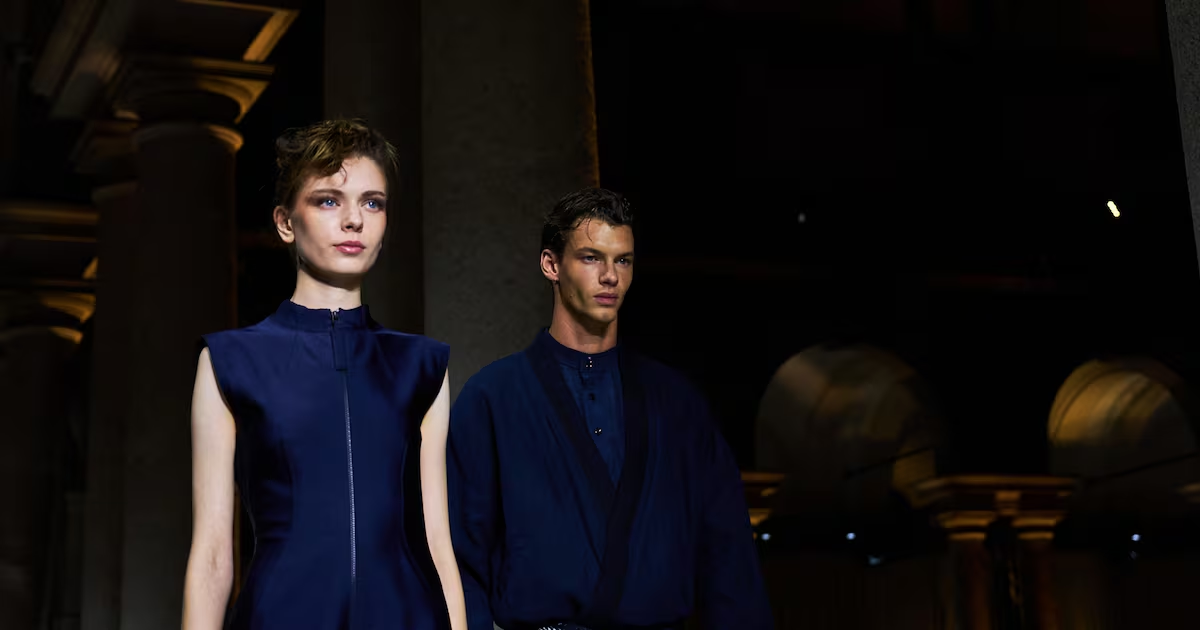
Meanwhile, it appears to be business as usual at the company, even as its future hangs in the balance. Longtime deputies of Mr. Armani are leading the design of new collections, which will be presented this week in the brand’s traditional venues. (Silvana Armani, the late designer’s niece who worked alongside him for decades, will be there to take a bow after Sunday’s runway display of the latest Giorgio Armani lineup in a theatre at Mr. Armani’s long-time residence).
Mr. Armani, who had a near-maniacal attention to detail for the sprawling business he built over half a century, stipulated in his last testament that the first 15 percent of the company must be sold to LVMH, L’Oréal, EssilorLuxottica or a group of similar stature. A further stake of between 30 percent and 54.9 percent is to be sold to the initial buyer between three to five years after his death, but the Armani Foundation will retain at least 30.1 percent of the company. An initial public offering is allowed as a safety valve if no buyer is found.
“It’s not a straight deal with one company buying another and multiple parties are involved, so it’s normal that this takes time, which is why in his will Armani gave them 18 months to get it done,” said Pierre Mallevays, who worked for six years as LVMH’s head of acquisitions in the early 2000s and is launching a new boutique advisory firm this month.
Armani is probably worth between €4 billion ($4.7 billion) and €7 billion if somebody were to buy the entire company outright, according to industry analysts and insiders. The stipulations Mr. Armani put in his will are expected to be a drag on the price of the initial 15 percent, as are the 2024 operating loss and 5 percent drop in revenue. At the mid-point of the current valuation, the 15 percent stake would cost €825 million.
L’Oréal and EssilorLuxottica are seen as the most likely buyers because of their large long-term licensing deals with Armani. The L’Oréal partnership is estimated to generate about €1.5 billion in revenue, and for EssilorLuxottica it’s likely around €300 million. About 10 percent of these amounts gets kicked back to Armani in royalties.
“L’Oréal’s licence with Armani runs to 2050 so there is no risk of non-renewal or breakup in the short term; however, it would make a lot of sense to secure the assurance that the licence is infinite [by buying a stake in Armani],” said Charles-Louis Scotti, the head of luxury goods equity research at Kepler Cheuvreux. “For L’Oréal, the licence is probably the third-biggest luxury beauty brand of their portfolio after Lancôme and Yves Saint Laurent.”
LVMH, L’Oréal and EssilorLuxottica declined to comment.
“When the time comes we will study options that open up to us,” L’Oréal CEO Nicolas Hieronimus told French daily Les Echos this month. The executive stressed the beauty giant’s forty-year partnership with Armani, adding that Armani should continue to focus on areas like fashion and hospitality while L’Oreal looks after the long-term beauty licence.
Estée Lauder’s 2023 acquisition of Tom Ford — with the American company buying the label for the beauty licence and outsourcing management of the fashion business to Zegna — could be a template, said Scotti.
Kering is seen by some industry insiders as a potential partner to L’Oréal, given the beauty giant’s longtime licence for Kering label Yves Saint Laurent and its recent acquisition of beauty licences for several of Kering’s other brands.
L’Oréal has dabbled outside of its vast portfolio of beauty brands. The beauty giant owned Lanvin in the 1990s, but eventually sold it. It owns Mugler, which it bought in 2019, obtaining the brand’s top selling perfumes Angel and Alien. L’Oréal also recently took a minority stake in French fashion upstart Jacquemus with an eye to launching beauty products for the brand.
EssilorLuxottica has said little about its intentions regarding Armani. Chief executive Francesco Milleri told Il Sole 24 Ore earlier this month that he wants to preserve the close relationship the two companies shared when they were run by Armani and the late Luxottica founder Leonardo Del Vecchio.
“If our support is useful during this transition phase, we will be there,” Milleri told the Italian daily newspaper. But almost four years after his death, Del Vecchio’s eight heirs are still at an impasse regarding their inheritance, which could complicate any decision to invest in Armani.
Armani’s sprawling business empire, which includes hotels in Milan and Dubai and restaurants around the world, could also attract a wider pool of potential buyers: sovereign wealth funds, private equity firms, even a consortium of investors led by a luxury executive are other scenarios that have been evoked by M&A specialists.
“LVMH built its business by progressively reducing its dependence on fashion, which by its nature is volatile, and diversifying its portfolio from the late 1980s into more recurring and less cyclical areas such as wines and spirits, retailing, watches and jewellery,” said Carmine Porcaro, a director at AlixPartners who heads the advisory firm’s fashion and luxury goods practice in Milan. “A potential buyer could look at Armani through this same diversification lens.”
Meanwhile, LVMH or another large fashion group is seen by industry insiders as less likely to invest in Armani. Though Armani is one of Europe’s last sizeable, independent luxury brands, and LVMH in the past has shown interest in the Milanese fashion house, the luxury slump has prompted the group to sharpen its focus. Portfolio trimming seems more likely for the French giant, which is known to prefer gaining full control of an acquisition.
“I don’t see LVMH taking a minority stake in a business that is big and quite diverse with lots of price points,” said Mallevays.
LVMH might also be turned off by the possibility that the Italian government could get involved to protect a national icon, he said.
Armani’s final act, a will designed to protect his legacy at all costs, may have inadvertently built a fortress that even the deepest-pocketed suitors are hesitant to storm.
Disclosure: LVMH is part of a group of investors who, together, hold a minority interest in The Business of Fashion. All investors have signed shareholders’ documentation guaranteeing BoF’s complete editorial independence.
