


Abstract
Liver fibrosis represents a dynamic process characterized by excessive deposition of extracellular matrix components in response to chronic hepatic injury. Progressive fibrosis may ultimately lead to cirrhosis, portal hypertension, and hepatic failure. Accurate assessment of fibrosis stage is therefore central to clinical management of chronic liver disease. Traditionally, liver biopsy has been considered the reference method for fibrosis assessment. However, biopsy is invasive, subject to sampling variability, and not suitable for repeated monitoring. These limitations have driven the development of non-invasive biomarker-based approaches. The Enhanced Liver Fibrosis test was developed to quantify circulating indicators of fibrogenesis and matrix turnover. By measuring biochemical products involved in connective tissue remodeling, the test provides insight into the biological activity underlying fibrotic progression rather than simply structural change. This research-based article presents a comprehensive discussion of the biological foundation, analytical methodology, interpretation principles, clinical applications, advantages, limitations, and integrative perspectives relevant to the ELF test.
Introduction
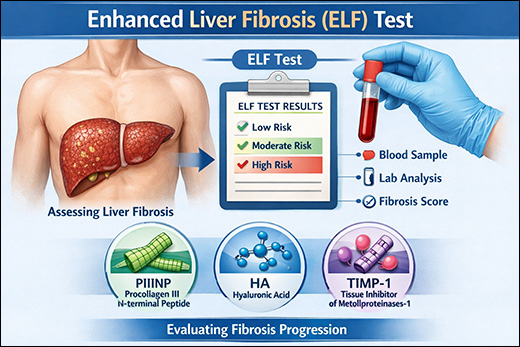
The Enhanced Liver Fibrosis (ELF) test is a non-invasive serum biomarker panel designed to assess liver fibrosis by measuring circulating markers of extracellular matrix turnover and fibrogenesis. It provides a quantitative score reflecting fibrotic activity within hepatic tissue, enabling evaluation of disease severity, risk stratification, and monitoring of disease progression in chronic liver disorders. The test integrates three biochemical markers associated with collagen formation and tissue remodeling, offering an objective measure of fibrotic burden without the need for invasive biopsy.
Biological Basis of Liver Fibrosis
Fibrosis develops as a wound-healing response to persistent hepatic injury. Key pathophysiological mechanisms include:
- Activation of hepatic stellate cells
- Increased synthesis of collagen and matrix proteins
- Reduced degradation of extracellular matrix
- Tissue remodeling and architectural distortion
The process involves continuous turnover of connective tissue components. Molecules released during matrix formation and degradation enter the bloodstream and can be quantified as indicators of fibrotic activity.
The ELF test is based on the principle that circulating levels of specific matrix-related proteins correlate with the degree of fibrogenesis within liver tissue.
Biomarker Components of the ELF Test
The ELF score is derived from three serum biomarkers representing distinct aspects of extracellular matrix remodeling.
Hyaluronic Acid (HA)
Hyaluronic acid is a glycosaminoglycan produced by hepatic stellate cells and cleared by liver sinusoidal endothelial cells. Elevated circulating levels reflect impaired clearance and increased matrix deposition. Hyaluronic Acid concentration rises as fibrosis progresses and correlates with extracellular matrix expansion.
Procollagen III Amino Terminal Peptide (PIIINP)
PIIINP is released during synthesis of type III collagen, a major structural component of fibrotic tissue. Increased levels indicate active collagen production and fibrogenesis.
Tissue Inhibitor of Metalloproteinase-1 (TIMP-1)
TIMP-1 regulates matrix degradation by inhibiting matrix metalloproteinases. Elevated levels reflect reduced breakdown of the extracellular matrix and promotion of fibrotic accumulation.
Each marker represents a distinct biological pathway involved in fibrosis progression. Their combined measurement provides a comprehensive indicator of connective tissue remodeling.
Calculation of the ELF Score
The ELF score is generated through a proprietary algorithm that integrates concentrations of HA, PIIINP, and TIMP-1. The resulting numerical value represents the overall fibrotic activity within hepatic tissue.
The score is continuous rather than categorical, allowing stratification across a spectrum of disease severity.
Test Procedure and Methodology
Specimen Collection
- Venous blood sample
- Serum separation following centrifugation
- Standard laboratory handling procedures
No special patient preparation is typically required.
Analytical Techniques
Each biomarker is measured using immunoassay-based methods that employ antibodies specific to the target proteins. Automated platforms ensure standardized quantification and reproducibility.
Quality control measures ensure analytical precision and reliability of results.
Reference Values and Interpretation
Although exact thresholds vary among laboratories, general interpretive ranges are widely applied.
Typical Interpretive Framework
- Low ELF score – minimal fibrotic activity
- Intermediate ELF score – moderate fibrosis
- High ELF score – advanced fibrosis or cirrhosis
The score reflects biological activity rather than static structural damage. Clinical interpretation requires correlation with disease context and other diagnostic findings.
Clinical Interpretation Principles
- Low Score – Suggests limited extracellular matrix deposition and minimal fibrotic progression. Indicates relatively preserved tissue architecture.
- Intermediate Score – Reflects active fibrogenesis and moderate matrix remodeling. Clinical monitoring is recommended to assess progression risk.
- High Score – Indicates significant connective tissue accumulation and advanced fibrotic activity. Associated with increased risk of complications related to chronic liver disease.
- Trend Assessment – Serial ELF measurements provide valuable information regarding disease dynamics:
- Increasing values indicate progression of fibrosis
- Stable values suggest disease stability
- Declining values suggest reduced fibrotic activity
Clinical Applications
Assessment of Fibrosis Severity
The ELF test provides quantitative evaluation of fibrotic activity across various chronic liver conditions. It assists in staging disease severity and identifying patients at higher risk of progression.
Risk Stratification
Elevated ELF scores are associated with increased risk of hepatic complications and adverse outcomes. The test supports clinical decision-making regarding surveillance and management strategies.
Monitoring Disease Progression
Because the test is non-invasive, it is suitable for repeated measurement. Serial assessment allows monitoring of fibrotic activity over time.
Evaluation of Treatment Response
Changes in ELF score may reflect response to therapeutic interventions aimed at reducing hepatic injury or fibrogenesis.
Research Applications
The test is widely used in clinical research investigating fibrosis progression, treatment efficacy, and disease mechanisms.
Comparison With Traditional Fibrosis Assessment
Liver Biopsy
Biopsy provides direct histological assessment but has limitations:
- Invasive procedure
- Sampling variability
- Risk of complications
- Limited repeatability
Imaging-Based Methods
Imaging techniques evaluate structural changes but may not reflect biological fibrotic activity.
Biomarker-Based Assessment
The ELF test differs by measuring molecular processes underlying fibrosis. It provides a dynamic indicator of tissue remodeling rather than structural morphology.
Advantages
- Non-invasive assessment of fibrosis
- Reflects active fibrogenesis
- Quantitative and reproducible
- Suitable for serial monitoring
- Reduces need for invasive procedures
- Provides risk stratification information
Limitations
- Not a direct measure of histological architecture
- Interpretation requires clinical context
- Influenced by systemic connective tissue metabolism
- Laboratory-specific reference ranges
- Cannot determine etiology of liver disease
Despite these limitations, the ELF test represents a valuable tool for evaluating fibrotic activity in chronic liver disorders.
Pathophysiological Significance
Fibrosis reflects imbalance between matrix synthesis and degradation. Elevated ELF components indicate:
- Increased collagen production
- Reduced matrix breakdown
- Enhanced tissue remodeling
- Progressive architectural alteration
Thus, the ELF score serves as a biochemical representation of connective tissue dynamics within the liver.
Integrative Hepatic Support: Ayurvedic Perspective
Traditional hepatoprotective botanicals emphasize preservation of metabolic balance, tissue integrity, and physiological detoxification. From a biomedical standpoint, several herbs demonstrate antioxidant and hepatocyte-supportive properties that may help maintain conditions associated with stable extracellular matrix regulation.
Bhumi Amalaki (Phyllanthus niruri)
Bhumi Amalaki (Phyllanthus niruri) contains lignans such as phyllanthin and hypophyllanthin that support antioxidant defense systems and hepatocyte membrane stability. Experimental studies suggest modulation of oxidative stress pathways that influence cellular injury and fibrogenic signaling.
Kalmegha (Andrographis paniculata)
Kalmegha (Andrographis paniculata) is rich in andrographolide, which demonstrates anti-inflammatory and hepatocyte-protective properties. Research indicates potential influence on cellular stress pathways involved in fibrogenesis.
Kutki (Picrorhiza kurroa)
Kutki (Picrorhiza kurroa) contains iridoid glycosides that support hepatocyte function and reduce oxidative injury. Experimental evidence suggests modulation of inflammatory signaling associated with tissue remodeling.
Bhringaraja (Eclipta alba)
Bhringaraja (Eclipta alba) provides flavonoids and wedelolactone that support cellular regeneration and antioxidant activity. Traditionally regarded as supportive for hepatic structural integrity.
Punarnava (Boerhavia diffusa)
Punarnava (Boerhavia diffusa) demonstrates antioxidant and metabolic regulatory effects that support tissue homeostasis and microcirculatory balance within hepatic tissue.
These botanicals are considered supportive for maintaining physiological liver function and do not replace medical diagnosis or treatment.
Research Developments
Ongoing research continues to evaluate the role of ELF testing in predicting clinical outcomes, assessing therapeutic response, and improving non-invasive fibrosis staging. Advances in biomarker technology aim to enhance accuracy and integration with other diagnostic modalities.
Conclusion
The Enhanced Liver Fibrosis test is a scientifically grounded, non-invasive biomarker panel that quantifies extracellular matrix turnover and fibrogenesis within hepatic tissue. By integrating biochemical indicators of collagen formation and matrix regulation, it provides a dynamic assessment of fibrotic activity and disease progression. When interpreted alongside clinical findings and complementary diagnostic methods, the ELF test contributes to comprehensive evaluation of chronic liver disease. Its ability to monitor fibrosis over time supports a modern approach to liver health assessment focused on biological processes rather than invasive structural sampling.
