


Introduction
Gorakhbuti (Aerva lanata), belonging to the family Amaranthaceae, is a medicinal herb traditionally valued for its applications in urinary disorders. In Ayurveda, Ashmari (urinary calculi or kidney stones) is an important condition characterized by the formation of calculi within the urinary system. Several medicinal plants, including Varuna (Crataeva nurvala), Pashanbheda (Bergenia ligulata), Gokshura (Tribulus terrestris), and Kulattha (Macrotyloma uniflorum), are traditionally used in formulations intended to manage urinary complaints and stone-related conditions. Gorakhbuti has also attracted attention for its traditional use in urinary health and its potential antiurolithiatic and diuretic properties. Preliminary investigations have explored its possible role in urinary stone management, although further clinical evidence is required to establish its effectiveness in humans. Understanding Gorakhbuti’s traditional applications and pharmacological potential may contribute to the scientific evaluation of medicinal plants used in Ashmari management.
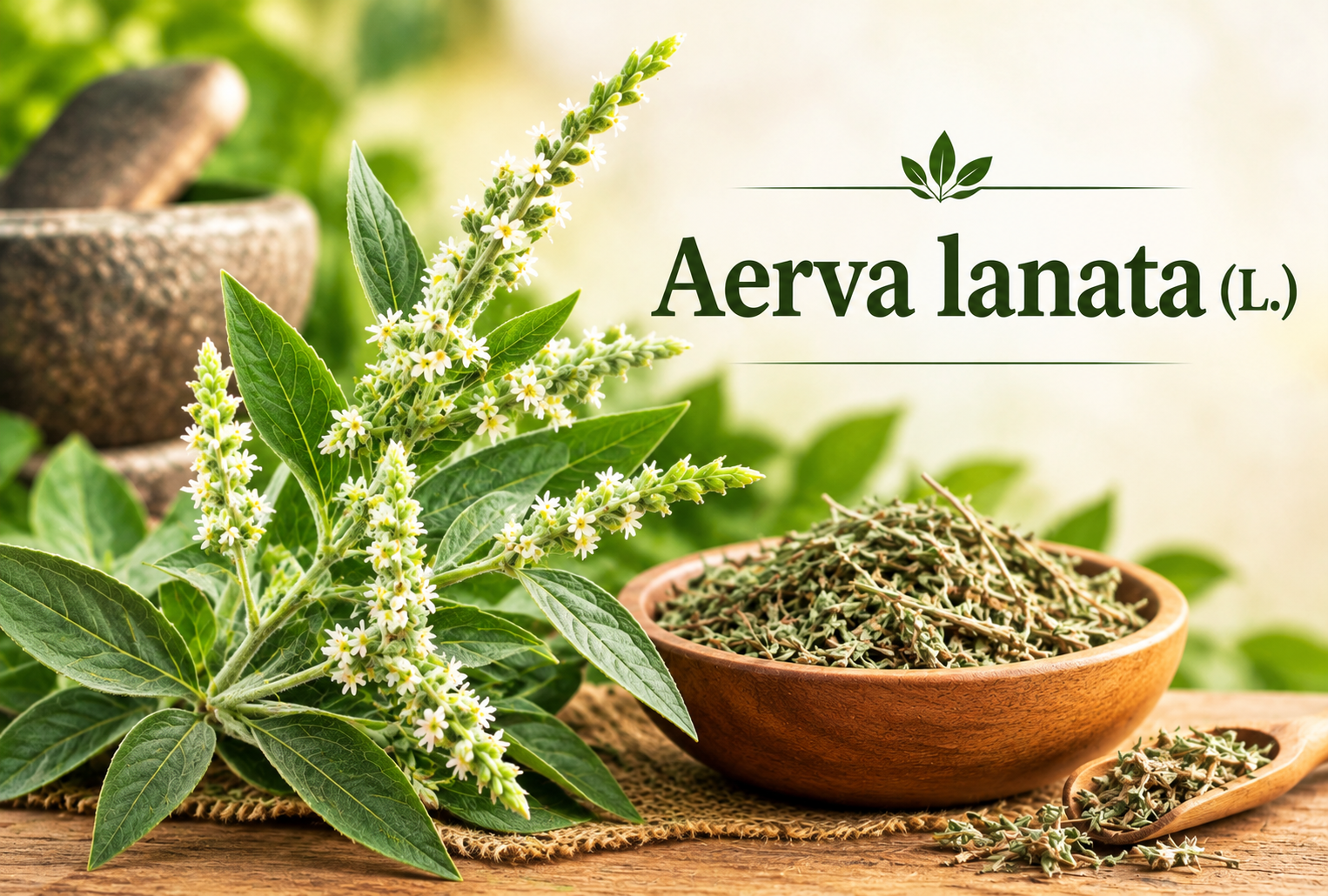
Taxonomic Classification Of Gorakhbuti
Gorakhbuti, scientifically known as Aerva lanata (L.) Juss. ex Schult., is a flowering plant belonging to the family Amaranthaceae. It is commonly known as mountain knotgrass and is recognized for its traditional medicinal applications. Its taxonomic classification is presented below.
Scientific Classification
- Kingdom: Plantae
- Division: Angiosperms (Flowering plants)
- Class: Dicotyledons
- Order: Caryophyllales
- Family: Amaranthaceae
- Genus: Aerva
- Species: Aerva lanata (L.) Juss. ex Schult.
Classical Synonyms
In classical Sanskrit texts and regional lexicons (Nighantus), Aerva lanata is recognized under various descriptive titles reflecting its morphology and therapeutic actions:
- Ādānapāka / Śatakābhedī: Indicating its stone-dissolving and channel-clearing capacity.
- Pashanabheda: The premier Classical epithet referring to its power to break urinary calculi (Ashmari).
- Gorakhganja / Gorakhbuti: The widely recognized traditional name associated with Nath yogic medicine.
- Kapoori Jadi: Derived from the camphoraceous or distinctive aroma of its fresh tissues.
Vernacular Names
- English: Mountain Knotgrass, White Snow Plant
- Sanskrit: Ādānapāka, Śatakābhedī
- Hindi: Gorakhganja, Gorakhbuti, Kapoorijadi
- Bengali: Chay
- Gujarati: Gorakh Ganjo, Kapuro Madhuri
- Marathi: Kapoorphuti, Kumarindi
- Punjabi: Bhu (Bu) Ikkalan
- Sindhi: Boor
- Tamil: Chirubule, Sirrupoolai
- Telugu: Pendidonda, Telagapindi
- Kannada: Vile Muli, Bili Hindigida
- Malayalam: Chirapula, Cherula
Habitat, Distribution
- Habitat: Grows in dry, open areas, grasslands, roadsides, wastelands, and rocky places
- Distribution: Widely distributed in tropical and subtropical regions of Africa, Asia, and other warm regions.Distribution in India: Found in many parts of India, particularly in dry and semi-arid regions.
- Soil: Commonly found in sandy, gravelly, and well-drained soils.
- Climate: Prefers warm tropical climates and tolerates dry conditions.
- Altitude: Generally occurs in lowland and foothill habitats, although its range varies by region.
Botanical Description Of Plant
Habit
- Habit: Annual or perennial herb.
- Growth form: Erect, spreading, or prostrate herb.
- Height: Usually about 30–100 cm, depending on growing conditions.
Stem
- The stem is slender, branched, and generally erect or spreading.
- It is cylindrical and may be green to reddish in colour.
- Young stems are often covered with soft, whitish hairs, giving the plant a woolly appearance.
- The stem bears leaves at the nodes and produces branches carrying small flower clusters.
Leaves
- Leaves are simple, entire, and arranged alternately on the stem.
- They are usually elliptic, oblong, or obovate in shape, with entire margins.
- The leaf apex is generally obtuse or rounded, while the base tapers towards the petiole.
- The upper surface is usually green, whereas the lower surface may appear paler and hairy.
- Leaves are generally small and may vary in size depending on growing conditions.
Flower
- Flowers are very small, numerous, and usually whitish or woolly in appearance.
- They are arranged in dense, axillary and terminal clusters or spikes.
- Individual flowers are bisexual.
- The perianth consists of five tepals, which are often covered with fine hairs.
- The stamens are united at the base into a short staminal tube, a characteristic feature of the family Amaranthaceae.
- Flowering generally occurs during the warmer and rainy seasons, depending on the region.
Roots
- The root system consists of a main taproot with lateral branches.
- The root is generally slender, elongated, and cylindrical.
- Its external colour is usually pale brown to yellowish-brown.
- The root surface may be slightly rough, and the internal tissue is generally whitish.
- The root is used in traditional medicine, particularly in preparations associated with urinary complaints.
Fruit
- The fruit is a small, dry, one-seeded utricle, characteristic of many members of Amaranthaceae.
- It is generally enclosed by the persistent perianth.
- The fruit is tiny, usually oval to nearly rounded, and inconspicuous to the naked eye.
- At maturity, it contains a single seed.
- The seed is small, typically dark reddish-brown to blackish, and rounded or lens-shaped.
Rasapanchak
|
Tikta (bitter), Kashaya (astringent) |
|
|
Laghu (light), Tikshna (sharp) |
|
|
Vipaka (Post-digestive effect) |
|
|
Prabhava (Specific action) |
|
|
Mutrakrichhra (Painful or difficult urination), Prameha (Diabetes mellitus and metabolic urinary disorders), Vrana (Wounds and ulcers) |
Dosha Karma
- Kapha: Shamana (pacifies Kapha)
- Pitta: May depend on the source and its described Virya
- Vata: May depend on the source and formulation
Parts Used
- Panchanga (whole plant)
- Leaves
- Roots
Pharmacological Properties
- Diuretic Activity: The plant has been investigated for its ability to promote urine formation and influence fluid excretion, which may explain its historical application in urinary health.
- Antiurolithiatic Activity: Experimental findings suggest that certain extracts may influence processes involved in urinary crystal formation and stone development. Further studies are needed to determine their practical significance.
- Antioxidant Activity: Plant extracts contain compounds capable of exhibiting free-radical-scavenging activity under experimental conditions, indicating potential protective effects against oxidative damage.
- Anti-inflammatory Activity: Preclinical investigations suggest that selected extracts may influence inflammatory responses. The active constituents and mechanisms responsible require further examination.
- Antimicrobial Activity: Laboratory testing has indicated inhibitory effects against selected microorganisms. These findings require additional evaluation before therapeutic applications can be established.
- Antidiabetic Activity: Preliminary experimental evidence suggests possible effects on glucose metabolism. Human studies are necessary to establish its efficacy and safety in individuals with diabetes.
- Hepatoprotective Activity: Animal-based investigations have explored the potential of Aerva lanata extracts to protect liver tissue against experimentally induced damage. Clinical benefits have not been established.
- Anthelmintic Activity: Certain extracts have been examined for their effects on parasitic worms in experimental settings, providing a basis for further investigation into their biological activity.
Reference
|
Mutravirechaniya Mahakashaya |
|
|
Bhavapraksha |
Haritakyadi Varga |
|
Kaiyadeva Nighantu |
Aushadi varga |
|
Dhanvantri Nighantu |
Chandanadi varga |
Major Chemical Constituents
- Alkaloids: Aervine, Ervine, Methylervine, Aervoside.
- Flavonoids: Kaempferol, Quercetin, Isorhamnetin, Chrysin, Rutin.
- Triterpenoids: Lupeol, Lupeol acetate,
-Amyrin,
-Amyrin.
- Phenolic Compounds: Benzoic acid derivatives, Vanillic acid, Syringic acid, Ferulic acid.
- Sterols:
-Sitosterol, Daucosterol, Stigmasterol.
- Glycosides: Ervoside, Aervoside, Flavonoid glycosides.
- Tannins & Minerals: Gallotannins, Potassium salts, Silicates.
Pharmacological Relevance
The reported chemical constituents are of interest because of their potential biological activities:
- Flavonoids and phenolic compounds: investigated for antioxidant activity.
- Alkaloids: important bioactive compounds studied for their pharmacological properties.
- Triterpenoids, including lupeol: investigated for various biological effects.
- Whole-plant extracts: studied experimentally for diuretic, anti-inflammatory, antimicrobial, and anti-urolithiatic activities.
Systemic Actions And Pharmacological Profile
Gorakhbuti (Aerva lanata) has been investigated for several pharmacological activities that may contribute to its traditional medicinal applications. Its reported actions are associated with different organ systems and biological processes.
- Urinary System: The plant has traditionally been used for urinary complaints and kidney stone-related conditions. Its potential diuretic activity has been explored in experimental studies.
- Renal System: Aerva lanata has been investigated for its possible role in supporting urinary stone management and renal function. Further clinical evidence is required to establish its effectiveness in humans.
- Antioxidant Activity: Certain plant extracts contain bioactive compounds that demonstrate antioxidant potential in experimental models, suggesting an ability to counter oxidative stress under specific conditions.
- Anti-inflammatory Activity: Preliminary investigations indicate potential anti-inflammatory effects, although the mechanisms and clinical relevance require further clarification.
- Antimicrobial Activity: Extracts of the plant have demonstrated antimicrobial effects in some laboratory studies. Their effectiveness against infections in humans remains unestablished.
- Metabolic Activity: Experimental research has explored possible blood glucose-regulating effects, but sufficient clinical evidence is not available to recommend the plant for diabetes management.
- Endocrine System: Regulates blood glucose levels via pancreatic β-cell protection and enhancement of insulin sensitivity.
- Cardiovascular System: Shows hypolipidemic properties, lowers systemic edema, and supports mild blood pressure regulation via fluid excretion.
- Respiratory System: Clears Kapha blockage in Pranavaha Srotas, alleviating dry cough, bronchitis, and asthmatic wheezing.
- Immune System: Modulates cell-mediated and humoral immune responses, enhancing cellular resilience.
- Gastrointestinal System: Promotes digestive power, reduces intestinal cramps (Shoola), and exhibits antidiarrheal action.
- Infectious Research: Displays broad-spectrum antimicrobial, antifungal, and anthelmintic effects in laboratory evaluation.Key Ayurvedic Therapeutic Actions (Karma)
- Ashmaribhedana: Disintegrates renal and vesical calculi.
- Mutrala: Induces diuresis, clearing urinary stasis.
- Mutrakrichhraghna: Relieves painful and burning micturition.
- Shothahara: Reduces generalized and localized edema.
- Pramehara: Useful in managing metabolic syndrome and urinary disorders.
- Vranaropana: Accelerates wound healing internally and externally.
- Krimighna: Eliminates intestinal worms and microbial pathogens.
Clinical Applications In Disease Management
- Renal Calculi (Ashmari)- Disintegrates stone matrices (Calcium Oxalate/Urate) and flushes micro-calculi out through the ureter due to its Tikshna and Mutrala properties.
- Burning Micturition & UTIs (Mutrakrichhra / Mutradaha)- Soothes inflamed urinary mucosa, lowers bacterial load in the bladder, and normalizes urine pH.
- Edema & Water Retention (Shotha)- Expels excess fluid buildup from body tissues via enhanced renal excretion without disturbing essential electrolyte balance.
- Diabetes & Metabolic Syndrome (Prameha)- Reduces Kleda (excessive tissue moisture/fluid), clears micro-channel blockages (Srotorodha), and supports healthy glucose metabolism.
Simple Home Remedies
Whole-Plant Decoction For Kidney Stones & Dysuria
- Preparation: Take 10–15 g of dried Gorakhbuti coarse powder (Panchanga). Boil in 160 ml of water until reduced to 40 ml. Filter through clean cloth.
- Dosage: Take 20–40 ml twice daily before meals.
- Indication: Renal gravel (Sharkara), burning micturition, and localized edema.
Root Powder For Headaches & Sinus Congestion
- Preparation: Mix 2 g of fine Gorakhbuti root powder with warm water or honey.
- Dosage: Consume once or twice daily after food.
- Indication: Vascular headaches, sinus congestion, and Vata-Kapha head disorders.
Leaf Juice/Infusion for Urinary Tract Cleansing
- Preparation: Steep 5–10 g of clean, crushed fresh leaves in 100 ml of boiling water for 15 minutes. Strain.
- Dosage: Drink once daily in the morning.
- Indication: Maintenance of daily bladder hygiene and prevention of recurrent UTIs.
External Poultice For Wounds & Joint Swelling (Vrana / Shotha)
- Preparation: Crush fresh Aerva lanata leaves and stems into a smooth paste using warm water or sesame oil.
- Application: Apply externally over swollen joints or slow-healing ulcers for 30–45 minutes, then rinse with warm water.
Dosage Guidelines
- Churna (Powder): 3–6 grams daily in divided doses.
- Kwatha / Decoction: 30–50 ml daily in divided doses.
- Swarasa (Fresh Juice): 10–20 ml daily.
Classical Ayurvedic Formulations Containing Gorakhbuti
- Pashanabhedadi Kwatha
- Mutravirechani Kashayam
- Virataradi Kashayam
- Ashmarihar
Safety & Precautions
- Pregnancy & Lactation: Due to its active diuretic (Mutrala) and uterine-modulating properties, use strictly under medical supervision during pregnancy.
- Electrolyte Monitoring: Prolonged, unmonitored high-dose administration may cause transient fluid loss; ensure adequate daily hydration.
- Pitta Individuals: Persons with dominant Pitta Prakriti or active peptic ulcers should use Gorakhbuti with cooling adjuvants (Anupana) such as Mishri (unrefined sugar) or coconut water due to its Ushna Veerya (hot potency).
Conclusion
Gorakhbuti (Aerva lanata) is one of Ayurveda’s premier lithotriptic and nephroprotective botanicals. By unifying classical wisdom (Ashmaribhedana and Mutrala Karma) with modern phytopharmacology (anti-urolithiatic, antioxidant, and anti-inflammatory properties), Gorakhbuti remains a fundamental natural remedy for kidney stones, urinary disorders, and metabolic health.
