The effects of lack of sleep on skin may be more serious than you realize, especially if you—like many of us!—are regularly missing out on quality sleep.
You know how it goes. You have a late night, and the next morning, your skin tells on you. Your eyes look droopy and puffy, your complexion is dull, and the lines around your eyes are way more noticeable.
You may even notice inflammation in your cheeks, redness around your nose, and a general “older” appearance that you’d like to have .
But no problem, you figure. You’ll catch up and be fine tomorrow.
But what if things don’t bounce back as quickly as you hope?
A new 2026 study found that even one sleepless night—one!—can affect your skin for longer than expected. Some changes were still measurable two weeks later!
So if you want youthful, healthy-looking skin, it’s worth learning more about this and how you can repair sleep-deprived skin.
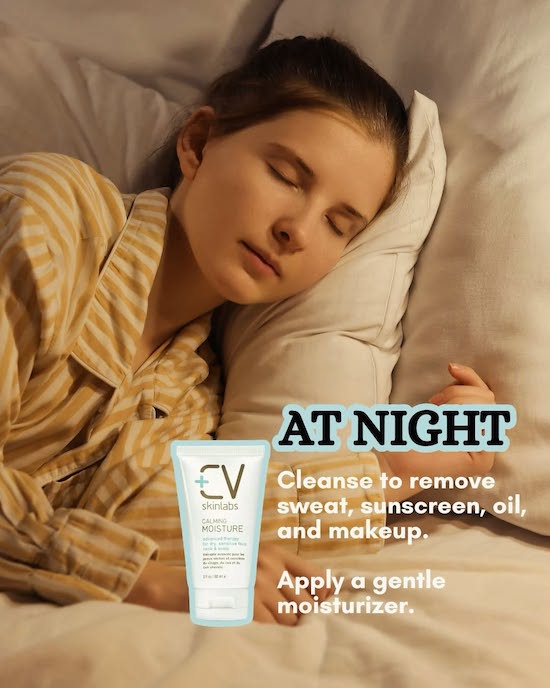
Tip: Our Tri-Rescue Complex in all CV Skinlabs products will help strengthen the skin barrier function while you sleep—when your skin is most receptive to regeneration. Try our Calming Moisture before bed. It’s an antioxidant-rich moisturizer with soothing ingredients that help reduce the appearance of puffiness, calm the skin, and revive radiance. Along with a powerful blend of ceramides, lipids and other nutrients help boost hydration, this lightweight moisturizer has ingredients that improve elasticity and restore a healthy-looking glow.
Let’s look at what’s happening beneath the surface and how you can help your skin better manage those difficult nights.
What Causes the Effects of Lack of Sleep On Skin?
Your skin does a lot of important work while you’re sleeping.
During the day, it’s busy protecting you from sunlight, pollution, dry air, and other environmental stressors. At night, it repairs that everyday damage, renews cells, and works to shore up the skin barrier.
These processes follow your body’s natural 24-hour clock, called the circadian rhythm.
This internal clock is all about when you wake up and when you go to bed. It’s influenced by your genes, but also by your exposure to the sun—daylight. Your circadian rhythm helps regulate things like hormone production, body temperature, and skin cell renewal.
When we don’t get enough sleep, that rhythm is disrupted. Stress hormones often rise, and the skin’s normal repair processes can become less effective.
Over time, that can affect how well your skin holds onto moisture, recovers from damage, and maintains a healthy appearance.
What New Research Reveals About the Effects of Lack of Sleep on Skin
In a 2026 study published in Sleep Research, scientists conducted some experiments to learn how long skin takes to recover after missing sleep.
They recruited 44 women between the ages of 21 and 49 who normally slept seven to eight hours a night. They measured several features of their skin, including moisture, oil production, color, and texture. Then, they had the women stay awake for an entire night.
The next morning, they measured their skin again. After the participants returned to their normal sleep schedules, the researchers checked their skin 14 days later.
They discovered several noticeable changes after just one sleepless night:
- Less moisture: Skin hydration dropped, potentially making the skin look drier and less supple.
- More oil: Skin oil production increased by about 61 percent.
- Duller appearance: Skin became slightly darker and redder.
- Rougher texture: Skin roughness increased.
- More visible signs of fatigue: Dark circles and certain fine lines became more noticeable.
Here’s where things got interesting.
After 14 days, many measurements had returned to their normal levels. Hydration improved, oil production normalized, and several wrinkle measurements improved.
But other changes, including some measurements of skin transparency, roughness, and dark circles, had not yet returned to baseline.
That suggests that the skin may need more time to recover from lost sleep than we thought!
Keep in mind that this was a small study. It doesn’t tell us whether this would happen to everyone or what may happen if someone loses only a few hours of sleep (rather than an entire night).
Still, it raises an important question about how regular sleep deprivation can hurt our skin.
Can the Effects of Lack of Sleep on Skin Lead to Premature Aging?
Researchers have been studying the connection between sleep and the appearance of aging for years.
In a 2015 study, for example, researchers compared women who regularly slept well with those who didn’t. They found that the poor sleepers showed more signs of natural skin aging and had weaker skin barrier function. Their skin also recovered more slowly after minor damage.
After 72 hours, good sleepers had 30 percent greater skin barrier recovery.
Remember that the skin barrier is the outermost protective layer of your skin. It’s like a shield that helps keep moisture inside while blocking out irritants and other harmful substances.
When that barrier isn’t working as well as it should, your skin can become drier, more sensitive, and more prone to irritation and reactions.
Dryness can also make your fine lines more visible, and can contribute to dullness.
The 2015 study also found a link between poor sleep and increased signs of skin aging. It didn’t prove that lack of sleep alone caused those changes, but it added to the evidence that healthy sleep habits are better for your skin.

How to Reduce the Effects of Lack of Sleep on Skin
It’s nearly impossible to avoid a bad night’s sleep now and then, particularly as we age. Health changes, hormonal changes, stress, work, family responsibilities, and more often interfere with that ideal 7-8 hours of restful sleep.
Fortunately, you can take steps to support your skin while working toward more consistent sleep.
1. Replace Lost Moisture
Because sleep loss affects skin hydration, moisturizing is especially important. Choose a gentle moisturizer that helps replenish moisture and supports your skin barrier.
Calming Moisture is designed for dry, sensitive skin. Its nourishing ingredients help calm redness, provide hydration, and restore a healthier-looking glow.
Apply it morning and night, preferably when your skin is slightly damp.
Pro Tip: Mask it at night. While you sleep, this nourishing formula helps strengthen the skin’s natural barrier, supporting its overnight renewal process for skin that feels softer, smoother, and more resilient and glowing by morning.
2. Be Gentle with Tired Skin
When your complexion looks dull, you may be tempted to reach for a strong exfoliating product. But if your skin is already dry or irritated, harsh treatments can make it look and feel worse.
Stick with a gentle cleanser, avoid excessive scrubbing, and give your skin time to recover.
If your skin feels uncomfortable during the day, try our Rescue + Relief Spray to refresh and soothe it. Not only will it give you a luminous boost of hydration, but it will help rebuild the skin barrier function to strengthen and protect skin.
3. Support Your Skin Barrier Overnight
Your skin works hard to recover while you sleep, making your evening routine a good opportunity to provide extra moisture.
Gently remove makeup, sunscreen, and the day’s buildup before applying your regular moisturizer. For especially dry or rough areas, use our Restorative Skin Balm to help seal in moisture, help heal, and protect vulnerable skin.
Also, pay attention to your diet. Eating healthy, moisture-rich foods—like melons, berries, kiwi, and cucumbers—can also contribute to your skin’s recovery.
4. Protect Your Skin from Additional Damage
If your skin is already stressed from poor sleep, it’s even more important to protect it from the sun and from pollution.
Apply broad-spectrum sunscreen with SPF 30 or higher every morning. Sun exposure contributes to premature skin aging, so regular protection helps prevent additional stress on your skin.
Then use a moisturizer rich in antioxidants (like our Calming Moisture and Body Repair Lotion) to help fight off the damage caused by environmental pollutants.
5. Make Sleep a Regular Habit
Of course, the biggest issue here is sleep! Skincare products can help, but they can’t replace the benefits of 7-8 hours of quality rest.
Scientists recommend 7-8 hours of sleep per night. To increase your odds of getting that, try these tips:
- Maintain a regular bedtime and wake-up time, even on weekends.
- Keep your bedroom cool, dark, and quiet. Use a fan if you need to block out any noise.
- Limit the use of phones, TVs, tablets, and computers at least an hour before bedtime.
When you have a bad night’s sleep, try not to stress out over it. Just get back to your usual schedule as soon as you can.
The Effects of Lack of Sleep on Skin: What You Can Do Starting Tonight
This new research gives us another reason to take sleep seriously as part of our skincare routine.
We now know that even one sleepless night can change how your skin looks and feels, and some of those changes may last longer than expected.
The good news is that many of the effects do improve with time. By getting regular sleep, protecting your skin barrier, using gentle moisturizing products, and guarding against sun damage, you can give your skin the support it needs.
You already spend time choosing products that are good for your skin. Making room for quality sleep is another way to protect that investment.
And it’s one skincare habit that doesn’t cost a thing!
How does a lack of sleep affect your skin?
Featured image by Miriam Alonso via Pexels.