
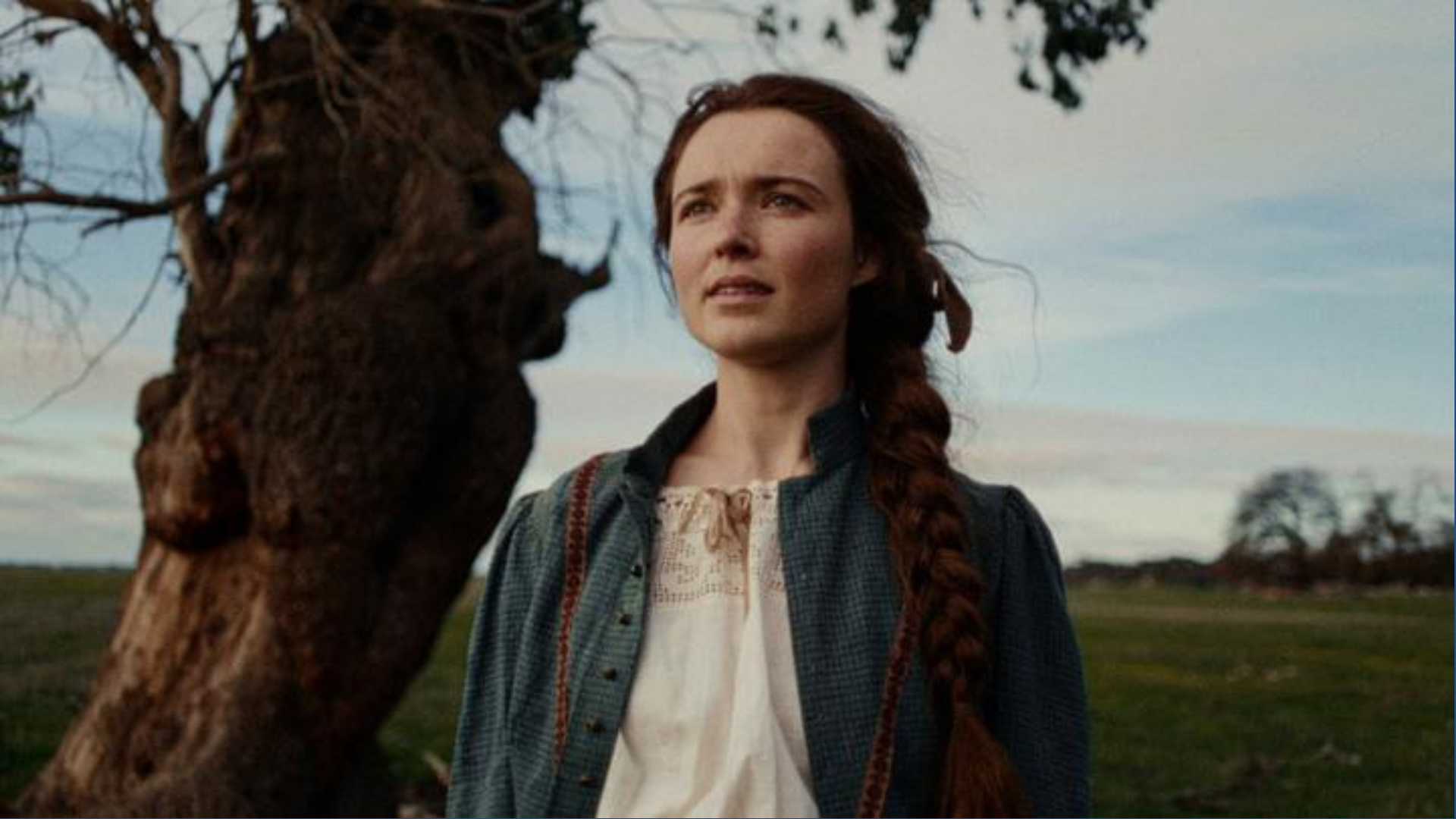

An interesting parallel can be drawn between Netflix’s new series My brilliant career and the original source material on which it is based. In the 1901 Australian classic, young author Miles Franklin wrote about a young woman who wanted to become a writer because she simply refused to let society decide her life.
And this year, another group of female storytellers of the current generation took Franklin’s story and did something very similar: They rejected the purist notion that an adaptation must be completely faithful to the original.
In my opinion, that’s exactly what makes Liz Doran’s six-part adaptation more than just a feminist historical drama. “My Brilliant Career” was created and written by Doran and directed by Alyssa McClelland and Anne Renton. “My Brilliant Career” is a vivid example of this Writing by women.
For the uninitiated, “écriture féminine” refers to the French feminist concept, most closely associated with Hélène Cixous, in which women reclaim the authority to represent the female experience rather than allowing it to be defined by historically male-dominated structures.
A woman determined to become her own author
If you look at the book’s protagonist, Sybylla Melvyn, she fights above all for precisely this authority. She just wants to write. But her family, like most families of the time, does not support her wishes.
Her parents want her to help solve her father’s financial problems. Her grandmother, Mrs. Bossier, sees marriage as the only respectable goal for a woman. The men around her only judge her based on whether she would be a suitable wife. Even her relationship with her romantic interest Harry Beecham seems to drag her into a life that has already been planned for her by someone else.
Sybylla (Philippa Northeast) in a scene from My Brilliant Career. Image source: Jungle Entertainment/South Australian Film Corporation
Her rebellion is therefore not limited to her refusal to marry. What she’s actually fighting against is society’s preconceived notion that someone else should decide the current and future course of her life.
While it initially seems like a foregone conclusion that Sybylla loves Harry and is willing to wait for him after his financial collapse, to the surprise of most viewers, when he finally returns and agrees to marry her, she refuses. This is because over time she has come to realize that marrying him could mean giving up writing, which has become the most important aspect of her life – or, one might even say, her identity.
A scene from “My Brilliant Career.” Image source: Jungle Entertainment/South Australian Film Corporation
Therefore, she decides to stay in her parents’ house for the time being, as her mother encourages her to write about her own experiences and gives her the freedom and material resources to do so. Then Sybylla sets out to write about Caddagat, her grandmother’s homestead.
And after spending the entire story fighting against the future others have imagined for her, she finally takes control of her own destiny.
What was missing from Franklin’s Australia?
However, as previously mentioned, the Netflix adaptation is much more than that. Beyond mere storytelling, the authors essentially ask the question: who or what was missing from Franklin’s Australia? And the answer they find is what changes history.
Harry Beecham, portrayed as a relatively wealthy white landowner in the novel, is reimagined as a Chinese Australian in the series. Granted, his vast inherited wealth allows him entry into a society that might otherwise exclude him. But even this privilege has its own limits.
Harry Beecham (Christopher Chung) in a scene from My Brilliant Career. Image source: Jungle Entertainment/South Australian Film Corporation
The indigenous sisters Nell and Betty Kirby also come more to the fore in the series, as their characters have significantly more weight. Nell is a highly skilled rancher whose goal is to one day become Caddagat’s foreman, but then she finds herself confronted with racism and sexism. Meanwhile, Betty has a discreet relationship with a police officer who refuses to marry her because a relationship with an indigenous woman could jeopardize his career.
The list goes on to Julius Bossier. In Franklin’s novel, he is a happy bachelor with a penchant for women. However, in the Netflix series he is portrayed as a gay man who is secretly in a relationship with Everard Grey, who was actually a potential suitor for Sybylla in the original text.
These changes are interesting and go beyond simply trying to embrace diversity. Instead, they seem to be a genuine and well-intentioned attempt to explore the lives and experiences that Franklin’s original failed to address.
After all, sometimes what a story doesn’t say can be much more revealing than what it does say. But make no mistake: Franklin was writing in 1901 within the social and literary limitations of her time. Almost 125 years later, Doran’s writers’ room can now look back on that world and ask different questions.
Nell Kirby (Sherry-Lee Watson) in a scene from My Brilliant Career. Photo credit: Jungle Entertainment/South Australian Film Corporation
What happens to an indigenous woman whose talent cannot be easily denied but whose society is not yet ready to accept it? What does it mean to be gay in a society where you are not allowed to express your sexuality in public? What does it mean to be a Chinese Australian in a society that has historically been notoriously racially exclusionary?
None of this is to say that the adaptation rejects Franklin’s feminism. If anything, it builds on that and expands on it. In this sense, My Brilliant Career joins a much older practice of returning to the work of earlier women – or men – and bringing to light stories that were left unexplored in the original.
When the female body becomes its own story
The series takes a similar approach with Sybylla’s body. It moves away from the reserved sexuality often seen in previous period dramas, where a woman’s desires are either implied, punished, or viewed through the male gaze.
Sybylla urinates outdoors, swims, dances, masturbates, has sex and openly enjoys her own body. The opening scene, with an erotic poem followed by Sybylla pulling down her clothes and jumping into a pond, makes it clear that this Netflix adaptation has no interest in hiding female desire.
Sybylla (Philippa Northeast) in a scene from My Brilliant Career. Image source: Jungle Entertainment/South Australian Film Corporation
While it’s easy to reduce this aspect of the series to its eroticism, that would be unfair. Doran described the series as “unabashedly” made for a female audience. So Sybylla is not just presented as a woman to look at; She is someone who looks, desires, touches, imagines and acts.
Here the series comes remarkably close to the idea of the female gaze. When women are behind the camera, it doesn’t automatically mean a work that focuses on the female gaze. What matters is the attention the series pays to the inner lives of women and the way they experience and understand their own bodies.
Helen (Genevieve O’Reilly) and Sybylla (Philippa Northeast) in a scene from My Brilliant Career. Photo credit: Jungle Entertainment/South Australian Film Corporation
Sybylla’s Aunt Helen cannot inherit Caddagat just because she is not a man. Nell recognizes that professional skills alone cannot overcome racial and gender hierarchies. Betty finds that private love cannot escape public prejudice. Blanche, on the other hand, is caught in an engagement where social expectations are more important than what she wants or doesn’t want.
Together, their stories show that Sybylla is not alone. Her fight is part of a much larger question: Who gets to decide what a woman’s life can look like?
The art of writing back
That’s ultimately what makes “My Brilliant Career” more ambitious than a simple feminist adaptation. It’s not just about updating Franklin’s story, but also responding to it sincerely and kindly. Franklin gave Sybylla the courage to write her own story. Doran’s “My Brilliant Career” extends this gesture to the women Franklin could not write to.
Sybylla (Philippa Northeast) and Frank Hawden (Jake Dunn) in a scene from My Brilliant Career. Image source: Jungle Entertainment/South Australian Film Corporation
And that is perhaps this series’ most significant achievement: the story of a woman who refuses to let others decide who she should become has itself been reclaimed by women who refuse to let an ancient story dictate what it can mean.
In this sense, “My Brilliant Career” is an écriture féminine brought to television – not just women who write about women, but women who write back.
Heaven is not a pillar of sacrifice.is a Bangladesh-based author, researcher and journalist.
