


Trump’s remarks at Davos reveal how gendered power operates when women challenge male authority.
As a rule, when I sit down to write an article for Ms., I have a clear and well-defined focus—even when the subject matter is disquieting, or occasionally unhinged, such as the Department of Veterans Affairs’ rollout of a ban on abortion, the Trump administration’s support of pronatalism, or the rising influence of abortion abolitionists.
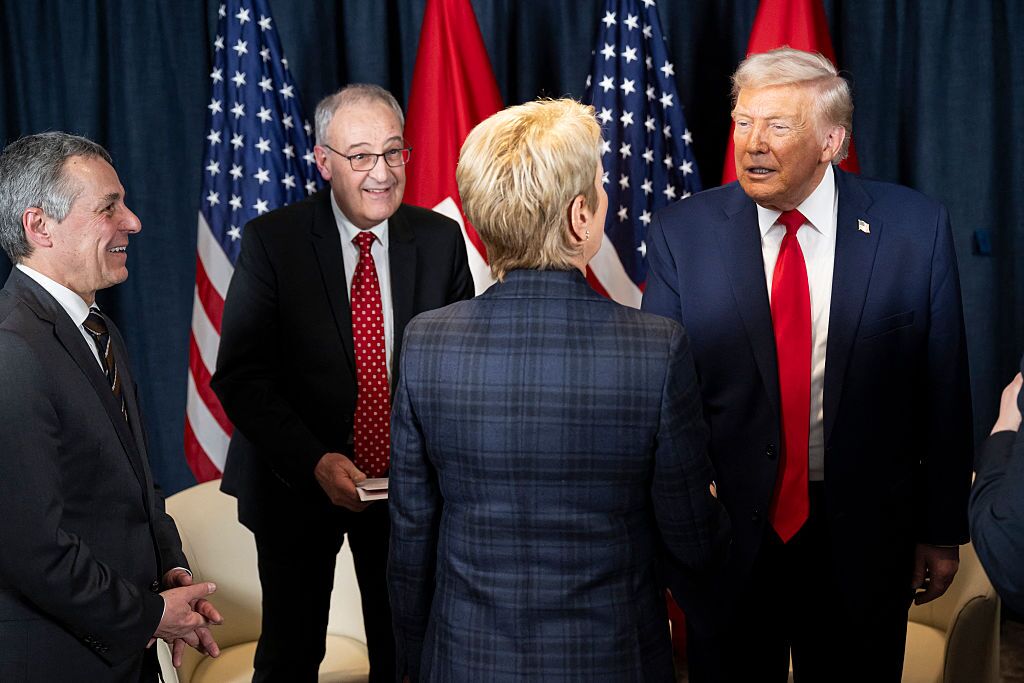
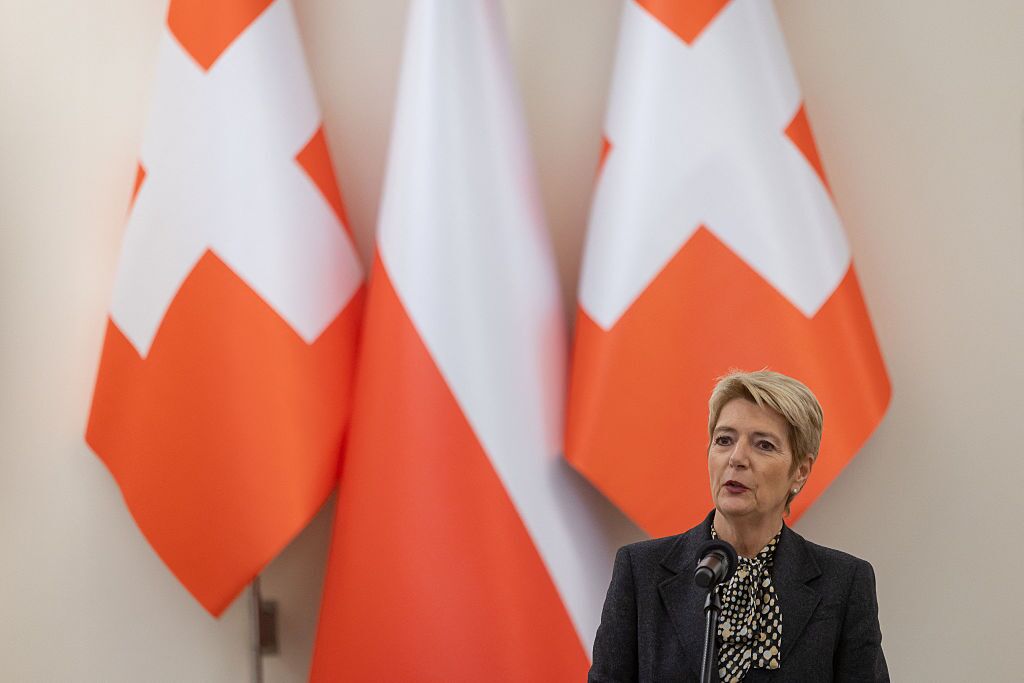
This time, however, as I sat down to write, my mind was spinning in a million directions—triggered by the apparently unscripted remarks Trump made in his keynote at the World Economic Forum about a phone conversation he had with Karin Keller-Sutter, then-president of Switzerland, regarding his plan to impose a 30 percent tariff on her country in an effort to close the trade deficit.
Under the Jan. 21 New York Times headline “‘She Just Rubbed Me the Wrong Way’: Trump Suggests Swiss Tariffs Were Personal,’” Jonathan Wolfe quotes Trump calling Keller-Sutter “so aggressive.”
“And she was very repetitive. She said: ‘No, no, no, you cannot do that, 30 percent. You cannot do that. We are a small, small country.’
“And she just rubbed me the wrong way, I’ll be honest with you … “
As reported, he then “thanked Ms. Keller-Sutter and ended the call. ‘And I made it 39 percent.’”
Seeking to make sense of the existential breakdown in norms that flooded me after reading the article, it became apparent that that much more was at play here than a clash of personalities, as suggested by Times’ headline.
As I began envisioning the article I would write, my initial aim was to locate Trump’s remarks within the broader context of his administration’s attacks on women and the LGBTQ+ community. I turned first to Ms.’ monthly War on Women Report, which has carefully and thoroughly documented the rise of “U.S. patriarchal authoritarianism.” However, I soon decided that rather than reinvent the wheel by calling out the myriad of ways in which misogyny has found a comfortable and highly visible perch in the current administration, I would chart a different course.
I instead wish to offer a conceptual framework, to anchor the deeply misogynistic tell of his remarks.
To do so, I turned to Cynthia Miller-Idriss’ recent book Man Up: The New Misogyny and the Rise of Violent Extremism (which she discusses in a two-part conversational series in Ms. with Jackson Katz, who writes about masculinities and violence). Trump’s promise to “make America great again,” she writes, relies upon a highly gendered “aggressive, militant masculinity,” which has a particular appeal to white evangelicals and Christian nationalists seeking the restoration of “traditional, patriarchal gendered norms that depict men as entitled to power, status, and positions of leadership and women as in need of a strong hand to guide them.”
Undergirding this appeal, Miller-Idriss explains, is the righteous insistence “on a rigid male/female binary that is depicted as natural or biologically determined”—such as was decreed by Trump in an early executive order under the banner “Defending Women from Gender Ideology and Restoring Biological Truth to the Federal Government.”
In turn, Miller-Idriss invokes the definition of misogyny elucidated by Kate Manne in her now classic book, Down Girl: The Logic of Misogyny, writing that it is comprised of “strategies to enforce patriarchal norms and expectations, including the boundaries of acceptable masculine and feminine behaviors.”
As Manne elaborates in Down Girl, rather than understanding misogyny “as primarily a property of individual agents who are prone to feel hatred … toward … at least some women generally, simply because they are women,” it is better understood as the “‘law enforcement’ branch of a patriarchal order, which has the overall function of policing and enforcing its governing norms and expectations.”
Distilled to its essence, she writes, “misogyny is what misogyny does.”
With this framework in mind, we return to Trump’s comments in Davos, where what “misogyny does” to female politicians—who, according to Manne, are “a tempting and common outlet for misogynist aggression,” which is trip wired by their challenge to “gendered hierarchies” and appropriation of “masculine-coded social roles”—was on full display.
Taking center stage was Keller-Sutter’s bold contestation of Trump’s plan to impose a 30 percent tariff on Swiss goods, made apparently all the more offensive by the “repetitive” nature of her challenge to his authority to do so.
Following Manne’s logic, Keller-Sutter’s refusal to engage with Trump in the way she describes as providing “feminine-coded goods”—the “respect” and “loyalty” women are thought to “owe men”—did more than challenge him. In standing up to Trump, Keller-Sutter also deprived him of the “masculine-coded goods and privileges” some men believe they are due, including “social positions of leadership, authority, influence, money and other forms of power.”
Having “rubbed [Trump] the wrong way,” with her “repetitive” and “aggressive” insistence that he change his intended course of action, Keller-Sutter was subjected to his “down girl” retaliatory move of a 9 percent increase in tariffs—a wielding of misogyny’s law enforcement “cudgel” to restore the patriarchal order along its gender-normative axis.
While this form of hostility-engendered punishment pales in comparison to the violence-soaked acts and threats of retribution that both Manne and Miller-Idriss examine—such as Elliot Rodger’s “Day of Retribution” and the Isla Vista murders, the online valorization of rape, or the plot by Michigan militia members to kidnap Gov. Gretchen Whitmer (whom they derided as a “tyrant bitch”)—it nonetheless matters that The New York Times framed Trump’s tariff escalation as purely personal. Like his earlier Access Hollywood “grab them by the pussy” remark, the episode speaks directly to the instrumental role of Trump’s militant masculinity as he moves the country precipitously toward authoritarian rule.
