
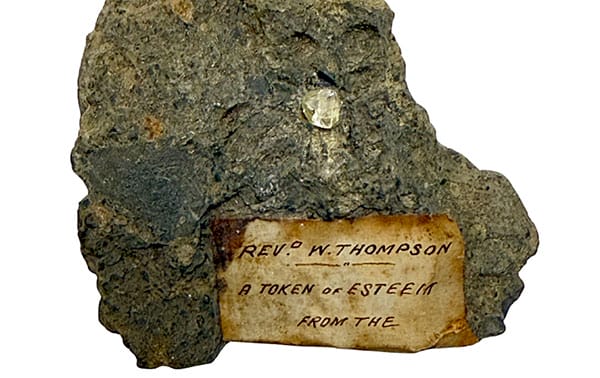

Last week, Furlong Auction House sold an exceptionally rare diamond specimen still embedded in its original kimberlite matrix for £10,500 (about $14,000) during its “Collectables & Memorabilia” sale at the London Diamond Bourse in Hatton Garden. The specimen dates to May 23, 1873, placing it squarely in the infancy of South Africa’s diamond industry — and at the dawn of De Beers’ rise.

The relic consists of a chunk of kimberlite — “blue ground” to early diamond miners — with a visible natural diamond crystal still locked in place. The term “blue ground” was used to describe weathered, bluish volcanic rock that carried diamonds from deep within the Earth’s mantle to the surface through violent eruptions millions of years ago. In the 19th century, recognizing blue ground marked a turning point: It signaled that diamonds weren’t just found in riverbeds, but could be mined directly from the Earth itself.

What makes this specimen especially remarkable is its intact provenance. A handwritten manuscript label affixed to the piece reads: “Rev’d W. Thompson – A token of esteem from the Cong’l Church, De Beers New Rush, May 23, 1873.” Such labeled specimens from the early Kimberley fields — particularly those with an exposed diamond — are extraordinarily scarce outside museum collections.
The specimen hails from Colesberg Kopje, later known simply as the Kimberley Mine, where diamonds were first discovered in 1871 during what became known as the “New Rush.” That rush followed the watershed 1867 discovery of the Eureka Diamond, found by 15-year-old Erasmus Jacobs near the Orange River. Within a few short years, Kimberley transformed from farmland into the epicenter of a global diamond boom.
For collectors, the appeal lies not just in rarity, but in symbolism. A diamond still embedded in kimberlite evokes the origin story of the world’s most famous diamond of all: the Cullinan. In 1905, Captain Frederick Wells spotted a glint in the wall of South Africa’s Premier Mine and pried out what turned out to be a 3,106-carat rough diamond, forever changing gem history.
South Africa would go on to dominate global diamond production for nearly a century. By the 1880s, the Kimberley mines produced 95 percent of the world’s diamonds, and the country remained the leading source by value well into the 20th century.
Credits: Images courtesy of Furlong Auctions.
